You've done everything right. You bought a hardware wallet, carefully wrote down your 24-word seed phrase, and stored it in a secure location. But here's a question that keeps many Bitcoin holders awake at night: what happens if someone finds that piece of paper with your recovery words?
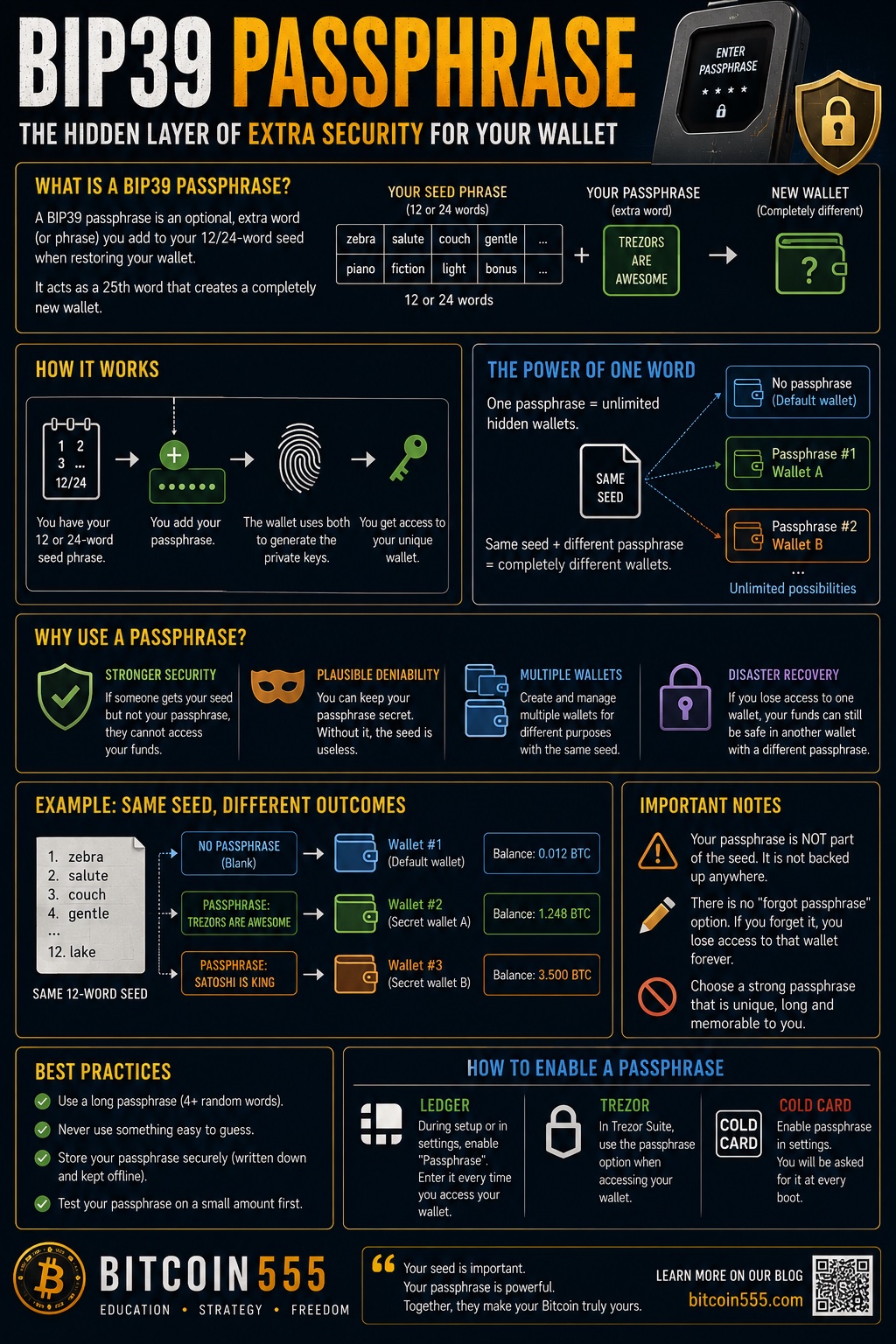
This is exactly where the BIP39 passphrase comes into play — an often misunderstood but incredibly powerful security feature that can transform your Bitcoin self-custody setup from good to nearly impenetrable. Think of it as a 25th word that only exists in your mind, creating an entirely separate wallet that remains hidden even if your seed phrase is compromised.
In this comprehensive guide, we'll explore everything you need to know about BIP39 passphrases: what they are, how they work, when you should use one, and — critically — the risks involved if you don't implement them correctly. Whether you're holding a modest amount of Bitcoin or planning for long-term wealth preservation with our Bitcoin retirement calculator, understanding this security layer could make all the difference.
What Is a BIP39 Passphrase and How Does It Work?
BIP39 stands for Bitcoin Improvement Proposal 39, which defines the standard for generating mnemonic seed phrases — those 12 or 24 words that serve as the master key to your Bitcoin wallet. But what many people don't realize is that BIP39 also includes an optional passphrase feature built directly into the specification.
Here's how it works technically: when your wallet generates private keys from your seed phrase, it combines the mnemonic words with a passphrase (which can be empty by default) to create a "seed." This seed then generates all your wallet addresses and private keys through a deterministic process.
The crucial point: changing the passphrase — even by a single character — produces an entirely different set of wallets with completely different addresses and private keys. Your original 24-word seed phrase with no passphrase creates Wallet A. The same 24 words plus the passphrase "MySecret" creates Wallet B. Add "MySecret!" and you get Wallet C. Each is mathematically unrelated to the others.
This isn't encryption in the traditional sense. Your passphrase doesn't "lock" your existing wallet — it creates an entirely new wallet. Someone who discovers your seed phrase without knowing your passphrase will access only the wallet associated with the empty passphrase, not your actual funds.
Why You Should Consider Using a Passphrase
The BIP39 passphrase addresses several real-world security scenarios that seed phrases alone cannot handle:
Protection Against Physical Theft
Imagine a burglar finds your metal seed phrase backup hidden in your home safe. Without a passphrase, they have complete access to your Bitcoin. With a passphrase that exists only in your memory, your seed phrase alone is worthless to them. They would need both components — something they have (the seed) and something they must know (the passphrase).
Plausible Deniability
This is where the passphrase feature becomes strategically brilliant. You can maintain a small amount of Bitcoin in the wallet without a passphrase (your "decoy" wallet) while keeping your main holdings in a passphrase-protected wallet. If ever coerced to reveal your seed phrase, you can comply honestly — the attacker will find a wallet with minimal funds and have no way to know that other wallets exist.
Defense Against Supply Chain Attacks
Though rare with reputable manufacturers, there's always a theoretical risk that a hardware wallet could be compromised before it reaches you. A passphrase adds protection because even if an attacker somehow knew your seed phrase, they still wouldn't know your passphrase.
Multi-Location Security
With a passphrase, you can store your seed phrase in one location and your passphrase in another (or memorize it). This geographic separation means no single point of failure can compromise your funds.
Step-by-Step: Setting Up a BIP39 Passphrase
The exact process varies by wallet, but here's a general guide using hardware wallets like Ledger devices, which handle passphrases securely:
For Ledger Hardware Wallets
- Access Settings: On your Ledger device, navigate to Settings > Security > Passphrase.
- Choose Your Method: Ledger offers two options — "Attach to PIN" (which creates a secondary PIN that automatically applies your passphrase) or "Set temporary" (which requires entering the passphrase each time).
- Enter Your Passphrase: Carefully type your chosen passphrase directly on the device. Passphrases are case-sensitive and can include spaces and special characters.
- Confirm and Set PIN (if applicable): If attaching to a PIN, you'll create a second PIN code. Entering this PIN will automatically open your passphrase-protected wallet.
- Verify the New Wallet: Your device will now show a new, empty wallet. This is correct — it's a completely separate wallet from your original.
- Document Carefully: Before sending any Bitcoin to this new wallet, ensure you have properly backed up your passphrase according to best practices.
For Software Wallets
Many software wallets like Electrum, Sparrow, and BlueWallet also support BIP39 passphrases. Typically, you'll find the option during wallet creation or restoration:
- Begin creating or restoring a wallet with your seed phrase
- Look for an "Advanced options" or "Passphrase" checkbox
- Enter your passphrase when prompted
- The wallet will generate addresses based on your seed phrase + passphrase combination
Important: When using software wallets, ensure you're on a secure, malware-free device. Hardware wallets like Ledger provide better security because the passphrase is entered on the device itself, never on your computer where keyloggers could capture it.
Best Practices for Creating and Storing Passphrases
Your passphrase is only as strong as its creation and storage. Follow these guidelines to maximize security while maintaining access to your funds:
Passphrase Creation
- Length Matters: Aim for at least 12-20 characters. Longer passphrases exponentially increase security against brute-force attacks.
- Complexity: Mix uppercase and lowercase letters, numbers, and special characters. "Bitcoin" is weak; "B!tc0in_2024#Secure" is much stronger.
- Avoid Predictable Phrases: Don't use song lyrics, famous quotes, birthdays, or anything that could be guessed through social engineering.
- Consider Diceware: You can generate random word combinations using dice for truly random, memorable passphrases. Something like "correct horse battery staple" is both secure and memorable.
- Test Before Funding: Always send a small test transaction to your new passphrase-protected wallet, then verify you can restore access using both the seed phrase and passphrase before depositing significant funds.
Passphrase Storage
Here's where many people make critical errors. Consider these approaches:
- Memory Alone (Risky): Only for short-term or smaller amounts. Human memory is fallible — illness, accidents, or simply forgetting over time can mean permanent loss.
- Physical Backup: Write down your passphrase and store it separately from your seed phrase. Use the same durable methods — metal plates, fireproof containers, or safety deposit boxes.
- Split Storage: Keep your seed phrase at home and your passphrase at a trusted family member's location, or in a bank vault.
- Shamir's Secret Sharing: For advanced users, consider splitting your passphrase into multiple shares where only a threshold (like 2-of-3) is needed to reconstruct it.
Documentation for Heirs
Unlike traditional financial accounts, Bitcoin requires explicit planning for inheritance. If you use a passphrase, your heirs need to know:
- That a passphrase exists
- Where to find it
- How to use it with your seed phrase
Consider including sealed instructions with your estate planning documents, or use a Bitcoin inheritance service that can guide your beneficiaries through recovery.
Common Mistakes and How to Avoid Them
The passphrase feature's power comes with responsibility. These are the most common errors that lead to permanent fund loss:
Forgetting or Losing the Passphrase
This is the number one risk. Unlike a forgotten password on a website, there is no recovery mechanism. Your passphrase cannot be reset, retrieved, or brute-forced (if sufficiently complex). If you forget it, your Bitcoin is gone forever.
Solution: Multiple backups in different locations. Test your backups periodically by restoring access to verify everything works.
Typos During Setup
You carefully set up a passphrase but accidentally type "Bitcoln" instead of "Bitcoin." You don't notice, send funds to this wallet, and later try to recover with what you think is the correct passphrase. Different passphrase = different wallet = funds inaccessible.
Solution: Triple-check every character. Use the "show password" feature if available. Send a small test amount first, then verify you can restore access before depositing larger amounts.
Confusing Passphrase with PIN or Password
Your device PIN, your wallet password, and your BIP39 passphrase are three different things:
- Device PIN: Unlocks your hardware wallet device
- Wallet Password: Often encrypts wallet files on your computer
- BIP39 Passphrase: Mathematically generates a different wallet from your seed phrase
Solution: Understand the distinction clearly. Label your backups unambiguously.
Using a Weak Passphrase
Common words, short phrases, or personal information can potentially be brute-forced, especially if your seed phrase is compromised and an attacker knows to try common passphrases.
Solution: Treat your passphrase with the same seriousness as your seed phrase. Random, lengthy, and complex is best.
Advanced Passphrase Strategies
Once you understand the basics, consider these sophisticated approaches:
Multiple Passphrases for Different Purposes
Since each passphrase creates a unique wallet, you can compartmentalize your Bitcoin holdings:
- No passphrase: Decoy wallet with minimal funds
- Passphrase A: "Checking" wallet for regular transactions
- Passphrase B: Long-term cold storage (deep savings)
- Passphrase C: Inheritance wallet with instructions left for heirs
This creates multiple independent vaults from a single seed phrase, each with its own security profile and purpose.
Geographic Distribution
For maximum protection against regional disasters or seizure:
- Store your seed phrase in your home country
- Store your passphrase backup in another jurisdiction
- Memorize the passphrase as an additional backup
No single event in any one location can compromise both pieces of information.
Combining with Multisig
For the security-conscious with significant holdings, you can combine passphrase protection with multi-signature setups. Each key in your multisig arrangement can be derived from a passphrase-protected seed, creating layers upon layers of security.
Frequently Asked Questions
What happens if I forget my BIP39 passphrase?
Unfortunately, there is no recovery option. Your passphrase is not stored anywhere — not on your hardware wallet, not with the manufacturer, not on any server. It exists only in your backup and your memory. If lost, the Bitcoin in that passphrase-protected wallet is permanently inaccessible. This is why multiple secure backups are essential.
Is a BIP39 passphrase the same as a wallet password?
No, they serve different functions. A wallet password typically encrypts your wallet file or locks your wallet application. You can usually recover or reset a wallet password with your seed phrase. A BIP39 passphrase, however, creates an entirely different wallet. It's not encryption — it's generation. Without the exact passphrase, you cannot access that specific wallet, even with the correct seed phrase.
Should everyone use a passphrase?
Not necessarily. A passphrase adds security but also adds complexity and risk of self-loss. If you're new to Bitcoin, focusing on proper seed phrase security first is wise. As your holdings grow or your security needs evolve, adding a passphrase makes more sense. For significant long-term holdings, a properly implemented passphrase is highly recommended.
Can I change my passphrase later?
You cannot "change" a passphrase because it's not a password protecting a fixed wallet. To move to a new passphrase, you would create a new wallet with your desired passphrase, then transfer your Bitcoin from the old wallet to the new one. This is a standard Bitcoin transaction and will incur network fees.
How long should my passphrase be?
There's no maximum length defined in BIP39, though some wallets may have practical limits. For strong security, aim for at least 12-20 characters with a mix of character types, or use a sequence of 4-6 random words. The key is unpredictability and length — both matter for resistance against brute-force attacks.
Conclusion: A Powerful Tool That Demands Respect
The BIP39 passphrase stands as one of the most powerful security features available to Bitcoin holders. When implemented correctly, it transforms a potentially vulnerable single point of failure (your seed phrase) into a two-part security system that can protect your wealth against physical theft, coercion, and even your own carefully hidden backup being discovered.
However, this power comes with significant responsibility. The same properties that make a passphrase secure against attackers — its irreversibility and the impossibility of recovery — also mean that carelessness can result in permanent loss of your own funds. There's no customer support to call, no password reset link, no appeals process.
If you decide to use a passphrase — and for serious long-term holders, it's a decision worth considering — approach it methodically. Create a strong passphrase, test it thoroughly before depositing significant funds, back it up as carefully as your seed phrase (but separately), and ensure your loved ones know how to access both components if something happens to you.
Your Bitcoin represents more than money — it represents sovereignty over your financial future. A properly implemented BIP39 passphrase is one more layer ensuring that future remains secure and in your control.