Every four years, something remarkable happens in the Bitcoin network. The reward that miners receive for validating transactions gets cut in half—a programmed event known as the Bitcoin halving. This isn't just a technical detail; it's one of the most fundamental aspects of Bitcoin's monetary policy and has historically been associated with significant price movements.
Whether you're new to Bitcoin or have been following cryptocurrency for years, understanding the halving mechanism is essential. It directly affects Bitcoin's supply dynamics, mining economics, and potentially its long-term value proposition as a scarce digital asset.
In this comprehensive guide, we'll break down exactly how Bitcoin halving works, examine its historical impact through concrete data, and explore what it means for miners, investors, and the broader ecosystem. No hype—just the facts you need to make informed decisions.
What Is Bitcoin Halving? The Basics Explained
Bitcoin halving (sometimes called "halvening") is a pre-programmed event built into Bitcoin's code that reduces the block reward—the amount of new Bitcoin given to miners for successfully adding a new block to the blockchain—by 50%.
When Satoshi Nakamoto created Bitcoin, they designed a fixed monetary policy with a maximum supply of 21 million coins. Unlike traditional currencies where central banks can print unlimited money, Bitcoin's supply schedule is entirely predictable and unchangeable without consensus from the network.
Here's how the halving schedule works:
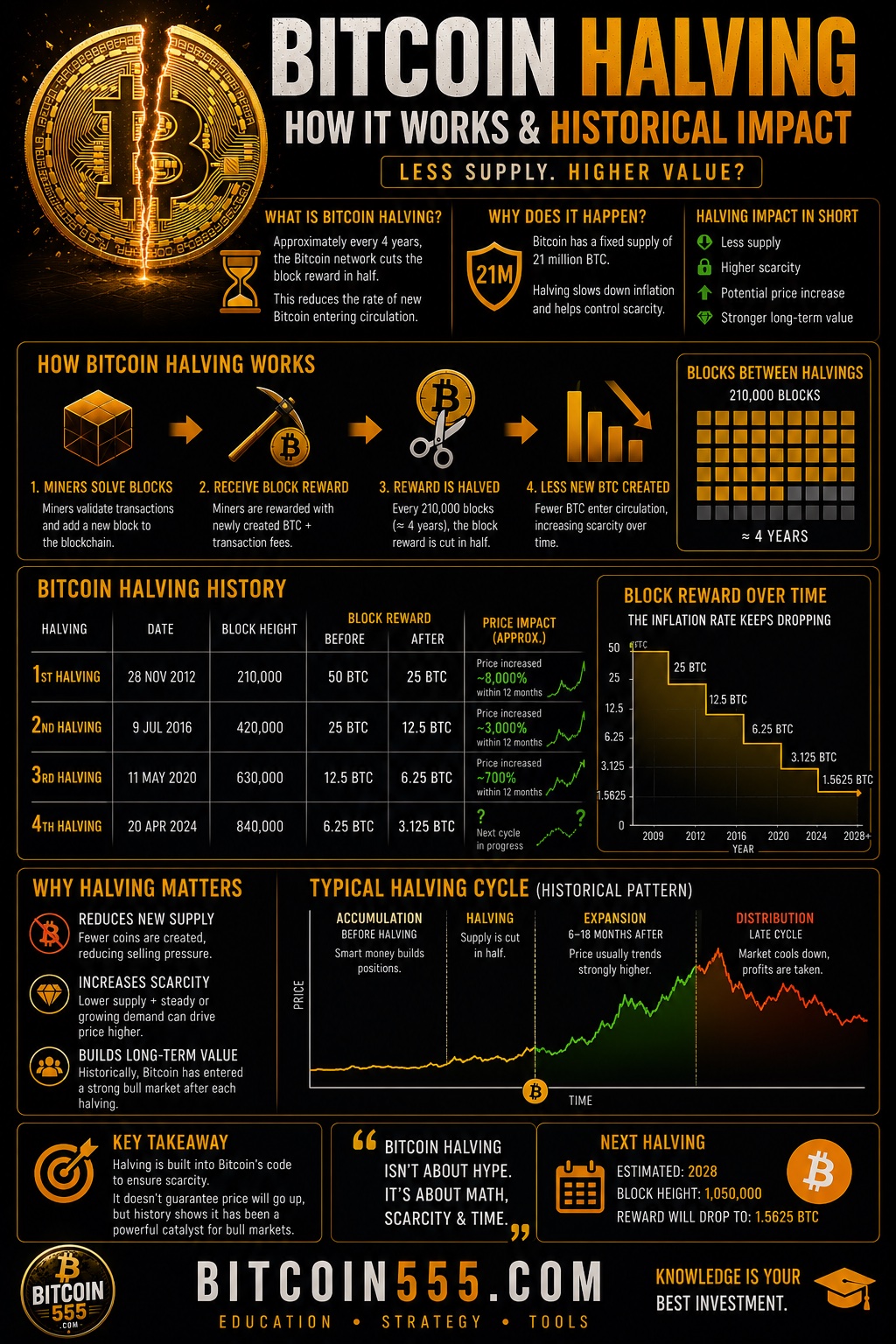
- Genesis (2009): Block reward starts at 50 BTC per block
- First halving (2012): Reward drops to 25 BTC
- Second halving (2016): Reward drops to 12.5 BTC
- Third halving (2020): Reward drops to 6.25 BTC
- Fourth halving (2024): Reward drops to 3.125 BTC
This process continues approximately every 210,000 blocks, which takes roughly four years given Bitcoin's target of one block every 10 minutes. The halvings will continue until around the year 2140, when the last Bitcoin will be mined and block rewards will consist entirely of transaction fees.
The mathematical elegance of this system means that over 90% of all Bitcoin that will ever exist has already been mined. Each halving makes new supply increasingly scarce, creating what economists call a disinflationary model—the inflation rate decreases over time until it eventually reaches zero.
The Technical Mechanics Behind Bitcoin Halving
Understanding the technical side of halving doesn't require being a programmer, but it helps to know the basics of how Bitcoin's blockchain operates.
How Blocks Are Created
Bitcoin miners compete to solve complex mathematical puzzles using specialized hardware. When a miner successfully solves the puzzle, they earn the right to add a new block of transactions to the blockchain. As compensation for their computational work and electricity costs, they receive the block reward plus any transaction fees included in that block.
The Halving Code
The halving mechanism is hardcoded into Bitcoin's software. Every 210,000 blocks, the protocol automatically reduces the block reward by half. This isn't controlled by any person or organization—it's an immutable rule that every Bitcoin node enforces.
Here's a simplified step-by-step explanation of what happens during a halving:
- Block countdown: The network tracks block height (the number of blocks mined since Bitcoin's genesis block in 2009)
- Trigger point: When the block count reaches a multiple of 210,000, the halving is triggered
- Automatic adjustment: The very next block mined carries the new, reduced reward
- Network consensus: All nodes recognize and enforce the new reward level
There's no ceremony, no manual intervention, and no possibility of delay. The halving simply happens as programmed, demonstrating the trustless nature of Bitcoin's monetary policy.
Difficulty Adjustment
It's worth noting that Bitcoin also has a difficulty adjustment mechanism that recalibrates every 2,016 blocks (approximately two weeks). This ensures that regardless of how much computing power joins or leaves the network, blocks are produced at a relatively consistent rate of one every 10 minutes on average. This mechanism works independently of halving but affects the overall mining economics.
Historical Analysis: How Previous Halvings Affected Bitcoin
Let's examine concrete data from each halving event to understand their historical impact. While past performance doesn't guarantee future results, these patterns provide valuable context.
First Halving: November 28, 2012
Block reward reduced from 50 BTC to 25 BTC.
- Price on halving day: Approximately $12
- Price one year later: Approximately $1,000
- Percentage gain: Roughly 8,000%
The first halving occurred when Bitcoin was still relatively unknown, with a small community of enthusiasts and minimal mainstream attention. The dramatic price increase that followed helped establish the narrative that halvings could be bullish catalysts.
Second Halving: July 9, 2016
Block reward reduced from 25 BTC to 12.5 BTC.
- Price on halving day: Approximately $650
- Price 18 months later (December 2017): Approximately $20,000
- Percentage gain: Roughly 3,000%
The second halving coincided with growing institutional interest and the emergence of Initial Coin Offerings (ICOs). While the percentage gain was smaller than the first cycle, the absolute price increase was substantial, bringing Bitcoin into mainstream financial consciousness.
Third Halving: May 11, 2020
Block reward reduced from 12.5 BTC to 6.25 BTC.
- Price on halving day: Approximately $8,600
- Price 18 months later (November 2021): Approximately $69,000
- Percentage gain: Roughly 700%
The third halving saw more muted immediate price action, with the significant rally occurring months later. This cycle featured unprecedented institutional adoption, including public companies adding Bitcoin to their balance sheets.
Fourth Halving: April 2024
Block reward reduced from 6.25 BTC to 3.125 BTC.
The most recent halving continued the pattern of diminishing percentage returns while still representing significant market movements. The long-term effects continue to unfold as the market matures.
If you're curious about how an investment made before any of these halvings would have performed, you can explore historical scenarios using our Bitcoin investment calculator to see concrete numbers based on actual price data.
The Economic Theory: Why Halving Matters for Bitcoin's Value
The halving's potential impact on price comes down to basic supply and demand economics, though the relationship isn't as simple as some suggest.
The Supply Shock Argument
Proponents of the bullish halving thesis argue that cutting the rate of new Bitcoin creation in half creates a supply shock. If demand remains constant or increases while new supply drops, basic economics suggests price should rise.
Consider this example: Before a halving, miners might sell 900 BTC per day (144 blocks × 6.25 BTC) to cover operational costs. After the halving, only 450 BTC per day enters the market. If buyers were previously absorbing 900 BTC daily, the market now has a deficit that can only be filled by existing holders selling—presumably at higher prices.
The Efficient Market Counter-Argument
Critics point out that halvings are perfectly predictable events known years in advance. In efficient markets, predictable future events should already be priced in. If everyone knows the supply will be cut, shouldn't that already be reflected in current prices?
The reality likely lies somewhere in between. While sophisticated traders certainly factor in upcoming halvings, the broader market includes participants with varying time horizons, information levels, and investment strategies. The halving may serve as a narrative catalyst that attracts new attention and capital to Bitcoin.
Stock-to-Flow Model
One popular framework for understanding halving's impact is the stock-to-flow (S2F) model, which compares existing supply (stock) to annual production (flow). After each halving, Bitcoin's S2F ratio doubles, making it increasingly scarce by this metric. Gold has historically had a high S2F ratio, contributing to its value as a store of wealth. Bitcoin's S2F ratio now exceeds gold's, though the model's predictive accuracy remains debated.
Impact on Bitcoin Mining: Winners and Losers
For miners, halvings present both challenges and opportunities. Understanding this helps explain network security dynamics and potential market pressures.
Immediate Revenue Impact
The math is straightforward: when rewards halve, miners' revenue in BTC terms drops by 50% overnight (assuming constant hash rate and difficulty). For an industry operating on thin margins, this can be devastating for inefficient operations.
Historical Mining Outcomes
Each halving has triggered a shakeout in the mining industry:
- Inefficient miners capitulate: Operations with high electricity costs or outdated hardware become unprofitable and shut down
- Hash rate temporarily drops: As miners exit, total network computing power decreases
- Difficulty adjusts: Lower hash rate triggers difficulty reduction, making mining easier for remaining participants
- Efficient miners survive: Well-capitalized operations with access to cheap power and modern equipment capture market share
Long-Term Adaptation
The mining industry has consistently adapted to halvings through:
- More efficient hardware (ASICs have improved dramatically over the years)
- Access to cheaper or stranded energy sources
- Vertical integration and economies of scale
- Increased reliance on transaction fees as block rewards diminish
This evolution is crucial for Bitcoin's long-term security model. Eventually, block rewards will become negligible, and miners will need to be compensated primarily through transaction fees.
How to Prepare for Bitcoin Halvings: Practical Strategies
Whether you're an investor, trader, or simply someone interested in Bitcoin, here are practical considerations around halving events.
For Long-Term Investors
If you believe in Bitcoin's long-term value proposition, halving cycles can inform your accumulation strategy:
- Understand the cycle: Historically, significant price appreciation has occurred 12-18 months after halvings, not immediately
- Dollar-cost average: Rather than timing the market perfectly, consistent buying over time can reduce the impact of volatility
- Maintain perspective: Each cycle has shown diminishing percentage returns, suggesting more mature, less volatile markets over time
- Secure your holdings: Regardless of timing, storing Bitcoin properly is essential. Hardware wallets like Ledger provide offline storage that protects your assets from online threats
For Traders
Active traders often look for patterns around halving events:
- Pre-halving accumulation phases have historically occurred as anticipation builds
- Post-halving consolidation periods can test patience before potential price discovery
- Increased volatility around the event itself can present opportunities and risks
For New Entrants
If you're just getting started with Bitcoin:
- Learn before investing: Understanding halving is just one piece of Bitcoin education
- Start small: Consider what you can afford to lose entirely
- Choose reputable platforms: Major exchanges like Binance offer straightforward ways to purchase Bitcoin with various payment methods
- Prioritize security: Learn about private keys, wallet types, and best practices for protecting your assets
Common Misconceptions About Bitcoin Halving
Several myths persist around halving events. Let's address them directly:
Myth 1: "Halving Guarantees Price Increase"
While historical correlation exists between halvings and subsequent bull markets, correlation doesn't equal causation. Multiple factors influence Bitcoin's price, including macroeconomic conditions, regulatory developments, and technological adoption. Halvings reduce supply growth but don't guarantee demand increases.
Myth 2: "Price Will Immediately Pump"
Historical data shows that price appreciation following halvings typically occurs over months, not days. The 2020 halving saw relatively muted immediate action, with significant gains coming 6-18 months later.
Myth 3: "Halvings Will Eventually Stop Mattering"
As block rewards become smaller, their reduction becomes less economically significant in absolute terms. However, this transition increases the importance of transaction fees, which introduces different dynamics worth understanding.
Myth 4: "Mining Will Become Unprofitable and End"
Mining economics are self-correcting through difficulty adjustments. If mining becomes unprofitable, some miners exit, difficulty drops, and profitability is restored for remaining participants. The network has survived every halving and continues operating normally.
Frequently Asked Questions About Bitcoin Halving
When is the next Bitcoin halving?
Bitcoin halvings occur approximately every four years, or more precisely, every 210,000 blocks. Since blocks are mined roughly every 10 minutes, you can estimate the next halving by adding about four years to the most recent one. Various websites track the exact block countdown in real-time. The fifth halving is expected around 2028, reducing the block reward from 3.125 BTC to 1.5625 BTC.
How many Bitcoin halvings are left?
There will be approximately 32 total halvings before the block reward becomes effectively zero. As of the fourth halving in 2024, there are about 28 halvings remaining. The final Bitcoin is expected to be mined around the year 2140, after which miners will be compensated solely through transaction fees.
Does halving affect Bitcoin transaction fees?
Not directly or immediately. Transaction fees are determined by network demand and block space availability, independent of block rewards. However, as block rewards diminish over time, transaction fees will need to increase to adequately compensate miners and maintain network security. This transition will occur gradually over many decades.
Can the halving schedule be changed?
Technically, yes—but practically, no. Changing the halving schedule would require modifying Bitcoin's core code and achieving consensus across the vast majority of network participants. Such a change would be extremely controversial as it would alter Bitcoin's fundamental monetary policy. Any group attempting such a change would likely create a fork rather than modify the main Bitcoin network.
Should I buy Bitcoin before or after the halving?
There's no universally correct answer. Some investors accumulate before halvings anticipating reduced supply growth; others wait to see market reactions. Dollar-cost averaging—buying fixed amounts at regular intervals regardless of price—removes the need to time the market perfectly and has historically served long-term investors well across multiple halving cycles.
Conclusion: Halving as Part of the Bigger Picture
Bitcoin halving is a fascinating mechanism that distinguishes Bitcoin from traditional monetary systems. By programmatically reducing new supply creation, it creates an increasingly scarce asset with a perfectly predictable emission schedule—something unprecedented in monetary history.
However, it's important to maintain perspective. Halving is one factor among many that influence Bitcoin's value and adoption. Macroeconomic conditions, regulatory developments, technological improvements, and network effects all play crucial roles.
For those interested in Bitcoin, understanding halving provides insight into its monetary policy and the philosophy behind its design. It represents Satoshi Nakamoto's solution to creating digital scarcity—a concept many thought impossible before Bitcoin's invention.
Whether you're actively investing, casually curious, or professionally researching, halving knowledge helps you understand why Bitcoin works the way it does and what makes it unique in the landscape of money and digital assets. As with any investment, combine this knowledge with your own research, understand your risk tolerance, and never invest more than you can afford to lose.
The halving mechanism will continue operating for over a century, gradually transitioning Bitcoin from a miner-subsidized network to one sustained entirely by transaction fees. It's a long-term experiment in digital monetary policy, and we're still in the relatively early chapters of this story.