Here's an uncomfortable truth that most Bitcoin holders avoid thinking about: if something happens to you tomorrow, would your family be able to access your Bitcoin? For many, the honest answer is no. Unlike traditional bank accounts that have established processes for beneficiary claims, Bitcoin operates on a fundamentally different principle — whoever controls the private keys controls the coins, period.
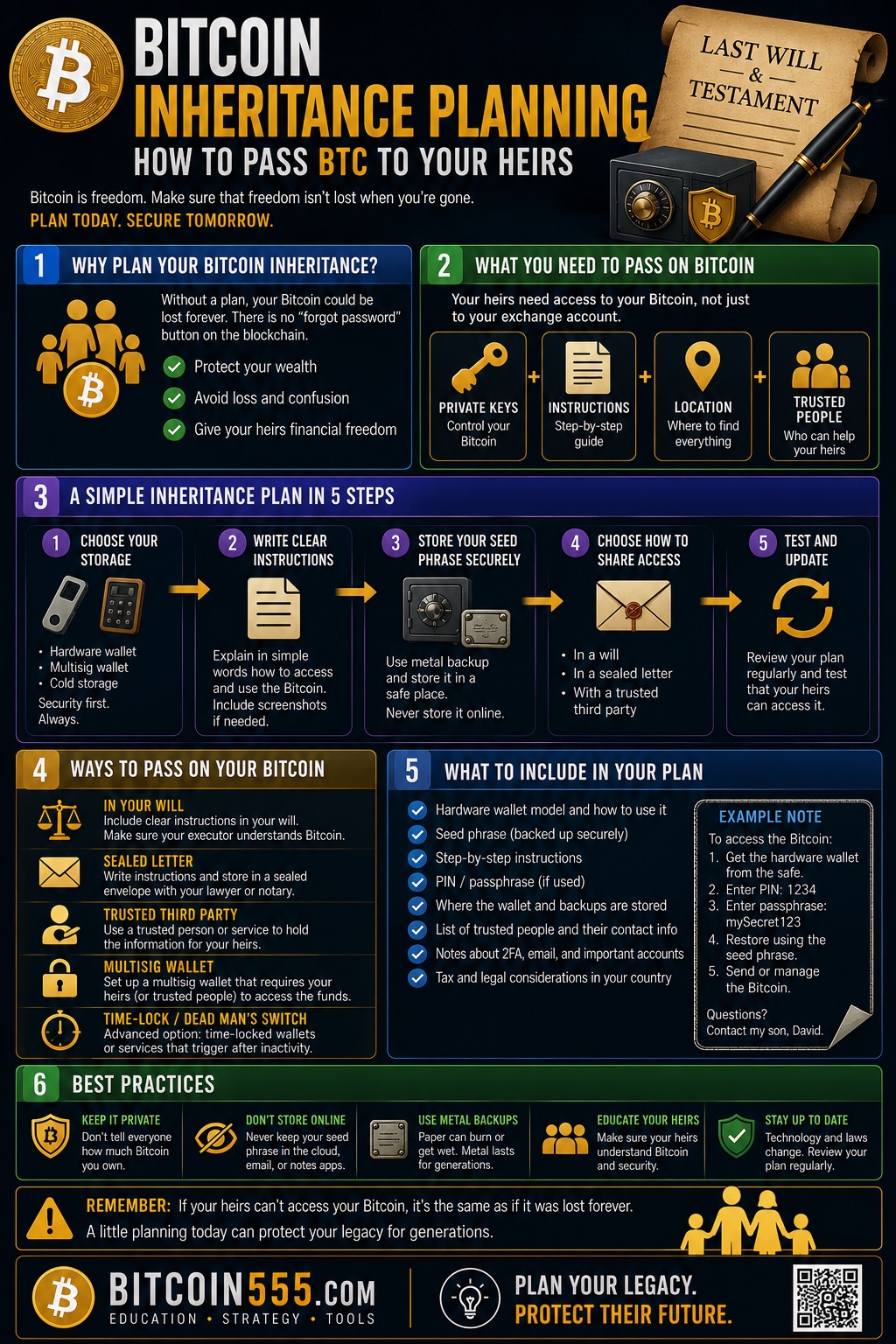
This creates a unique challenge. The very features that make Bitcoin powerful — self-custody, censorship resistance, and the elimination of intermediaries — also mean that without proper planning, your Bitcoin could be lost forever when you pass away. Industry estimates suggest that millions of BTC are already permanently inaccessible due to lost keys, and a significant portion of this loss happens during generational transfers.
But here's the good news: with thoughtful preparation, you can ensure your Bitcoin reaches your intended heirs while maintaining security during your lifetime. This guide walks you through practical, proven strategies for Bitcoin inheritance planning — no technical wizardry required, just careful thought and systematic execution.
Why Traditional Estate Planning Falls Short for Bitcoin
When your great-grandparents passed down wealth, things were relatively straightforward. Property deeds, bank accounts, and stock certificates all existed within systems designed to handle ownership transfers. Lawyers, banks, and courts understood these assets and had centuries of precedent to guide them.
Bitcoin breaks this mold entirely. Consider these fundamental differences:
- No password reset: If your heirs can't access your private keys or seed phrase, no court order or legal document can recover your Bitcoin. The blockchain doesn't recognize death certificates.
- No central authority: There's no Bitcoin customer service to call, no institution to petition. The protocol treats everyone equally — it doesn't care whether you're the rightful owner or a hacker.
- Immediate and irreversible transactions: Once Bitcoin moves, it's gone. A single mistake in the inheritance process could send your family's wealth to an attacker or an inaccessible address permanently.
- Technical complexity: Your heirs may have zero experience with cryptocurrency. Handing them a piece of paper with 24 words means nothing if they don't understand what to do with it.
Traditional wills and estate plans certainly play a role — you'll want to legally specify who inherits your Bitcoin. But the legal documents only address ownership rights; they don't solve the practical problem of access. Your estate plan needs both legal clarity and technical accessibility.
The Core Elements of a Bitcoin Inheritance Plan
Every effective Bitcoin inheritance strategy must balance two competing concerns: security during your lifetime and accessibility for your heirs after death. Lean too far toward security, and your family may never access the funds. Lean too far toward accessibility, and you create vulnerabilities that could be exploited while you're alive.
A robust plan addresses these five essential elements:
1. Secure Documentation of Access Information
Your heirs need access to several pieces of information:
- Your seed phrase (the 12 or 24 words that can restore your wallet)
- Any additional passphrases (the "25th word" if you use one)
- PIN codes for hardware wallets
- Instructions for which wallets and addresses hold your Bitcoin
- A rough estimate of your holdings so heirs know what to expect
2. Clear Instructions for Non-Technical Users
Don't assume your spouse, children, or siblings understand cryptocurrency. Create step-by-step instructions written for someone who has never touched Bitcoin. Include explanations of basic concepts and specific guidance on recovering and securing the funds.
3. Legal Integration
Work with an estate attorney to ensure your Bitcoin is addressed in your will or trust. While the legal documents won't provide access, they establish rightful ownership and can prevent family disputes.
4. Verification Mechanisms
Build in ways for you to periodically verify your plan still works. Technology changes, passwords get forgotten, and safe deposit boxes get abandoned. Regular check-ins keep your plan current.
5. Security Against Premature Access
Protect yourself from theft, coercion, or family members accessing funds before your death. The best plans make access practically impossible without your death being confirmed through multiple channels.
Practical Methods for Passing Bitcoin to Heirs
Now let's explore specific strategies, ranging from simple to sophisticated. Most people will benefit from combining multiple approaches.
Method 1: The Trusted Person Approach
The simplest method involves leaving complete access information with someone you trust absolutely — typically a spouse, adult child, or close family member.
How it works:
- Write down your seed phrase and any passphrases clearly on durable material (steel backup plates are ideal for fire and water resistance).
- Include written instructions explaining how to use this information to recover the Bitcoin.
- Store this package in a secure location your trusted person can access — a home safe, bank safe deposit box, or with an attorney.
- Verbally walk your trusted person through the process so they understand the basics.
Pros: Simple, no ongoing costs, immediate access when needed.
Cons: Your trusted person could access funds prematurely. Single point of failure if the trusted person dies first or the storage location is compromised.
This method works best for smaller holdings or when you have absolute trust in one person. For larger amounts, consider adding security layers.
Method 2: Geographic Distribution with Shamir's Secret Sharing
For enhanced security, you can split your seed phrase into multiple parts stored in different locations. Shamir's Secret Sharing is a cryptographic technique that divides a secret into multiple shares, where you need a certain number of shares (but not all) to reconstruct the original.
How it works:
- Use a tool or hardware wallet that supports Shamir's Secret Sharing (some hardware wallets offer this feature natively).
- Create, for example, 3 shares where any 2 can reconstruct your seed phrase.
- Distribute shares to different trusted people or locations — one with your attorney, one in a home safe, one with a family member in another city.
- Provide each share holder with instructions on how to combine shares when needed.
Pros: No single person or location can access your funds. Redundancy protects against loss of one share.
Cons: More complex to set up and explain to heirs. Requires coordination between share holders.
Method 3: Time-Locked Solutions and Dead Man's Switches
Some services and technical setups allow you to create conditions where access becomes available only after you stop checking in.
How it works:
- Set up a system that requires you to authenticate periodically (monthly or quarterly).
- If you fail to check in after a certain period, the system releases access information to designated recipients.
- This could be as simple as encrypted files with a password that gets emailed after you stop resetting a timer, or as sophisticated as smart contract-based solutions.
Pros: Access is automatic when you die. No premature access possible while you're alive and checking in.
Cons: Requires ongoing maintenance. Technical complexity varies. Some services may not exist long-term.
Method 4: Hardware Wallet with Documented Instructions
For those using hardware wallets — which security experts strongly recommend for any significant holdings — the device itself can be part of the inheritance plan.
A quality hardware wallet like a Ledger device keeps your private keys offline, protected from online threats. When combined with proper documentation, it provides both lifetime security and inheritance accessibility.
How it works:
- Set up your hardware wallet with a strong PIN and carefully back up your seed phrase.
- Store the hardware wallet in a location your heirs can access, along with the PIN.
- Store the seed phrase backup separately as a failsafe.
- Include detailed instructions covering: how to connect the device, how to access the Bitcoin, and what to do if the device is lost or damaged (restore from seed phrase).
Pros: Hardware wallet provides excellent security during your lifetime. Physical device makes the concept tangible for non-technical heirs.
Cons: Device could be lost, damaged, or become obsolete. Seed phrase backup is essential as the true failsafe.
For most individuals holding meaningful amounts of Bitcoin, a hardware wallet combined with proper seed phrase backup represents the gold standard for balancing daily security with inheritance planning.
Step-by-Step: Creating Your Bitcoin Inheritance Plan
Let's put this into action with a concrete process you can follow:
Step 1: Inventory Your Holdings
Create a comprehensive list of all your Bitcoin holdings:
- Hardware wallet addresses and approximate balances
- Exchange accounts (though ideally, you should move significant holdings to self-custody)
- Any other wallets or storage methods
Don't include private keys or seed phrases in this inventory — just locations and amounts.
Step 2: Consolidate When Possible
The more scattered your Bitcoin, the harder inheritance becomes. Consider consolidating to one or two secure storage solutions. This simplifies documentation and reduces the chance of funds being forgotten or lost.
Step 3: Create Your Seed Phrase Backup
If you haven't already, create a durable backup of your seed phrase. Metal backup plates that you stamp or engrave are far more durable than paper. Store this in a fireproof, waterproof location.
Step 4: Write Your Instructions
Create a document explaining everything your heirs need to know. Assume zero knowledge and explain:
- What Bitcoin is and approximately what your holdings are worth (you can reference our Bitcoin retirement calculator to help project long-term value for estate planning purposes)
- Where the seed phrase backup is located
- Where any hardware wallets are stored and their PINs
- Step-by-step instructions for accessing the Bitcoin
- Recommendations for what to do next (secure the Bitcoin, consult with a crypto-knowledgeable financial advisor, etc.)
- Warning signs of scams targeting crypto inheritors
Step 5: Secure Your Documentation
Decide where to store your instructions and seed phrase backup. Options include:
- Home safe (accessible but potentially vulnerable to home disasters or theft)
- Bank safe deposit box (secure but may have access delays after death)
- Attorney's office (professional custody, integrates with estate planning)
- Distributed across multiple locations for redundancy
Step 6: Update Your Legal Estate Plan
Work with an estate attorney to address your Bitcoin in your will or trust. The attorney doesn't need your private keys — just documentation that specifies who inherits your digital assets and where to find access instructions.
Step 7: Brief Your Heirs
Have at least one conversation with your primary heir about your Bitcoin holdings and where to find information when needed. They don't need all the details now — just enough to know that Bitcoin is part of your estate and that instructions exist.
Step 8: Schedule Annual Reviews
Set a calendar reminder to review your plan annually. Verify that:
- All storage locations are still accessible
- Your instructions are still accurate
- Your designated heirs are still appropriate
- Any technology you're using still functions
Common Mistakes to Avoid
In my years of educating Bitcoin holders, I've seen the same mistakes repeatedly. Avoid these pitfalls:
Leaving Bitcoin on exchanges: If you die with Bitcoin sitting on an exchange like Binance, your heirs face bureaucratic hurdles, identity verification challenges, and potential legal complications depending on your jurisdiction. Self-custody is always preferable for inheritance planning. By all means, use reputable exchanges like Binance for buying Bitcoin, but transfer significant holdings to your own wallet afterward.
Over-complicating the plan: Yes, you could create a sophisticated multi-signature setup with time locks and geographic distribution. But if your heirs can't figure it out, complexity becomes a liability. Match your plan's sophistication to your heirs' technical capabilities.
Single points of failure: One copy of your seed phrase in one location is a disaster waiting to happen. Fires, floods, and forgotten safe combinations have destroyed countless fortunes. Build in redundancy.
Telling no one: Some holders are so secretive that no one knows their Bitcoin exists. When they die, the coins die with them. At minimum, one trusted person should know that you own Bitcoin and where to find instructions.
Ignoring the tax implications: Depending on your jurisdiction, your heirs may face capital gains taxes or estate taxes on inherited Bitcoin. Include guidance about consulting a tax professional in your instructions.
Outdated information: Technology changes, you accumulate more Bitcoin, you change storage solutions. A plan created five years ago and never updated may be useless. Annual reviews are essential.
Teaching Your Heirs About Bitcoin Security
The best inheritance plan also includes education. Consider these ways to prepare your heirs:
Gift small amounts now: Sending a small amount of Bitcoin to your children or heirs gives them hands-on experience with wallets, transactions, and basic security concepts. They'll be far better prepared to handle a larger inheritance.
Include educational resources: In your instructions, recommend reputable educational resources where heirs can learn more about Bitcoin and cryptocurrency security.
Warn about scams: Inheritors of cryptocurrency are prime targets for scammers. Include explicit warnings about common scams: fake support numbers, phishing sites, people claiming they can "help" recover crypto for a fee, and anyone asking for seed phrases or private keys.
Recommend professional help: Suggest that heirs consult with a crypto-literate financial advisor or attorney before making any significant decisions about the inherited Bitcoin.
Frequently Asked Questions
Can I just put my seed phrase in my will?
This is strongly discouraged. Wills become public record during probate, meaning anyone could see your seed phrase and steal your Bitcoin. Additionally, probate can take months, during which time the information sits in court files. Instead, reference in your will that digital asset information exists in a separate secure location, and use proper secure storage for actual access information.
What happens if my heirs lose the seed phrase backup?
If all copies of your seed phrase are lost and there's no other way to access the wallet, the Bitcoin is gone forever. This is why redundancy is critical. Consider multiple backup copies in different secure locations, or use Shamir's Secret Sharing to distribute shares with built-in redundancy.
Should I use a cryptocurrency inheritance service?
Several companies now offer cryptocurrency inheritance services. These can be valuable, especially for complex situations, but come with tradeoffs. You're trusting a third party with access to sensitive information, and the company may not exist decades from now when your plan needs to execute. If you use such services, ensure they're reputable and maintain your own backups as failsafes.
How do I handle Bitcoin inheritance across international borders?
International inheritance adds complexity due to varying tax laws and estate regulations. The Bitcoin itself is borderless, but legal and tax implications depend on your residence, your heirs' residence, and where assets are deemed to be located. Consult with legal and tax professionals who understand both cryptocurrency and international estate planning.
What if I don't trust anyone completely?
If you're uncomfortable giving any single person full access, consider splitting access using Shamir's Secret Sharing or multi-signature wallets. You can also use attorney-held instructions combined with separately-held seed phrase backups, requiring coordination between parties. The key is designing a system where access requires conditions that only make sense after your death.
Conclusion: Protecting Your Legacy
Bitcoin represents a new form of wealth — one that offers unprecedented financial sovereignty but also demands unprecedented personal responsibility. That responsibility extends beyond your lifetime to ensuring the wealth you've accumulated can benefit those you leave behind.
The good news is that Bitcoin inheritance planning doesn't require technical expertise or expensive professional services. It requires thoughtfulness, organization, and follow-through. By documenting your holdings, creating secure backups, writing clear instructions, and integrating with your legal estate plan, you can ensure your Bitcoin becomes a blessing rather than a burden for your heirs.
Start today. Audit your current setup, identify the gaps, and begin building your plan. The process might feel uncomfortable — no one enjoys contemplating their own mortality — but it's one of the most important things you can do for the people you care about. Your future self, and your grateful heirs, will thank you for taking the time to get this right.