Your Bitcoin seed phrase is the master key to your entire cryptocurrency fortune. These 12 or 24 words hold more power than any password you've ever created — they can restore your wallet on any device, at any time, anywhere in the world. But this incredible convenience comes with an equally incredible responsibility. One careless mistake with your seed phrase, and your Bitcoin could vanish forever, with absolutely no customer service to call and no recovery option available.
In my years of educating Bitcoin users, I've witnessed heartbreaking stories of people losing life-changing amounts of money due to simple, avoidable seed phrase errors. A father who lost his children's college fund because he stored his phrase in a cloud note app. A retiree who watched helplessly as hackers drained her wallet after she accidentally photographed her seed phrase. A young investor who threw away a piece of paper worth hundreds of thousands of dollars during spring cleaning.
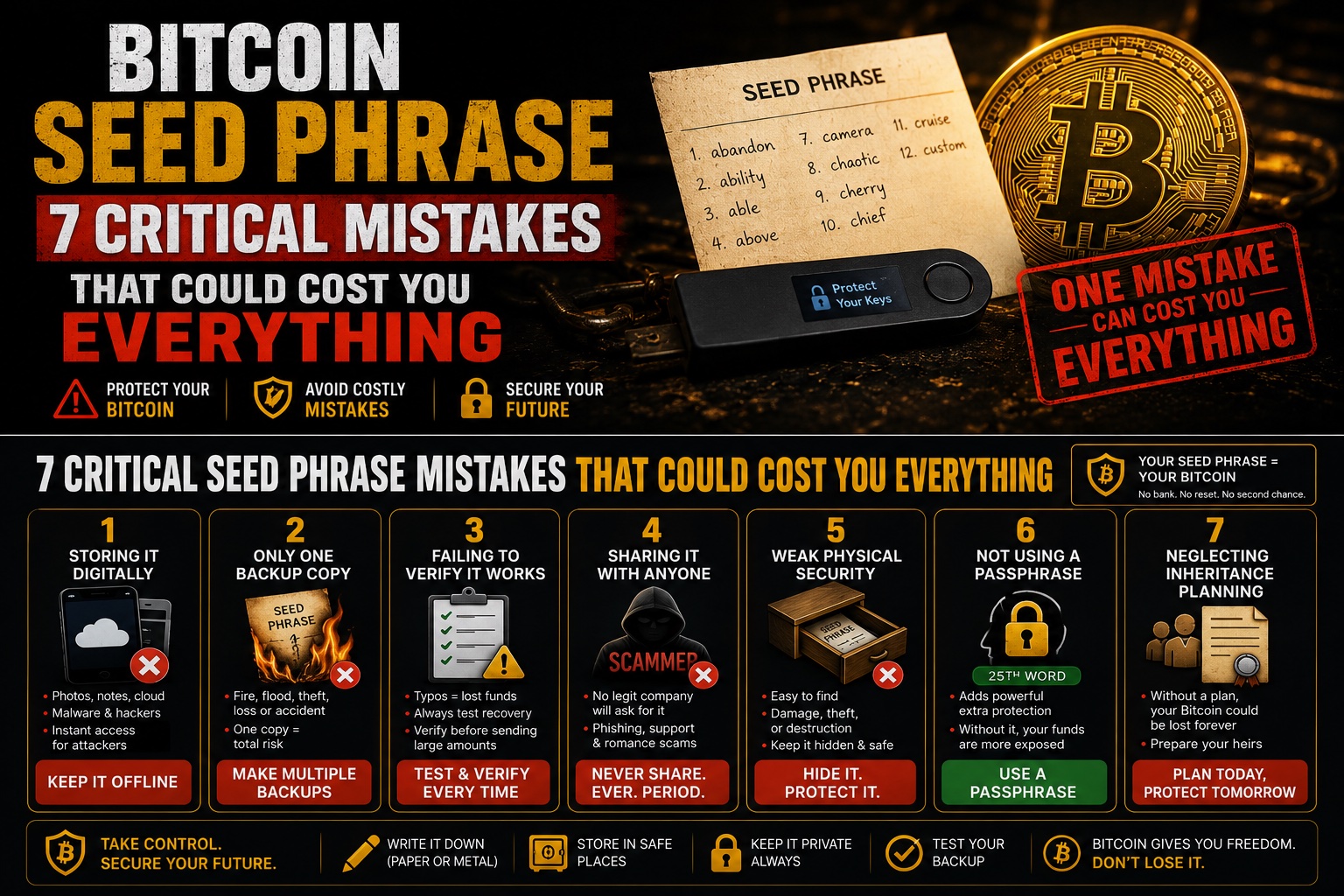
These aren't rare edge cases — they represent patterns I see repeatedly in the Bitcoin community. The good news? Every single one of these disasters was preventable. In this comprehensive guide, I'll walk you through the seven most critical seed phrase mistakes and show you exactly how to avoid them. Whether you're a complete beginner or someone looking to upgrade your security practices, this knowledge could literally save your financial future.
Understanding What a Seed Phrase Actually Is
Before diving into the mistakes, let's establish a solid foundation. A seed phrase — also called a recovery phrase, mnemonic phrase, or backup phrase — is a human-readable representation of the cryptographic keys that control your Bitcoin. When you set up a non-custodial wallet, the software generates a random sequence of words from a standardized list of 2,048 possibilities called the BIP-39 wordlist.
This sequence typically contains 12 or 24 words, and the order matters enormously. "apple banana cherry" is completely different from "cherry banana apple" — each arrangement produces entirely different wallet addresses and private keys. The mathematical security behind this system is staggering: a 24-word phrase has more possible combinations than there are atoms in the observable universe.
Here's what makes seed phrases both beautiful and terrifying: whoever possesses these words controls the Bitcoin. There's no additional verification, no identity check, no waiting period. If someone types your seed phrase into a compatible wallet application, they have instant, irreversible access to move your funds wherever they want. Your seed phrase isn't just a backup — it's the actual key to your wealth, expressed in words instead of complex numbers.
This is fundamentally different from traditional banking. If someone steals your credit card number, you can call the bank, dispute charges, and get your money back. With Bitcoin, once a transaction is confirmed on the blockchain, it's permanent. There's no institution to appeal to because the entire point of Bitcoin is operating without trusted intermediaries. This sovereignty is empowering, but it demands personal responsibility that most people aren't accustomed to.
Mistake #1: Storing Your Seed Phrase Digitally
This is the single most common and devastating mistake I encounter. In our digital-first world, the instinct to take a photo, create a note, or save a document feels natural and convenient. But digital storage transforms your seed phrase from a closely guarded secret into a target that can be attacked from anywhere on Earth.
Why digital storage is dangerous:
- Cloud synchronization: That note you created might automatically upload to iCloud, Google Drive, or Dropbox. Now your seed phrase exists on corporate servers, potentially accessible to employees, hackers, or government subpoenas.
- Device vulnerabilities: Smartphones and computers can be infected with malware designed specifically to scan for seed phrases. These programs search for patterns matching BIP-39 words and instantly transmit findings to attackers.
- Screenshot and photo analysis: Modern malware can analyze images for text, meaning that photo of your seed phrase written on paper is just as vulnerable as typing it directly.
- Backup systems: Your device likely creates automatic backups that could include your seed phrase, stored in locations you never explicitly chose.
The correct approach: Write your seed phrase on physical media only. Use a pen and paper as a minimum, but consider upgrading to a metal backup solution that can survive fire and water damage. When you first create your wallet, write the words carefully, double-check each one against the wallet's display, and immediately store the physical backup in a secure location. Never type, photograph, screenshot, or digitally record these words under any circumstances.
If you're using a hardware wallet like a Ledger device, the seed phrase is generated offline and never touches an internet-connected device. This air-gapped approach eliminates entire categories of digital attack vectors, which is one of the primary reasons security-conscious Bitcoin holders invest in dedicated hardware wallets rather than relying on software wallets alone.
Mistake #2: Creating Only One Backup Copy
You've carefully written your seed phrase on paper and stored it safely. You're done, right? Unfortunately, a single backup creates a dangerous single point of failure. What happens if that one piece of paper is destroyed in a house fire, damaged in a flood, accidentally thrown away, or simply lost during a move?
I've spoken with Bitcoin holders who did everything right regarding digital security but still lost access to their funds because their only physical backup was destroyed. One memorable case involved a woman who kept her seed phrase in a fireproof safe, not realizing that while the safe survived a house fire, the paper inside was reduced to ash because the safe's fire rating was for documents, not extreme heat scenarios.
Creating redundant backups safely:
- Make multiple copies: Create at least two or three physical backups of your seed phrase.
- Store them in geographically separate locations: Keep one at home, one in a bank safe deposit box, and perhaps one with a trusted family member. This protects against localized disasters.
- Use durable materials: Consider metal seed phrase backup devices that resist fire, water, and corrosion. These steel or titanium plates can survive conditions that would destroy paper.
- Verify your backups: Periodically check that your backups are still legible and intact. Don't wait until you need them to discover a problem.
The goal is ensuring that no single catastrophic event — whether natural disaster, theft, or accident — can eliminate all access to your Bitcoin. Think of it like having multiple keys to your house stored in different secure locations, except these keys protect potentially your entire life savings.
Mistake #3: Failing to Verify Your Seed Phrase Works
Here's a nightmare scenario that happens more often than you'd expect: Someone sets up a new wallet, writes down their seed phrase, transfers a significant amount of Bitcoin to the wallet, and then discovers months or years later that they wrote down one word incorrectly. Or the paper got smudged. Or they accidentally skipped a word. Their backup is useless, and if anything happens to their original device, those funds are gone forever.
How to properly verify your seed phrase:
- Immediately after writing: Most quality wallets include a verification step where you must re-enter certain words to confirm you recorded them correctly. Take this seriously — don't rush through it.
- Perform a test recovery: Before sending any significant amount to a new wallet, test the recovery process. Reset the wallet or use a different device to restore from your seed phrase backup. Verify that the same receiving addresses are generated.
- Start with small amounts: Send a tiny test transaction first. Confirm you can see it in your wallet and could theoretically spend it before transferring larger amounts.
- Double-check word spelling: Every word in the BIP-39 list is unique in its first four letters, which helps catch errors. But words like "abandon" and "ability" could be confused if handwriting is unclear.
This verification process takes maybe 15 extra minutes during wallet setup but could save you from catastrophic loss. Think of it as testing a parachute before jumping — you never want to discover it doesn't work when you actually need it.
Mistake #4: Sharing Your Seed Phrase with Anyone
It sounds obvious when stated directly, but social engineering attacks exploit human trust and helpfulness in remarkably effective ways. No legitimate service, company, or support representative will ever ask for your seed phrase. Period. Without exception.
Common social engineering attacks:
- Fake customer support: Scammers pose as wallet companies or exchange support staff, claiming they need your seed phrase to "verify your account" or "fix a problem." Real support never needs this.
- Phishing websites: Counterfeit wallet websites or apps ask you to "import" an existing wallet by entering your seed phrase. The site looks identical to the real thing but sends your phrase directly to attackers.
- Tech support scams: Someone claiming to help with a computer problem asks you to share your screen while your wallet is open, or requests remote access to your device.
- Investment opportunity scams: Fraudsters promise incredible returns if you "stake" or "verify" your wallet by entering your seed phrase on their platform.
- Romance scams: Long-running emotional manipulation where a fake romantic partner eventually asks for help with their crypto or access to your wallet.
The golden rule: Your seed phrase should enter a device in exactly one scenario — when you're restoring a wallet on legitimate, verified software that you downloaded directly from official sources. If anyone asks for your seed phrase for any other reason, they're attempting to steal from you.
Be especially cautious in online communities. Scammers monitor cryptocurrency forums and social media, waiting for people to post questions about wallet problems. They then send private messages posing as helpful community members or official support staff. Legitimate help never requires your seed phrase.
Mistake #5: Using Weak Physical Security Practices
Even if you've avoided digital storage and created multiple backups, poor physical security can still expose your seed phrase to theft. Where and how you store your backups matters enormously.
Common physical security failures:
- Obvious storage locations: Keeping your seed phrase in a desk drawer, bedside table, or filing cabinet labeled "important documents" makes it trivially easy for burglars or household visitors to find.
- Insufficient protection: A piece of paper can be destroyed by water damage, faded by sunlight, or eaten by pests. Cheap fireproof bags often provide inadequate protection.
- Leaving it visible during use: Writing down your seed phrase where roommates, family members, or security cameras can see invites trouble.
- Carrying it with you: Keeping your seed phrase in your wallet or bag means losing that item loses your Bitcoin access and potentially exposes it to thieves.
Better physical security practices:
- Use concealment: Store your backup in non-obvious locations. A seed phrase hidden inside a book on a shelf among hundreds of books is harder to find than one in a labeled safe.
- Consider tamper-evident storage: Sealed containers or envelopes that show obvious signs of tampering let you know if someone has accessed your backup.
- Invest in quality materials: Metal backup devices from reputable manufacturers resist fire, water, and physical degradation far better than paper.
- Be discreet: Don't tell people you own significant cryptocurrency, and certainly don't discuss where your backups are stored. Social awareness of your holdings makes you a target.
Hardware wallets like those from Ledger add another security layer by requiring physical confirmation of transactions on the device itself. Even if someone obtained your seed phrase, a properly configured hardware wallet with a passphrase (discussed below) provides additional protection.
Mistake #6: Not Using a Passphrase (25th Word)
Most people don't realize that seed phrases support an optional additional security feature: a passphrase, sometimes called the "25th word." This is different from a PIN or password — it's a user-chosen phrase that mathematically creates an entirely different set of wallet addresses from the same seed phrase.
How the passphrase works: Your 24 words might generate Wallet A. But those same 24 words plus the passphrase "giraffe7sunset" generate Wallet B — a completely separate wallet with different addresses and different funds. Someone who obtains only your 24-word seed phrase cannot access Wallet B without also knowing your passphrase.
Benefits of using a passphrase:
- Protection against physical theft: If someone finds or steals your seed phrase backup, they still can't access your funds without the passphrase.
- Plausible deniability: You can keep a small amount in the no-passphrase wallet (Wallet A) while your main holdings exist in the passphrase-protected wallet (Wallet B). Under duress, you could reveal your seed phrase and show a modest balance without exposing your primary holdings.
- Additional memorization security: You can memorize your passphrase, keeping part of your security in your head rather than written anywhere.
Important warnings about passphrases:
- A forgotten passphrase cannot be recovered. It's as critical as the seed phrase itself.
- The passphrase must be backed up with the same care as the seed phrase, but stored separately for security benefits.
- Slight variations produce completely different wallets. "MyPassphrase" and "mypassphrase" access different funds.
When you purchase Bitcoin through exchanges like Binance and transfer it to self-custody, implementing a passphrase ensures that even a compromised seed phrase backup doesn't mean automatic loss of funds. It's an advanced technique but worth implementing once you're comfortable with basic seed phrase management.
Mistake #7: Neglecting Inheritance Planning
Bitcoin's design means that when you die, your coins don't automatically transfer to anyone. Without proper planning, your Bitcoin could be lost forever — a painful irony after all your careful security measures. This isn't just about significant holdings; it's about not letting any amount simply vanish.
The inheritance challenge: You've secured your seed phrase against theft, fire, and digital attacks. But your security measures might work too well, preventing even legitimate heirs from accessing funds. Meanwhile, simply giving your seed phrase to family members defeats much of your security during your lifetime.
Approaches to inheritance planning:
- Lawyer-held instructions: A sealed letter with your lawyer explaining where backups are located and how to access them, opened only upon confirmed death.
- Split secrets: Using methods like Shamir's Secret Sharing to split your seed phrase into multiple parts, where a certain threshold (like 3 of 5 parts) is needed to reconstruct it. Different parts go to different trusted parties.
- Time-delayed dead man's switches: Services or setups that require regular check-ins; failure to check in eventually releases information to designated recipients.
- Trusted family member with partial information: One person knows where backups are stored; another knows the passphrase. Neither can access funds alone, but together they can.
- Detailed written instructions: Step-by-step guides assuming the reader knows nothing about cryptocurrency, explaining exactly how to restore and access the wallet.
Whatever method you choose, test it periodically. Have your intended heirs demonstrate they could follow the instructions if needed. The best inheritance plan is worthless if the instructions are confusing or outdated.
Frequently Asked Questions
Can I change my seed phrase if I think it's been compromised?
You cannot change a seed phrase — it's mathematically derived and permanent. If you believe your seed phrase has been exposed, you must immediately create a new wallet with a fresh seed phrase and transfer all your funds to the new wallet addresses. Time is critical in this scenario because anyone with your compromised phrase could move your funds at any moment. Generate a new wallet on a secure device, write down the new seed phrase carefully, verify it works, and transfer your Bitcoin immediately. Then destroy all copies of the old seed phrase.
Is it safe to store my seed phrase in a bank safe deposit box?
Bank safe deposit boxes offer excellent protection against theft and home disasters, making them a reasonable choice for one of your multiple backup copies. However, they have limitations: banks can restrict access during financial crises, safe deposit boxes can be drilled or seized under legal orders, and bank employees theoretically have access. For best security, store a metal backup in a tamper-evident container, and consider using a passphrase so the physical seed phrase alone isn't sufficient to access funds. Don't rely on a safe deposit box as your only backup — it should be part of a distributed backup strategy.
What should I do if I lose one of my backup copies?
Immediately create a replacement backup from one of your remaining copies. This is exactly why having multiple backups matters — losing one shouldn't be catastrophic. However, also consider whether the lost backup might have been stolen rather than simply misplaced. If there's any possibility someone else might have obtained it, treat it as a potential compromise: create a fresh wallet and transfer your funds. If you're confident the backup was simply destroyed (shredded papers, house fire, etc.), creating a replacement is sufficient. Never reduce yourself to having only one backup copy.
How often should I verify my seed phrase backups are still intact?
Check your physical backups at least once or twice per year. During verification, ensure the backup is still legible, hasn't suffered water or fire damage, and that all words are clearly readable. For paper backups, check for fading ink or paper degradation. For metal backups, verify no corrosion or physical damage has occurred. This is also a good time to confirm you still have access to all backup locations — a safe deposit box you forgot to renew or a relative who moved creates problems. Document when you've verified each backup and add it to your calendar as a recurring reminder.
Is there any way to recover a lost seed phrase?
If you've completely lost all copies of your seed phrase and lost access to your wallet device, recovery is essentially impossible for properly generated phrases. The 24-word combination cannot be guessed or brute-forced. However, some partial recovery scenarios exist: if you remember most words but are missing one or two, specialized recovery services can attempt to find the missing words (this works because there's a checksum in the phrase). If you have access to the original device but forgot a PIN, some advanced techniques might recover the seed phrase depending on the wallet type. But if both the seed phrase and device access are gone, accept that those Bitcoin are permanently inaccessible. This harsh reality underscores why proper backup creation and verification matter so much.
Conclusion: Your Seed Phrase Deserves Obsessive Protection
Managing a Bitcoin seed phrase requires a mindset shift that most people in the digital age find uncomfortable. We're accustomed to passwords being recoverable, accounts being protected by institutions, and mistakes being reversible. None of that applies here. Your seed phrase is a bearer instrument — whoever holds it, owns the Bitcoin. No appeals, no exceptions, no second chances.
The seven mistakes we've covered — digital storage, single backups, skipped verification, sharing with others, weak physical security, ignoring passphrases, and neglected inheritance planning — represent the most common ways people lose access to or control of their Bitcoin. Each mistake is entirely preventable with awareness and proper practices.
Start by honestly assessing your current seed phrase storage. Is any copy stored digitally? Do you have multiple physical backups in separate locations? Have you verified that restoration actually works? Could your heirs access your Bitcoin if something happened to you today? Use this article as a checklist and address any gaps immediately.
For those just beginning their Bitcoin journey, take these lessons to heart as you set up your first proper wallet. When you buy Bitcoin through an exchange like Binance, understand that moving it to self-custody — a hardware wallet like a Ledger device with your own seed phrase — transfers both the power and the responsibility to you. Handle that responsibility with the seriousness it deserves.
Your future self, looking back years from now when your Bitcoin holdings have potentially grown substantially, will thank you for the care you took today. The few hours invested in proper seed phrase management are nothing compared to the peace of mind knowing your Bitcoin is truly secure. Take action today.