There's an old saying in the Bitcoin community: "Not your keys, not your coins." It's been repeated so many times that it might sound like a cliché, but the truth behind these words has been proven repeatedly throughout Bitcoin's history. From exchange hacks to sudden platform collapses, millions of people have learned the hard way that trusting third parties with your Bitcoin comes with serious risks.
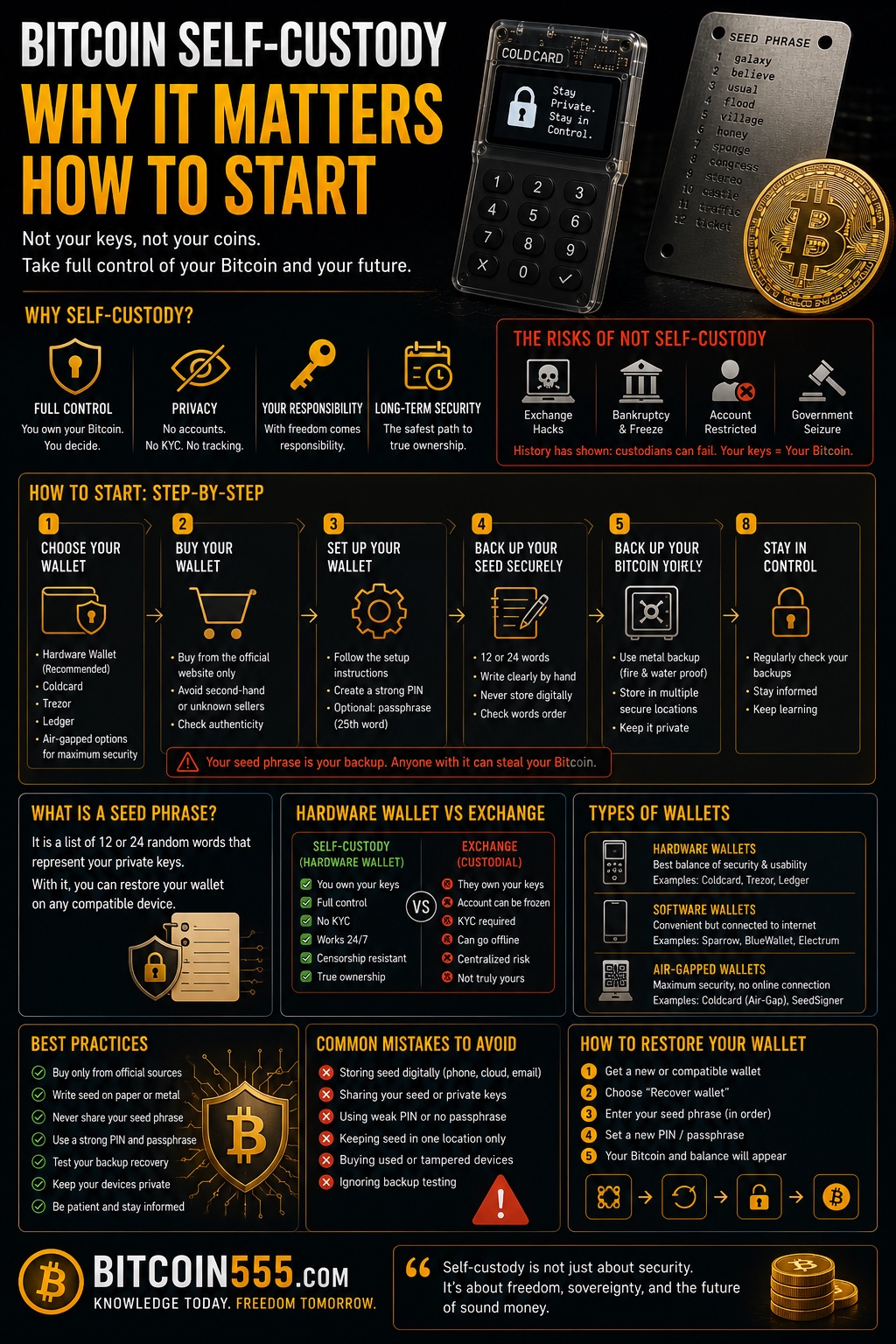
Self-custody means taking full control of your Bitcoin by holding your own private keys. It's the difference between truly owning your wealth and merely having an IOU from a company that promises to give you access to your funds. If you've been buying Bitcoin on exchanges and leaving it there, this guide will explain why that's risky and show you exactly how to take control of your financial sovereignty.
Think of this article as a conversation with a knowledgeable friend who wants to help you protect your investment. We'll cover everything from the basics of how Bitcoin custody works to step-by-step instructions for setting up your own secure wallet. By the end, you'll understand not just the "how" but the "why" — and you'll be equipped to make informed decisions about securing your Bitcoin for years to come.
Understanding Bitcoin Custody: What Does It Really Mean?
Before diving into self-custody, let's clarify what "custody" means in the context of Bitcoin. Every Bitcoin address has a corresponding private key — a secret string of characters that proves ownership and allows you to spend the coins associated with that address. Whoever controls the private key controls the Bitcoin. It's that simple.
When you buy Bitcoin on an exchange, you don't actually receive the private keys. Instead, the exchange holds the Bitcoin in their wallets and maintains a database entry showing that you own a certain amount. You're essentially trusting them to honor their promise to let you withdraw your coins when you want.
Custodial wallets are services where a third party holds your private keys on your behalf. These include cryptocurrency exchanges, some mobile apps, and various online platforms. The convenience is obvious: if you forget your password, you can recover your account. The exchange handles all the technical complexity.
Self-custody wallets put you in complete control. You generate and store your own private keys, typically in the form of a seed phrase — a series of 12 or 24 words that can restore your entire wallet. No company can freeze your funds, and no hack of a centralized service can affect you directly. But this power comes with responsibility: lose your seed phrase, and your Bitcoin is gone forever.
The distinction matters enormously. With self-custody, your Bitcoin exists on the blockchain, secured by mathematics and the most powerful computing network ever created. With exchange custody, your Bitcoin's safety depends on a company's security practices, financial health, and ethical standards.
Why Self-Custody Is Essential for Bitcoin Holders
You might wonder why self-custody matters if you're using a reputable exchange. After all, major platforms invest millions in security, employ expert teams, and have insurance policies. While these points have merit for small amounts or active trading, they miss fundamental risks that self-custody eliminates.
Exchange Failures and Bankruptcies
History is littered with exchange failures. Mt. Gox, once handling 70% of all Bitcoin transactions, collapsed in 2014. Users waited years to receive partial reimbursement. More recently, we've seen major platforms freeze withdrawals overnight, leaving customers unable to access their funds during crucial moments. In bankruptcy proceedings, customers often become unsecured creditors — last in line to recover anything.
Regulatory Seizures and Account Freezes
Exchanges must comply with regulations in their jurisdictions. Governments can order account freezes, require identity verification that excludes certain users, or impose withdrawal limits. These rules can change without warning. What's legal today might restrict your access tomorrow. With self-custody, no third party can prevent you from transacting.
Security Breaches
Even well-funded exchanges experience security breaches. Hackers specifically target cryptocurrency platforms because successful attacks can yield massive payoffs. While some exchanges reimburse affected users, others cannot afford to. Self-custody removes you from this target entirely — attackers would need to specifically compromise your personal security, which is far less attractive than hitting a centralized honey pot.
Counterparty Risk Elimination
Every company carries counterparty risk — the possibility that they won't fulfill their obligations. Exchanges might engage in fractional reserve practices, lending out customer deposits, or making risky investments. Self-custody eliminates this entirely. Your Bitcoin exists on the blockchain, verifiable by anyone, dependent on no company's solvency.
If you're accumulating Bitcoin as a long-term investment, particularly for goals like retirement planning, self-custody becomes even more critical. You can use our Bitcoin retirement calculator to project your potential future holdings, but those projections only matter if your coins remain securely under your control for decades.
Types of Self-Custody Wallets Explained
Self-custody wallets come in several forms, each with different security profiles and use cases. Understanding these options helps you choose the right solution for your situation.
Hardware Wallets
Hardware wallets are dedicated physical devices designed specifically to secure cryptocurrency private keys. They store your keys offline and sign transactions internally, meaning your private keys never touch an internet-connected device. This "cold storage" approach provides excellent security against remote attacks.
Popular options include devices from Ledger, Trezor, and Coldcard. These typically cost between $50 and $200, which is a small price for securing potentially life-changing wealth. Ledger devices, for example, use secure element chips similar to those in credit cards, adding an extra layer of protection against physical attacks.
Hardware wallets represent the gold standard for self-custody. They're ideal for anyone holding Bitcoin they don't need to access frequently and for amounts too significant to risk on less secure methods.
Software Wallets
Software wallets are applications that run on your computer or smartphone. They're more convenient than hardware wallets but inherently less secure because they operate on devices connected to the internet.
Desktop wallets like Sparrow, Electrum, or Wasabi run on your computer. They offer advanced features and can connect to hardware wallets for enhanced security. Desktop wallets are suitable for moderate amounts and users who want more control over their transactions.
Mobile wallets like Blue Wallet, Muun, or Phoenix are convenient for smaller amounts you might spend. They're essentially Bitcoin in your pocket. However, smartphones are vulnerable to malware, theft, and damage, making them inappropriate for significant holdings.
Paper and Metal Backups
Your seed phrase — the master backup for your wallet — needs physical protection. Paper backups work but degrade over time and are vulnerable to fire and water damage. Metal backup solutions, which let you stamp or engrave your seed words into steel plates, offer superior durability and can survive house fires and floods.
Multisignature Setups
Advanced users might consider multisignature (multisig) arrangements, which require multiple private keys to authorize transactions. For example, a 2-of-3 multisig setup needs any two of three keys to spend funds. This provides redundancy — losing one key doesn't mean losing your Bitcoin — and protection against single points of failure. Multisig is more complex to set up but offers exceptional security for larger holdings.
Step-by-Step Guide to Setting Up Your First Hardware Wallet
Let's walk through setting up a hardware wallet, the recommended approach for most people taking their first steps into self-custody. We'll use a Ledger device as our example, though the general process applies to other hardware wallets with minor variations.
Step 1: Purchase From Official Sources
Always buy hardware wallets directly from manufacturers or authorized resellers. Never purchase from random marketplace sellers or used devices. Tampered wallets could have compromised seed phrases, allowing thieves to drain your funds after you deposit. When your device arrives, verify that packaging seals are intact.
Step 2: Initialize the Device
Connect your new hardware wallet to your computer using the provided cable. Download the official companion app — Ledger Live for Ledger devices — only from the manufacturer's website. The app will guide you through setup, including firmware updates if needed.
Step 3: Generate and Record Your Seed Phrase
Your device will generate a seed phrase, typically 24 words displayed on the device screen. Write these words down carefully on paper (most hardware wallets include seed cards) in the exact order shown. Never type your seed phrase into any computer, phone, or website. Never photograph it or store it digitally.
Double-check every word. A single mistake could make recovery impossible. Take your time with this step — it's the most critical moment in the entire process.
Step 4: Verify Your Backup
The device will ask you to confirm certain words from your seed phrase. This verification ensures you've recorded it correctly. Some users perform an additional test: after setup, they wipe the device and restore it using their written seed phrase to confirm everything works.
Step 5: Set a Strong PIN
Create a PIN for your hardware wallet. This protects against physical theft — without the PIN, attackers face limited attempts before the device resets. Choose something unpredictable, not birthdays or simple patterns.
Step 6: Receive Your First Bitcoin
Use your companion app to generate a receiving address. Before receiving significant amounts, send a small test transaction first. Verify the address on your hardware wallet's screen, not just your computer, as malware can potentially modify addresses shown on computers.
Step 7: Secure Your Seed Phrase Storage
Store your written seed phrase in a secure location separate from your hardware wallet. Consider fireproof safes, safety deposit boxes, or splitting the phrase between locations. Some people create multiple copies stored in different places to protect against localized disasters.
Congratulations — you now have self-custody of your Bitcoin. The blockchain records your holdings, your hardware wallet protects your keys, and your seed phrase backup ensures you can recover even if the device fails.
Common Self-Custody Mistakes and How to Avoid Them
Self-custody empowers you but also means you're responsible for avoiding costly errors. Let's examine common mistakes and how to prevent them.
Losing or Damaging Seed Phrases
The most devastating mistake is losing access to your seed phrase and hardware wallet simultaneously. Protect against this by creating durable backups. Metal seed storage plates survive conditions that destroy paper. Store backups in multiple secure locations. Never rely on a single copy.
Exposing Seed Phrases Digitally
Never store seed phrases in cloud services, email drafts, note apps, or any digital format. Screenshots, photos, and text files are all vulnerable to theft. Sophisticated malware specifically searches devices for cryptocurrency seed phrases. Keep your backup strictly analog.
Phishing and Scams
Scammers constantly attempt to trick people into revealing seed phrases or sending Bitcoin to fraudulent addresses. Remember: no legitimate company, service, or support team will ever ask for your seed phrase. Hardware wallet manufacturers will never request it. "Recovery services" that ask for your seed are scams. When in doubt, verify information through official channels only.
Improper Address Verification
Always verify receiving addresses on your hardware wallet screen before confirming transactions. Malware can modify addresses displayed on your computer, redirecting funds to attackers. The hardware wallet's screen shows the true destination. Make this verification a habit for every transaction.
Neglecting Physical Security
A hardware wallet protects against remote attacks but not physical theft. If someone steals your device and knows your PIN, or steals your written seed phrase, they can take your Bitcoin. Consider your threat model: Who might target you? Who knows about your holdings? Keep details private and secure physical storage appropriately.
Overcomplicating Security
Some people create elaborate security schemes — splitting seeds into complex arrangements, creating multiple passphrases, or implementing systems they later forget. While advanced techniques can enhance security, simplicity has value. A straightforward setup you understand completely is safer than a complex system you might mishandle. Start simple and add complexity only as needed and as your knowledge grows.
Integrating Self-Custody Into Your Bitcoin Strategy
Self-custody should align with your overall approach to Bitcoin. Here's how to integrate secure storage with common strategies.
Buying and Transferring Regularly
If you purchase Bitcoin on an exchange like Binance or Coinbase, develop a regular withdrawal habit. Many investors buy monthly and transfer to self-custody after accumulating a threshold amount (to minimize transaction fees). Others withdraw after every purchase regardless of size. Find a rhythm that works for you, but don't leave significant funds on exchanges indefinitely.
Long-Term Holding (HODLing)
For Bitcoin you don't plan to touch for years, hardware wallet cold storage is ideal. Set it up properly, verify your backup, and store the device securely. You can check balances using read-only watch wallets without connecting your hardware wallet. Periodic verification (annually, for instance) that your device works and your seed phrase correctly restores confirms your setup remains functional.
Active Trading Considerations
If you actively trade, keeping some Bitcoin on exchanges might be necessary for quick execution. The key is sizing appropriately — only keep amounts you're actively using and can afford to lose in a worst-case scenario. Move profits and long-term holdings to self-custody regularly.
Inheritance Planning
Self-custody creates unique inheritance challenges. If you're the only person who knows your seed phrase location and you become incapacitated, those funds could be lost forever. Consider how loved ones would access your Bitcoin. Some options include leaving clear instructions in a secure location, using a lawyer to hold sealed information, or setting up multisig arrangements that include trusted family members.
Frequently Asked Questions About Bitcoin Self-Custody
What happens if I lose my hardware wallet?
If you've properly backed up your seed phrase, losing your hardware wallet is inconvenient but not catastrophic. You can purchase a new hardware wallet (even from a different manufacturer) and restore your wallet using the seed phrase. Your Bitcoin remains safe on the blockchain — the hardware wallet is simply a secure key to access it. This is why protecting your seed phrase backup is essential.
Is self-custody safe for beginners?
Yes, but take time to understand the process before moving significant amounts. Start with a small test transaction. Verify your backup works by performing a practice restoration. Read documentation thoroughly. The learning curve exists but isn't steep, and the security benefits far outweigh the initial effort. Many beginners successfully self-custody by following careful, methodical steps.
How much Bitcoin justifies a hardware wallet?
There's no universal threshold, but a common guideline is: if losing the Bitcoin would significantly upset you, it's worth protecting properly. Hardware wallets cost roughly $50-$200, making them sensible for holdings worth several hundred dollars or more. For smaller amounts, reputable software wallets provide reasonable security, though upgrading to hardware as your stack grows is wise.
Can someone steal my Bitcoin if they find my seed phrase?
Yes — anyone with your seed phrase can completely drain your wallet. Treat your seed phrase like the combination to a vault containing your entire net worth. Some users add a "passphrase" (sometimes called the 25th word) for additional protection, creating a hidden wallet that requires both the seed phrase and the passphrase. However, this adds complexity and another potential point of failure, so understand the tradeoffs before implementing it.
Should I tell anyone about my Bitcoin holdings or storage?
Practice operational security by limiting who knows about your Bitcoin. Advertising wealth makes you a target for scams, physical threats, and social engineering. Close family members might need limited information for inheritance purposes, but avoid discussing specific amounts or storage details casually. The less attackers know about you, the safer you are.
Taking Control of Your Financial Future
Bitcoin offers something unprecedented: truly sovereign money that no institution can confiscate, inflate, or freeze. But this promise only materializes when you take custody of your own keys. Leaving Bitcoin on exchanges surrenders these benefits to third parties who may not deserve your trust.
Self-custody might feel intimidating initially, but millions of people successfully secure their own Bitcoin. The tools have matured significantly, with hardware wallets offering both robust security and reasonable usability. The process we've outlined — buying from official sources, carefully recording your seed phrase, verifying your backup, and maintaining good security practices — provides a solid foundation.
Start small if needed. Move a modest amount to self-custody first, get comfortable with the process, and gradually transfer more as your confidence builds. Each step toward self-custody is a step toward true financial sovereignty.
The cryptocurrency space constantly reminds us why self-custody matters through exchange failures, hacks, and regulatory actions. You can choose to learn from others' painful experiences or risk repeating them. Taking control of your Bitcoin today protects you from tomorrow's uncertainties.
Your keys, your coins, your future. The tools exist. The knowledge is accessible. The only remaining ingredient is your decision to act.