If you're exploring the cryptocurrency space, you've almost certainly encountered two names more than any others: Bitcoin and Ethereum. These two networks dominate conversations, market capitalization, and media coverage. But despite often being mentioned in the same breath, they're fundamentally different projects with distinct purposes, technologies, and philosophies.
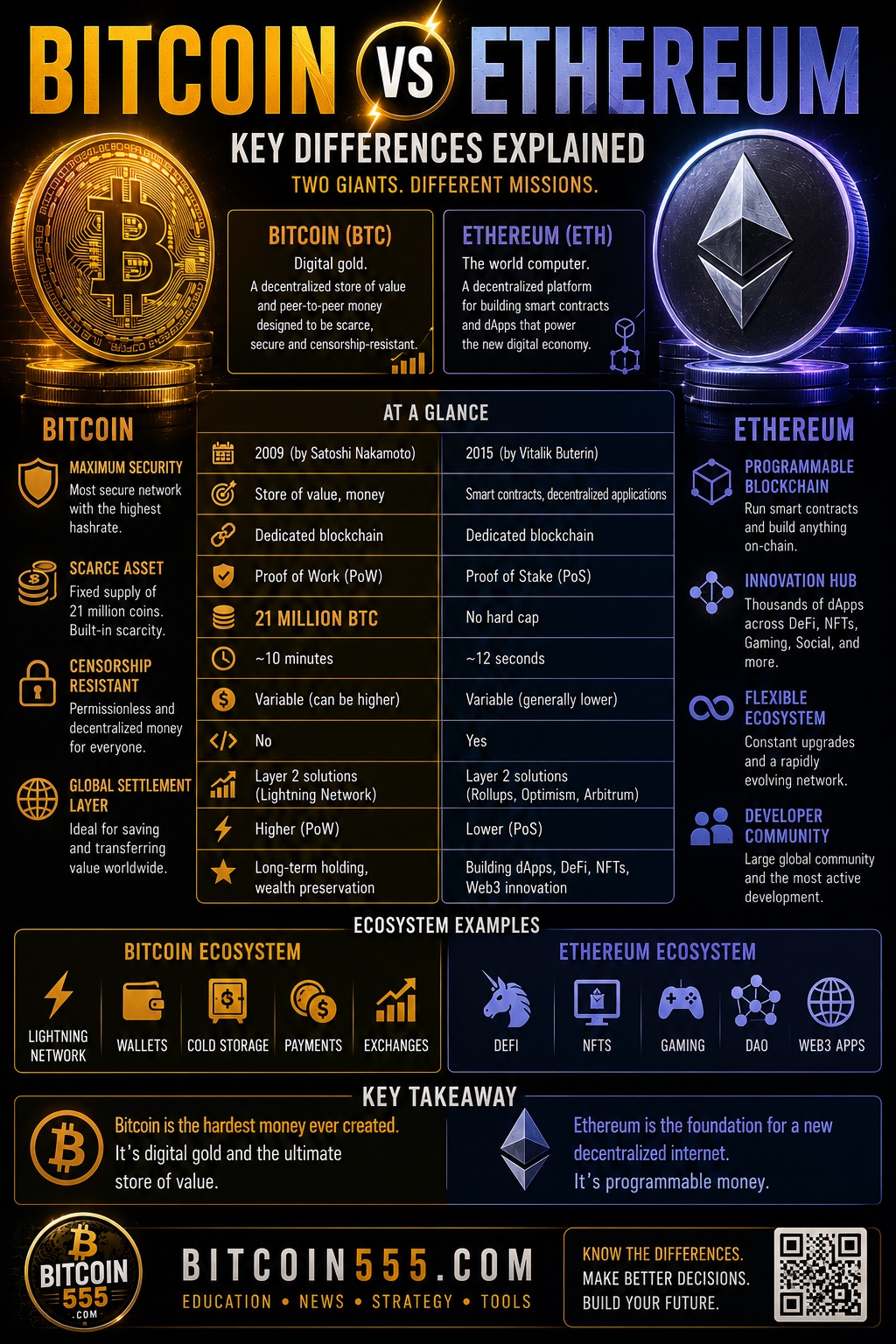
Understanding these differences isn't just academic curiosity—it's essential knowledge for anyone looking to make informed decisions about their digital asset journey. Whether you're considering which to buy, trying to understand blockchain technology, or simply want to speak intelligently about cryptocurrency, grasping what sets Bitcoin and Ethereum apart will serve you well.
In this comprehensive guide, we'll break down the key differences between Bitcoin and Ethereum in plain language. No hype, no tribalism—just a clear-eyed look at what makes each network unique and valuable in its own right.
The Origin Stories: Different Problems, Different Solutions
To truly understand Bitcoin and Ethereum, we need to start with why they were created. Their founding purposes reveal everything about their fundamental differences.
Bitcoin: Digital Sound Money
Bitcoin emerged in 2009, created by the pseudonymous Satoshi Nakamoto in response to the 2008 financial crisis. The goal was revolutionary yet focused: create a peer-to-peer electronic cash system that operates without banks, governments, or any central authority.
Bitcoin was designed to solve a specific problem—the need for trustless, censorship-resistant money. Its creator wanted to build digital gold: a scarce asset with a fixed supply that no one could manipulate, inflate, or confiscate. Every design decision in Bitcoin serves this singular mission.
The Bitcoin network prioritizes:
- Security above all else
- Decentralization to prevent any single point of failure or control
- Immutability so that transaction history cannot be altered
- Predictable monetary policy with a hard cap of 21 million coins
Ethereum: A World Computer
Ethereum launched in 2015, conceived by Vitalik Buterin and a team of co-founders. While Bitcoin proved blockchain technology could work for money, Buterin envisioned something broader: a global computing platform where anyone could build and deploy decentralized applications.
Think of Ethereum as a smartphone operating system for the decentralized world. Just as iOS and Android let developers create apps, Ethereum lets developers create "dApps"—decentralized applications that run on a global network of computers without any company controlling them.
The Ethereum network prioritizes:
- Programmability through smart contracts
- Flexibility for building various applications
- Innovation with regular protocol upgrades
- Functionality as a platform for decentralized finance, NFTs, and more
This fundamental difference in purpose—money versus platform—shapes almost every other distinction between these two networks.
Technical Architecture: Consensus and Security Models
How a blockchain network reaches agreement and maintains security reveals much about its values and trade-offs. Bitcoin and Ethereum have taken notably different paths here.
Bitcoin's Proof of Work
Bitcoin uses Proof of Work (PoW) consensus, where miners compete to solve complex mathematical puzzles using specialized hardware. The winner gets to add the next block of transactions and receives newly minted bitcoin as a reward.
This system has operated continuously since 2009 without a single successful attack on the core protocol. The energy expenditure, often criticized, actually serves as Bitcoin's security budget—making attacks prohibitively expensive.
Key characteristics of Bitcoin's PoW:
- Miners invest real-world resources (electricity, hardware)
- Attack costs are external and measurable
- New blocks arrive approximately every 10 minutes
- Difficulty adjusts every 2,016 blocks to maintain this schedule
- The system has proven extremely robust over more than a decade
Ethereum's Proof of Stake
Ethereum originally used Proof of Work but transitioned to Proof of Stake (PoS) in a major upgrade. In PoS, validators stake their ETH as collateral to participate in block creation. If they behave dishonestly, their stake gets slashed (destroyed).
This approach dramatically reduces energy consumption and changes the security model from external costs (electricity) to internal costs (staked capital).
Key characteristics of Ethereum's PoS:
- Validators lock up ETH as collateral
- Block creation is semi-random among validators
- New blocks arrive approximately every 12 seconds
- Dishonest behavior results in financial penalties
- Lower barrier to entry than mining hardware
Neither system is objectively "better"—they represent different philosophies about security, decentralization, and efficiency. Bitcoin maximizes security through proven, unchanging mechanisms, while Ethereum optimizes for efficiency and environmental considerations.
Monetary Policy: Fixed Scarcity vs. Flexible Supply
Perhaps no difference matters more to long-term holders than how each network handles its native currency's supply. This is where Bitcoin and Ethereum diverge dramatically.
Bitcoin's Hard Cap
Bitcoin has an absolute maximum supply of 21 million coins. This number is enforced by the protocol itself and cannot be changed without overwhelming consensus from the entire network—something that's essentially impossible given Bitcoin's culture and governance.
New bitcoin enters circulation through mining rewards, which halve approximately every four years in events called "halvings." This creates a predictable, decreasing inflation rate:
- 2009-2012: 50 BTC per block
- 2012-2016: 25 BTC per block
- 2016-2020: 12.5 BTC per block
- 2020-2024: 6.25 BTC per block
- And so on until approximately 2140
This fixed supply makes Bitcoin function like digital gold—a scarce asset that cannot be debased. For those interested in understanding how this scarcity has affected Bitcoin's price over time, our Bitcoin vs stocks vs gold comparison tool provides historical perspective on Bitcoin as a store of value.
Ethereum's Flexible Model
Ethereum's monetary policy is more complex and has changed over time. There's no hard cap on total ETH supply, though recent upgrades have introduced mechanisms that can make ETH deflationary under certain conditions.
A fee-burning mechanism destroys a portion of transaction fees, removing ETH from circulation. When network activity is high, more ETH might be burned than created, causing supply to decrease. When activity is low, supply increases.
This flexibility allows Ethereum to adjust its monetary policy to balance security needs with user costs—a feature some view as beneficial adaptability and others see as unpredictable intervention.
Smart Contracts and Programmability
The term "smart contract" gets thrown around constantly in crypto discussions. Understanding what it means and how Bitcoin and Ethereum approach programmability clarifies why these networks serve different purposes.
Ethereum: A Turing-Complete Platform
Ethereum was built from the ground up to support complex smart contracts—self-executing programs that run on the blockchain. These contracts can hold funds, interact with other contracts, and execute complex logic automatically.
This programmability has enabled:
- Decentralized Finance (DeFi): Lending, borrowing, and trading without intermediaries
- Non-Fungible Tokens (NFTs): Unique digital assets for art, collectibles, and more
- Decentralized Autonomous Organizations (DAOs): Community-governed entities
- Token creation: New cryptocurrencies built on Ethereum's infrastructure
- Gaming and metaverse applications: Interactive digital experiences
This flexibility comes with trade-offs. More complexity means more potential for bugs and security vulnerabilities. Smart contract exploits have resulted in significant losses over the years, and the attack surface is inherently larger than simpler systems.
Bitcoin: Intentional Simplicity
Bitcoin's scripting language is deliberately limited. It can handle basic conditions—like multi-signature requirements or time-locked transactions—but can't support the complex applications Ethereum enables.
This isn't a limitation so much as a design choice. Bitcoin developers prioritize security and predictability over flexibility. Every feature added to Bitcoin undergoes years of scrutiny because the stakes of failure are so high.
That said, Bitcoin's programmability is expanding through secondary layers:
- Lightning Network: Enables fast, cheap payments and basic smart contracts
- Sidechains: Separate chains that can add functionality while anchoring to Bitcoin's security
- New opcodes: Gradual, carefully considered additions to Bitcoin's capabilities
The philosophy is to keep Bitcoin's base layer simple and secure while building additional functionality in layers above it.
Transaction Speed, Fees, and Scalability
How fast can you send money? How much will it cost? These practical concerns matter enormously for everyday use.
Base Layer Comparison
On their base layers, both networks face scalability limitations:
Bitcoin:
- Block time: ~10 minutes
- Transactions per second: ~7
- Fees: Variable, can spike during high demand
- Confirmation time: 1-6 blocks recommended (10-60 minutes)
Ethereum:
- Block time: ~12 seconds
- Transactions per second: ~15-30
- Fees: Highly variable based on network congestion
- Confirmation time: Generally faster, but finality takes longer
Neither network can handle Visa-level transaction volumes on their base layer. Both have acknowledged this and developed scaling solutions.
Scaling Approaches
Bitcoin's primary scaling solution is the Lightning Network—a layer 2 system that enables instant, nearly free transactions while settling periodically on the main chain. Lightning is particularly suited for payments and micropayments.
Ethereum pursues a multi-pronged approach including:
- Layer 2 rollups: Networks like Arbitrum and Optimism that bundle transactions
- Sharding: Planned protocol upgrades to increase base layer capacity
- Various scaling technologies: Continuous development of efficiency improvements
For occasional, high-value transactions, both networks work fine at the base layer. For frequent, small transactions, layer 2 solutions on either network provide better user experience.
Governance and Development Philosophy
How decisions get made about protocol changes reveals the soul of each project. Bitcoin and Ethereum have starkly different cultures here.
Bitcoin: Conservative and Decentralized
Bitcoin changes slowly and deliberately. There's no CEO, no foundation with real power, and no roadmap handed down from above. Changes require overwhelming consensus across miners, node operators, developers, and users.
This conservatism frustrates those who want faster innovation but provides assurance to those storing significant value. The rules you're playing by today will likely be the rules tomorrow, next year, and next decade.
Major changes like the SegWit upgrade took years of debate and multiple failed attempts before activation. This is a feature, not a bug—it ensures no small group can alter the protocol to benefit themselves.
Ethereum: Adaptive and Foundation-Guided
Ethereum evolves much more rapidly. The Ethereum Foundation, while not having formal control, significantly influences development direction. Core developers propose and implement changes more readily than in Bitcoin.
This has enabled Ethereum to make dramatic changes—including the shift from Proof of Work to Proof of Stake—that would be nearly impossible in Bitcoin's governance structure.
The trade-off is less predictability. Ethereum's monetary policy has changed multiple times, and future changes remain possible. For those building long-term applications or storing value over decades, this uncertainty matters.
Investment Considerations and Use Cases
With a clear understanding of technical differences, we can examine how each might fit different goals and strategies.
Bitcoin as Digital Gold
Bitcoin's primary use case has evolved toward being a store of value—digital gold for the internet age. Its fixed supply, proven security, and resistance to change make it attractive for:
- Long-term wealth preservation
- Hedge against monetary debasement
- Censorship-resistant savings
- International value transfer without intermediaries
- Portfolio diversification
Those who buy Bitcoin typically plan to hold for years or decades, treating it as a savings technology rather than a speculation.
Ethereum as a Technology Platform
Ethereum's value proposition ties to its utility as a platform. ETH is needed to pay for transactions and interact with applications built on Ethereum. Its value correlates with:
- Adoption of decentralized applications
- DeFi total value locked
- NFT market activity
- Developer activity and innovation
- Enterprise blockchain adoption
Ethereum investors often view it as a bet on the decentralized application ecosystem's growth.
Security Considerations for Both
Regardless of which you choose—or if you hold both—security practices matter enormously. Cryptocurrency ownership means you're responsible for your own security.
For significant holdings, a hardware wallet like Ledger provides essential protection by keeping your private keys offline and away from internet-connected devices. Both Bitcoin and Ethereum are supported by all major hardware wallets, making secure storage straightforward.
If you're purchasing either cryptocurrency, reputable exchanges like Binance offer straightforward on-ramps with multiple payment methods. Just remember: exchanges are for buying, not long-term storage. Move your assets to self-custody once purchased.
Frequently Asked Questions
Can Bitcoin and Ethereum coexist, or will one win?
They serve fundamentally different purposes, so coexistence is likely. Bitcoin functions as digital gold and a monetary network, while Ethereum serves as a platform for decentralized applications. Just as gold and the stock market coexist in traditional finance, Bitcoin and Ethereum can coexist in the digital asset space—each serving different needs and attracting different use cases.
Which is better for beginners to start with?
Bitcoin is generally simpler to understand and hold. Its single purpose—digital money—makes it conceptually cleaner than Ethereum's multi-faceted platform. Many educators recommend starting with Bitcoin to understand blockchain fundamentals, then exploring Ethereum once you're comfortable with basic concepts like wallets, private keys, and blockchain transactions.
Is Ethereum more centralized than Bitcoin?
By most measures, yes. Ethereum has identifiable leaders, a foundation that influences development, and has made dramatic protocol changes through relatively centralized decision-making. Bitcoin's development is more distributed, with no single entity capable of pushing through changes. However, "centralization" exists on a spectrum, and Ethereum remains far more decentralized than traditional financial systems.
Should I own both Bitcoin and Ethereum?
This depends entirely on your goals and beliefs. Some hold only Bitcoin, viewing it as the only truly decentralized cryptocurrency. Others diversify across multiple assets. There's no universally correct answer—understand what each offers, assess your own objectives, and make decisions aligned with your circumstances. Never invest more than you can afford to lose in any cryptocurrency.
Why does Ethereum have gas fees while Bitcoin has transaction fees?
The terminology differs, but both networks charge for transactions. Bitcoin fees pay for transaction data inclusion in blocks. Ethereum's "gas" measures computational work—more complex operations require more gas. Both systems use fees to prevent spam and compensate network validators. The practical experience is similar: you pay fees to transact, and fees rise when networks are congested.
Conclusion: Different Tools for Different Jobs
Bitcoin and Ethereum represent two distinct visions for blockchain technology. Bitcoin aims to be perfect money—unchanging, scarce, and secure above all else. Ethereum aims to be a world computer—flexible, programmable, and constantly evolving.
Neither is objectively superior; they're optimized for different purposes. Understanding this prevents the tribal arguments that often dominate cryptocurrency discussions. You can appreciate Bitcoin's monetary properties while acknowledging Ethereum's innovation in programmable money. You can hold both, hold one, or hold neither—what matters is that your decision comes from understanding rather than hype.
As you continue your cryptocurrency education, focus on fundamentals over price speculation. Learn how these technologies actually work, what problems they solve, and where they might fall short. This knowledge will serve you regardless of where markets go, enabling you to make informed decisions in a space still rife with misinformation and exaggeration.
The differences between Bitcoin and Ethereum aren't going away. If anything, their paths may diverge further as each optimizes for its core purpose. Understanding both puts you ahead of the vast majority of people discussing cryptocurrency—and that understanding is the foundation for everything else in this space.