Imagine you're standing at the edge of a swimming pool. The water looks inviting, but you're not sure how cold it is. You have two choices: jump in all at once and hope for the best, or wade in gradually, letting your body adjust to the temperature step by step. Investing in Bitcoin presents a similar dilemma, and dollar cost averaging is the equivalent of wading in slowly—a methodical, patient approach that has helped countless investors build significant Bitcoin positions without the stress of trying to time the market perfectly.
Bitcoin's price volatility is legendary. In any given year, it's not unusual to see swings of 30%, 50%, or even more in both directions. This volatility creates opportunity, but it also creates risk—particularly the risk of buying at a peak right before a significant correction. Dollar cost averaging (DCA) doesn't eliminate this volatility, but it transforms your relationship with it. Instead of fearing price swings, you learn to embrace them as opportunities.
In this comprehensive guide, we'll explore exactly how dollar cost averaging works, why it's particularly well-suited for Bitcoin investment, and how you can implement your own DCA strategy starting today. Whether you're completely new to Bitcoin or looking to optimize your existing approach, you'll find practical, actionable advice based on sound investment principles.
What Is Dollar Cost Averaging and Why Does It Work?
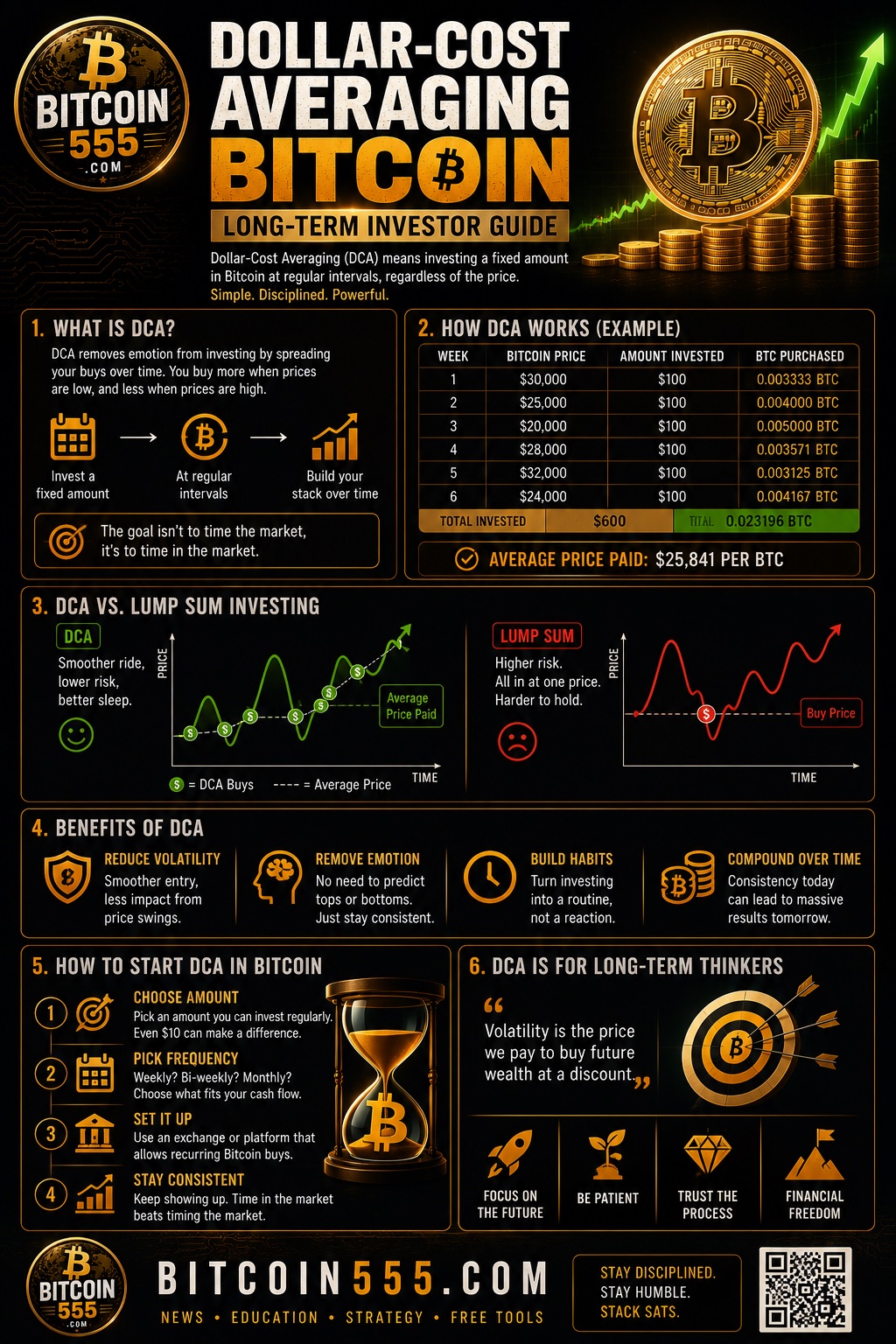
Dollar cost averaging is an investment strategy where you invest a fixed amount of money into an asset at regular intervals, regardless of the asset's price at the time of purchase. Instead of trying to buy low and sell high—a strategy that sounds simple but proves remarkably difficult in practice—you simply buy consistently over time.
Here's a simple example to illustrate how DCA works in practice:
Let's say you decide to invest $200 per month into Bitcoin. In your first month, Bitcoin is priced at $40,000, so your $200 buys you 0.005 BTC. The next month, the price drops to $25,000, and your $200 now buys 0.008 BTC. In the third month, the price recovers to $50,000, and you acquire 0.004 BTC.
After three months, you've invested $600 total and accumulated 0.017 BTC. Your average purchase price works out to approximately $35,294 per Bitcoin—which is actually lower than two of the three monthly prices. This is the mathematical magic of DCA: by buying more units when prices are low and fewer when prices are high, your average cost naturally gravitates toward the lower end of the price range.
The psychological benefits are equally important. DCA removes the emotional burden of decision-making. You don't have to agonize over whether today is a good day to buy or whether you should wait for a dip. Your strategy is predetermined, and you simply execute it mechanically. This discipline protects you from two of the most destructive investor behaviors: panic selling during downturns and FOMO buying during euphoric rallies.
To see how different DCA strategies might have performed historically, try our DCA calculator and experiment with various investment amounts and timeframes.
Why Bitcoin Is Uniquely Suited for Dollar Cost Averaging
While dollar cost averaging can be applied to any investment—stocks, bonds, mutual funds—Bitcoin possesses several characteristics that make it particularly well-suited for this approach.
Volatility Creates Opportunity
Bitcoin's volatility, which scares away many potential investors, actually works in favor of the DCA investor. Greater price swings mean more opportunities to accumulate at lower prices. A stock that trades in a narrow 10% range all year provides little advantage to the DCA investor. But Bitcoin's tendency to experience significant corrections—often 30% or more—creates regular opportunities to buy at discounted prices.
24/7 Market Access
Unlike traditional stock markets that operate during limited hours on weekdays, Bitcoin trades around the clock, every day of the year. This means you can set up automated purchases to execute at any time that suits your schedule, and you're never locked out of the market.
Infinite Divisibility
You can buy any fraction of a Bitcoin, down to 0.00000001 BTC (one satoshi). This means DCA works with any budget—whether you're investing $10 per week or $10,000 per month. Traditional assets like real estate or even some stocks require minimum investments that exclude smaller investors. Bitcoin's divisibility democratizes access.
Long-Term Fundamental Thesis
DCA works best when you have conviction in an asset's long-term trajectory. Bitcoin's fundamental proposition—a decentralized, scarce, censorship-resistant store of value—provides a compelling long-term thesis that many investors find worth betting on over multi-year timeframes. The fixed supply cap of 21 million bitcoins creates a scarcity dynamic that differs fundamentally from fiat currencies subject to unlimited printing.
Setting Up Your Bitcoin DCA Strategy: A Step-by-Step Guide
Implementing a Bitcoin DCA strategy is straightforward, but attention to detail will help you execute it efficiently and securely.
Step 1: Determine Your Investment Amount
Start by assessing your financial situation honestly. Your DCA amount should be money you can comfortably invest without needing it for at least five years. Consider the following guidelines:
- Never invest money you need for emergencies, rent, or other essential expenses
- Start with an amount small enough that you won't be tempted to stop during bear markets
- Consider allocating a fixed percentage of each paycheck rather than an arbitrary dollar amount
A common starting point is 5-10% of discretionary income. If your monthly budget allows $500 for savings and investments, allocating $50-$100 to Bitcoin DCA is a reasonable starting position.
Step 2: Choose Your Investment Frequency
Most DCA investors choose one of these frequencies:
- Weekly: More frequent purchases mean better smoothing of volatility. Ideal for those who receive weekly paychecks.
- Bi-weekly: Aligns well with typical pay schedules. A practical middle ground.
- Monthly: Simpler to track and manage. Slightly less effective at smoothing volatility but still highly effective.
Research suggests that for volatile assets like Bitcoin, more frequent purchases (weekly) provide slightly better average prices over time. However, the difference is usually marginal, and consistency matters more than frequency. Choose a schedule you'll actually stick with.
Step 3: Select a Reliable Exchange
You need a reputable cryptocurrency exchange that supports automated recurring purchases. When evaluating exchanges, consider:
- Fee structure: Look for competitive trading fees, especially for smaller recurring purchases where fees can significantly impact returns
- Automation features: Ensure the platform supports automatic recurring purchases so you don't have to remember to buy manually
- Security practices: Research the exchange's security history, insurance coverage, and cold storage policies
- Withdrawal options: Confirm you can easily withdraw your Bitcoin to your own wallet
Binance, for example, offers a recurring buy feature that allows you to automate purchases on your preferred schedule with competitive fees. Setting up automatic bank transfers combined with automatic Bitcoin purchases creates a truly hands-off system.
Step 4: Set Up Automatic Purchases
Once you've funded your exchange account, navigate to the recurring purchase or auto-invest feature. Configure the following:
- The amount to invest each period
- The frequency (daily, weekly, monthly)
- The specific day and time for execution
- Your funding source (bank account, deposited funds, etc.)
Pro tip: Schedule your purchases shortly after your regular paycheck deposits. This ensures funds are available and reduces the temptation to spend that money elsewhere.
Step 5: Withdraw to Self-Custody
This step is critical and often overlooked by new investors. Leaving your Bitcoin on an exchange exposes you to counterparty risk—the risk that the exchange could be hacked, go bankrupt, or freeze your account. The cryptocurrency industry has seen multiple high-profile exchange failures that resulted in customers losing their funds.
The solution is self-custody: holding your own private keys using a hardware wallet. A hardware wallet like a Ledger device stores your private keys offline, protected from online threats. Even if your computer is compromised, your Bitcoin remains secure because the keys never leave the device.
Consider establishing a withdrawal schedule—perhaps monthly or quarterly—where you move accumulated Bitcoin from your exchange to your hardware wallet. This balances security with practicality, as very frequent small withdrawals can accumulate significant transaction fees.
Common DCA Mistakes and How to Avoid Them
Even simple strategies can go wrong. Here are the most common pitfalls DCA investors encounter:
Stopping During Bear Markets
This is the cardinal sin of dollar cost averaging. Bear markets—when prices are declining—are precisely when DCA provides the most benefit. You're accumulating more Bitcoin for the same dollar amount. Investors who stop buying during downturns and resume during rallies are doing the exact opposite of what makes DCA effective.
Solution: Automate your purchases completely and resist the urge to check your portfolio constantly. The less you intervene, the better.
Investing Money You Can't Afford to Lose
If you might need your invested funds within the next few years, a market downturn could force you to sell at a loss. This transforms a temporary paper loss into a permanent realized loss.
Solution: Only DCA with money you genuinely don't need for at least five years, preferably longer.
Neglecting Security
Some investors diligently accumulate Bitcoin over months or years, only to lose it to hackers, scams, or exchange failures because they never took custody of their own keys.
Solution: Invest in a reputable hardware wallet like Ledger and learn proper security practices. The cost of a hardware wallet is trivial compared to the Bitcoin you're protecting.
Overcomplicating the Strategy
Some investors try to enhance their DCA by buying extra during dips or skipping purchases when prices seem high. While this sounds logical, it reintroduces the market timing element that DCA is designed to eliminate—along with all its psychological challenges.
Solution: Trust the process. Stick to your predetermined schedule regardless of price action.
Ignoring Tax Implications
Every Bitcoin purchase creates a tax lot with its own cost basis. Depending on your jurisdiction, you may need to track each purchase for capital gains calculations when you eventually sell.
Solution: Use portfolio tracking software from the beginning, and maintain records of all your DCA purchases including dates, amounts, and prices.
Building a Long-Term DCA Portfolio: Time Horizons and Expectations
Understanding realistic time horizons is essential for DCA success. Bitcoin operates in roughly four-year cycles, influenced by halving events that reduce the new supply entering the market. These cycles have historically included both dramatic bull markets and painful bear markets.
Short-Term (1-2 Years)
Over short periods, DCA may or may not outperform a lump sum investment—it depends entirely on whether prices trend up or down during your investment window. If you begin DCA just before a major rally, you'll wish you had invested everything immediately. If prices decline after you start, you'll be grateful for the gradual approach.
The key insight: over short periods, DCA is primarily a risk management tool, not necessarily a return optimization tool.
Medium-Term (3-5 Years)
This timeframe typically encompasses at least one full Bitcoin market cycle. DCA investors who maintain discipline through an entire cycle—accumulating through bear markets and holding through bull markets—have historically seen significant portfolio appreciation. The bear market accumulation becomes rocket fuel for the subsequent bull market.
Long-Term (5-10+ Years)
For investors with decade-long horizons, DCA becomes a wealth-building strategy rather than just a risk management technique. Multiple cycles allow for substantial accumulation, and compound growth can produce meaningful results.
Consider this hypothetical scenario: An investor who DCA'd $100 weekly for ten years would have invested $52,000 total. Depending on Bitcoin's price trajectory, this disciplined approach could result in a portfolio worth substantially more than the invested principal—though of course, past performance never guarantees future results.
Advanced DCA Variations Worth Considering
Once you've mastered basic DCA, you might explore these variations:
Value Averaging
Instead of investing a fixed dollar amount, you adjust your purchases based on your portfolio's current value relative to a target trajectory. If your portfolio falls behind target, you invest more. If it's ahead of target, you invest less or even sell small amounts. This approach requires more active management but can improve risk-adjusted returns.
Stack Sats
This philosophy focuses on accumulating satoshis (sats) rather than thinking in Bitcoin or dollar terms. Since one Bitcoin equals 100 million satoshis, even small purchases accumulate meaningful sat balances. This psychological reframe helps investors maintain consistency regardless of Bitcoin's dollar price.
Lifecycle Allocation
Younger investors with longer time horizons might allocate more aggressively to Bitcoin, while those approaching retirement might maintain smaller positions. Your DCA amount could adjust based on life stage, risk tolerance, and overall portfolio composition.
Frequently Asked Questions About Bitcoin DCA
What is the ideal amount to DCA into Bitcoin?
There's no universal ideal amount—it depends entirely on your financial situation, risk tolerance, and investment goals. Most financial advisors suggest that cryptocurrency should comprise no more than 5-20% of a diversified investment portfolio. Within that allocation, start with an amount that feels sustainable through both bull and bear markets. It's better to start smaller and remain consistent than to start aggressively and quit when prices decline.
Is it better to DCA weekly or monthly?
Both approaches work well, and the difference in outcomes is typically marginal over long time periods. Weekly DCA provides slightly better smoothing of volatility, but monthly DCA is simpler to manage and may involve lower total fees depending on your exchange. The most important factor is consistency—choose the frequency you're most likely to maintain indefinitely.
Should I stop DCA during a bear market?
Absolutely not—bear markets are precisely when DCA provides the greatest benefit. Your fixed dollar amount purchases more Bitcoin when prices are low, significantly reducing your average cost basis. Many successful Bitcoin investors point to bear market accumulation as the foundation of their gains during subsequent bull markets. The psychological challenge is real, but maintaining discipline during downturns is what separates successful long-term investors from the crowd.
How long should I continue my Bitcoin DCA strategy?
The beauty of DCA is that it can continue indefinitely. Many investors plan to DCA throughout their working years, treating Bitcoin as a long-term savings vehicle alongside traditional retirement accounts. Your exit strategy should be based on your personal financial goals rather than trying to time the market. Some investors gradually reduce their DCA as they accumulate their target Bitcoin position, while others continue indefinitely, viewing each purchase as an improvement to their long-term financial resilience.
What fees should I expect when dollar cost averaging Bitcoin?
Exchange trading fees typically range from 0.1% to 1.5% per transaction, with some platforms charging higher fees for smaller purchases or instant-buy features. For frequent DCA purchases, these fees can add up significantly. Shop around for platforms with competitive fee structures for recurring purchases, and factor withdrawal fees into your calculations when moving Bitcoin to self-custody.
Conclusion: The Disciplined Path to Bitcoin Accumulation
Dollar cost averaging won't make you rich overnight, and it won't protect you from all downside risk. What it will do is provide a structured, emotionally manageable framework for building a Bitcoin position over time. By removing the pressure of market timing, DCA allows you to participate in Bitcoin's potential upside while sleeping soundly at night.
The most successful DCA investors share common traits: they started with amounts they could afford to lose, they automated their purchases to remove emotional decision-making, they secured their Bitcoin with proper self-custody, and most importantly, they maintained discipline through the inevitable market volatility.
Your journey begins with a single purchase. Set up your first automated buy, transfer your accumulated Bitcoin to a secure hardware wallet, and then practice the most challenging skill of all: patience. The market will test your resolve with both terrifying crashes and euphoric rallies. Through it all, your DCA strategy remains constant—steady, mechanical, and ultimately, effective.
The best time to start dollar cost averaging was years ago. The second best time is today.