Every eight hours, billions of dollars quietly change hands between traders on crypto derivatives exchanges — and most retail traders have no idea it's happening to them. I learned about funding rates the expensive way: I once held a leveraged long through a euphoric market phase and watched roughly 0.9% of my position bleed away in funding payments over three days while the price went nowhere. The trade was flat. My account wasn't.
Funding rates are one of the most underrated tools in crypto trading. They're a cost, a signal, and occasionally an income stream — all at once. If you trade perpetual futures without understanding funding, you're playing poker without looking at your own cards. This guide covers how funding rates actually work, how to read them as a sentiment gauge, and the specific ways experienced traders build them into entries, exits, and even market-neutral strategies.
What Are Funding Rates and Why Do They Exist?
Perpetual futures — "perps" — are the most traded instruments in crypto. Unlike traditional futures, they never expire. That creates a problem: without an expiry date forcing convergence, the perp price could drift far away from the spot price and stay there.
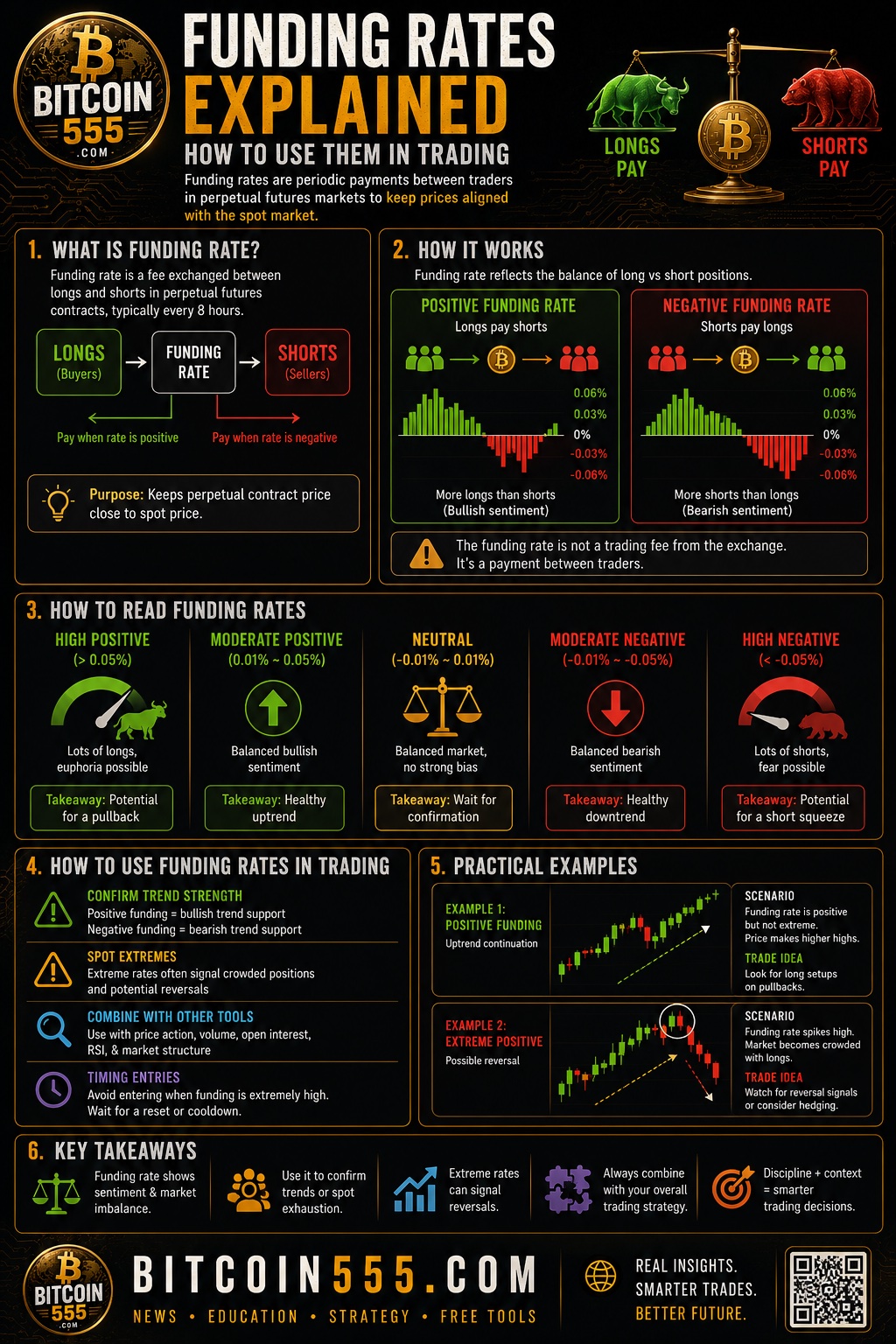
Funding rates are the mechanism that solves this. Here's the core logic:
- When the perp trades above spot (traders are aggressively long), the funding rate is positive. Longs pay shorts. This makes holding longs expensive and incentivizes shorting, pushing the perp price back down toward spot.
- When the perp trades below spot (traders are aggressively short), the funding rate is negative. Shorts pay longs. This punishes shorts and rewards longs, pulling the perp back up.
Critically, the exchange doesn't collect funding. It's a peer-to-peer payment between traders on opposite sides of the market. On most major venues, including Binance, funding is exchanged every 8 hours — at 00:00, 08:00, and 16:00 UTC. Some exchanges use 1-hour or 4-hour intervals, so always check the specifics of your venue.
The payment itself is simple: funding payment = position notional value × funding rate. If you hold a $50,000 long position and the funding rate for that interval is +0.01% (a typical "neutral" baseline on many exchanges), you pay $5. Sounds trivial. It isn't — and I'll show you why with real numbers below.
How Funding Rates Are Calculated
You don't need to compute funding by hand — the exchange displays the current and predicted rate — but understanding the components helps you interpret what you're seeing.
Most exchanges calculate funding from two parts:
- The premium index: the difference between the perpetual's price and the spot index price, sampled continuously throughout the funding interval. If perps consistently trade 0.05% above spot, the premium component pushes funding positive.
- The interest rate component: a fixed baseline, usually 0.01% per 8 hours on major exchanges. This is why funding sits at +0.01% in calm, balanced markets rather than at zero.
What matters for practical trading:
- +0.01% per 8 hours is neutral. That annualizes to roughly 10.95% — the baseline cost of holding a long perp position in a normal market.
- +0.05% to +0.1% per 8 hours is elevated. Annualized, +0.1% per interval is about 109% per year. The market is heavily long.
- Negative funding is relatively rare and meaningful. It usually appears during sharp sell-offs or sustained fear, when shorts dominate.
The annualization math is worth internalizing: multiply the 8-hour rate by 3 (payments per day) and then by 365. A rate of +0.03% per 8 hours = 0.09% per day = roughly 32.9% per year. If your directional thesis needs weeks to play out, that's a serious headwind.
Funding Rates as a Market Sentiment Indicator
This is where funding becomes genuinely useful, even if you never touch a perpetual contract. Funding is a real-time, money-weighted poll of trader positioning. Unlike social media sentiment, people are paying real dollars to express these opinions.
What extreme positive funding tells you
When funding across major exchanges climbs to +0.08% or higher per interval and stays there, the market is crowded long, usually with leverage. Crowded leveraged positioning is fragile. It doesn't mean the price must fall — strong trends can sustain elevated funding for surprisingly long stretches — but it means:
- Any dip will trigger cascading long liquidations, amplifying downside moves.
- Longs are paying a heavy carrying cost, so weak hands get shaken out even in sideways price action.
- The marginal buyer may already be positioned. Who's left to buy?
I treat sustained extreme positive funding as a yellow flag for new longs and a green light to tighten stops on existing ones. It is not, on its own, a short signal — shorting into a strong uptrend because funding is high is how accounts die.
What negative funding tells you
Deeply negative funding — say -0.05% per interval or lower during a panic — means shorts are crowded and paying to stay short. Historically, some of the best swing-long entries in crypto have occurred when funding was persistently negative while price stopped making new lows. The sellers are exhausted, they're paying rent on their positions, and any bounce forces them to cover.
The pattern I look for: price makes a lower low, funding stays negative, but price reclaims a key level within a day or two. That divergence — bearish positioning, resilient price — is one of the more reliable setups in this market.
Practical Strategy 1: Funding-Aware Directional Trading
Here's how funding changes a real trade. Two examples with concrete numbers.
Example A: The long that funding kills
Suppose you want to swing long BTC perps with a $10,000 account, risking 2% ($200) per trade.
- Entry: $60,000
- Stop loss: $57,600 (-4%)
- Target: $67,200 (+12%) — a 3:1 reward-to-risk trade
- Position size: risk $200 across a 4% stop = $5,000 notional (0.0833 BTC)
Now assume funding is running hot at +0.08% per 8 hours and your thesis takes three weeks to play out. That's 63 funding intervals: 63 × 0.08% = 5.04% of notional, or about $252 on your $5,000 position. Your funding cost exceeds your entire planned risk on the trade. If price chops sideways for two of those three weeks, you're down $170+ in funding before the market even decides. Your true R:R is no longer 3:1 — after funding drag on the full holding period, it's closer to 2.2:1, and worse if you get stopped after paying weeks of funding.
The fix: when funding is elevated and your timeframe is long, either buy spot instead of perps, or accept that the trade must work quickly. I set a rule years ago: if annualized funding exceeds ~40% against my direction, I don't hold that perp position for more than a few days.
Example B: The funded short entry
Flip it. Market has rallied 25% in ten days, funding across exchanges sits at +0.1% per interval, open interest is at highs, and price prints a rejection at a major resistance level.
- Entry: short at $68,000 after the rejection candle closes
- Stop loss: $70,040 (+3%, above the rejection high)
- Target: $61,880 (-9%) — 3:1 R:R
- Position size: $200 risk / 3% stop = $6,667 notional
Here funding works for you. At +0.1% per interval, you collect roughly 0.3% per day — about $20/day on this position — while you wait. If the trade takes a week, that's ~$140 of funding income cushioning the position. If longs get liquidated in a cascade, your target may be hit in hours. The crowded positioning that made longs fragile becomes your edge. Note: I still needed a technical trigger (the rejection at resistance). Funding told me the market was fragile; price action told me when.
Practical Strategy 2: The Cash-and-Carry Funding Trade
This is the market-neutral approach that funds and sophisticated traders use to harvest funding directly. The structure:
- Buy spot BTC — say 1 BTC at $60,000 on Binance.
- Short 1 BTC of perpetual futures at the same time, same notional.
- Your directional exposure is zero. Price up, price down — the legs offset.
- You collect funding on the short leg whenever funding is positive.
If funding averages +0.03% per 8 hours over a quarter, you earn roughly 0.09% per day, about 8% over 90 days on the notional — with no directional risk. During euphoric periods when funding averages +0.06–0.1%, annualized yields on this structure have historically reached 20–50%+.
The honest caveats, because this trade is not free money:
- Funding can flip negative. Then you're paying on the short leg. You must monitor and be willing to unwind.
- Liquidation risk on the short leg. If price rips upward, your spot gains offset the perp loss on paper — but the perp leg needs margin. Keep leverage low (2x or less on the short leg) and keep collateral topped up, or a violent rally liquidates your short and leaves you naked long at the top of a move.
- Execution and fees matter. Entering and exiting both legs costs maybe 0.1–0.2% round trip. If funding normalizes quickly, fees eat the edge.
- Exchange risk. Your capital sits on the exchange. This is a real, non-trivial risk in crypto. Only allocate what you'd accept losing to a platform failure, and keep long-term holdings that aren't part of active strategies in self-custody on a Ledger hardware wallet, not on any exchange.
For most retail traders, the carry trade makes sense only in periods of sustained high funding, with modest size, and with strict margin discipline. If your real goal is long-term accumulation rather than yield harvesting, systematic spot buying is simpler and has no liquidation risk — you can model what a steady accumulation plan would have looked like with our free DCA calculator.
Reading Funding Across Exchanges and Assets
A few refinements that separate casual funding-watchers from traders who actually use the data:
- Compare venues. If funding is extreme on one exchange but normal elsewhere, it's often a local positioning quirk, not a market-wide signal. Market-wide extremes across Binance, Bybit, OKX, and others carry far more weight.
- Altcoin funding is more extreme and more informative. Alt perps regularly print funding of ±0.3% per interval during manias and panics — that's over 300% annualized. When a mid-cap altcoin pumps 80% and funding hits +0.3%, longs are paying nearly 1% per day to stay in. Those moves almost always end in violent flushes. Conversely, deeply negative alt funding during capitulation marks zones where short squeezes ignite.
- Watch the trend of funding, not just the level. Funding rising steadily during an uptrend is normal. Funding spiking vertically while price stalls is a warning. Funding staying elevated after a 10% correction means longs haven't capitulated — the flush may not be done.
- Pair funding with open interest. High funding + rising open interest = new leveraged longs piling in (fragile). High funding + falling open interest = positions closing, pressure releasing. The combination tells you far more than either metric alone.
Common Mistakes Traders Make With Funding Rates
I've made most of these personally. Learn from my tuition payments:
- Ignoring funding entirely on multi-week holds. The single most common error. Traders calculate their R:R on price alone and then wonder why a breakeven trade lost 3%. If you hold perps, funding is part of your cost basis. Period.
- Using extreme funding as a standalone reversal signal. Funding stayed elevated for weeks during past strong trends. Fading high funding without a price-based trigger — a failed breakout, a rejection, a structure break — is fighting momentum with a statistic. Wait for price confirmation.
- Forgetting that funding is charged on notional, not margin. With 10x leverage, a 0.05% funding rate on your notional is 0.5% of your actual margin per interval — 1.5% of your capital per day. Leverage multiplies funding drag exactly as it multiplies everything else.
- Running the carry trade with too much leverage on the short leg. A 3x-leveraged short leg gets liquidated on a ~30% rally. Crypto does 30% rallies. Use 1.5–2x maximum and monitor margin daily.
- Chasing negative funding "free money" longs in a crashing market. Getting paid 0.2% per day to be long means nothing when price drops 8% in an afternoon. Funding income never outruns a real trend against you.
- Not checking the funding interval and timing. Funding is paid to whoever holds the position at the timestamp. Some scalpers close positions just before funding and re-enter after; whether that's worth the spread and fees depends on the rate. At minimum, know when your next payment hits.
- Keeping strategy capital and long-term holdings in the same place. Trading capital lives on the exchange out of necessity. Your long-term stack shouldn't. Hardware wallet, cold storage, done.
Frequently Asked Questions About Funding Rates
Do I pay funding if I only trade spot?
No. Funding rates apply exclusively to perpetual futures positions. Spot holders neither pay nor receive funding. This is a genuine argument for spot over perps when your holding period is measured in weeks or months — no funding drag, no liquidation risk, and you can withdraw to self-custody.
Is high positive funding always bearish?
No. It means longs are crowded and paying to stay in, which makes the market fragile — but strong uptrends can sustain elevated funding for extended periods while price keeps climbing. Treat it as context that raises the odds of sharp pullbacks and lowers the quality of fresh long entries, not as a sell signal by itself. Always combine it with price structure.
How much does funding actually cost over time?
At the neutral baseline of +0.01% per 8 hours, holding a long perp costs about 0.03% per day — roughly 11% annualized on notional. At +0.05% per interval, it's about 55% annualized. Multiply by your leverage to see the drag on your actual margin. On a $20,000 notional position at +0.05%, you pay $30 per day. Over a month, that's $900 — enough to turn a winning trade into a loser.
Can I make consistent income just from collecting funding?
The cash-and-carry structure (long spot, short perp) generates income when funding is positive, and it has produced solid returns during high-funding regimes. But it requires active margin management, carries liquidation risk on the short leg, exposes your capital to exchange risk, and yields little during calm markets when funding sits near baseline. It's a legitimate strategy, not passive income.
Where can I check funding rates?
Every derivatives exchange displays the current and predicted funding rate directly on the trading interface — on Binance it's shown next to the contract name along with a countdown to the next payment. Several free analytics sites also aggregate funding across exchanges, which is useful for spotting market-wide extremes versus single-venue anomalies.
Conclusion: Make Funding Work For You, Not Against You
Funding rates are the heartbeat of the perpetual futures market — a continuous, money-weighted reading of who's positioned where and how badly they want to be there. Most traders experience funding only as a mysterious line item eating their PnL. You now know better.
The practical takeaways: always price funding into your R:R on any perp trade held more than a day or two. Use market-wide funding extremes as context — a fragility warning when euphoric, a squeeze-fuel indicator when fearful — but demand price confirmation before acting. Consider the carry trade only with low leverage and eyes open to exchange risk. And keep a hard wall between trading capital on the exchange and long-term holdings in cold storage on a hardware wallet.
Funding won't hand you a trading edge by itself. Nothing does. But it's one of the few data points in crypto where participants pay real money to reveal their positioning — and traders who read it correctly stop being the ones quietly paying everyone else every eight hours.
Disclaimer: This article is for educational purposes only and is not financial advice. Trading cryptocurrencies involves substantial risk of loss. Never trade with money you cannot afford to lose.