I blew up my first futures account in eleven days. It wasn't a hack, it wasn't an exchange collapse, and it wasn't bad luck. It was 50x leverage on a position I was "sure" about, a 2% move against me, and a liquidation email that arrived while I was asleep. That lesson cost me about $4,000, and it was the cheapest expensive lesson of my trading career. Because here's the truth nobody selling you trading courses wants to say out loud: leverage doesn't make you a better trader — it makes your existing mistakes bigger and faster.
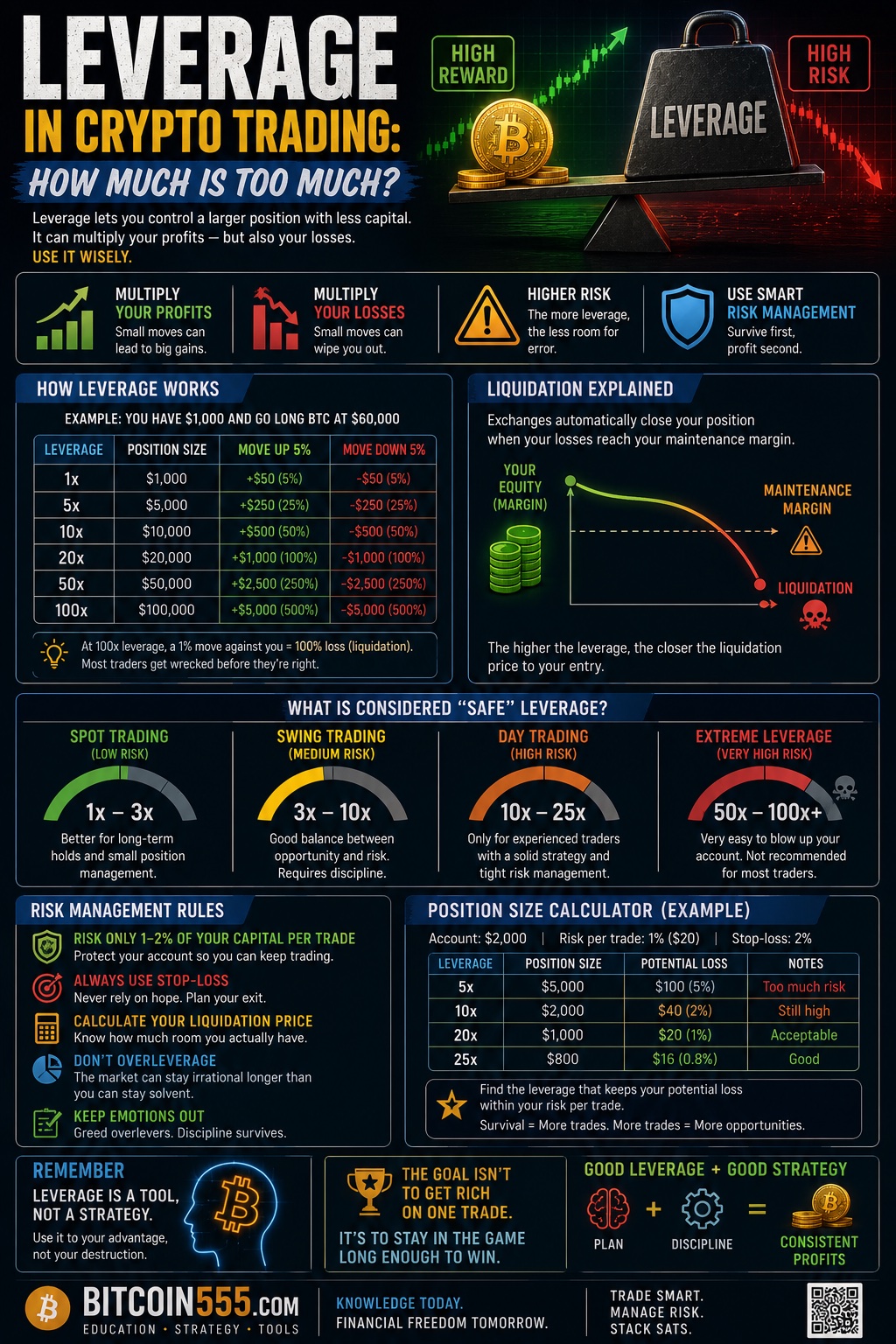
Crypto exchanges will happily hand you 50x, 100x, even 125x leverage. That's not a feature designed for your benefit. It's a feature designed for their liquidation engine. In this article, I'll walk you through how leverage actually works in crypto, the math behind liquidations, how much leverage professional traders really use (spoiler: far less than you think), and how to size positions so a single bad trade never ends your account.
What Leverage Actually Is (And What It Isn't)
Leverage lets you control a position larger than your account balance. If you have $1,000 and open a position at 10x leverage, you're controlling $10,000 worth of Bitcoin or whatever asset you're trading. Your profits are calculated on the full $10,000 — and so are your losses.
Here's the part beginners consistently misunderstand: leverage is not a multiplier on your skill. It's a multiplier on your exposure. If Bitcoin moves 1% in your favor on a 10x position, you make 10% on your margin. If it moves 1% against you, you lose 10%. Move that to 50x and a 2% adverse move wipes out 100% of your margin. You're liquidated. Game over on that position.
Crypto is an asset class where 3-5% daily moves are routine and 10%+ moves happen multiple times a month. Now overlay 50x leverage on that volatility. You're not trading anymore — you're buying lottery tickets where the house also gets to burn your ticket if the number wobbles.
There's another subtlety: on most perpetual futures platforms, including Binance Futures, you also pay funding rates — periodic payments between longs and shorts. On a heavily leveraged position held for days, funding can quietly eat 0.03-0.1% of your notional position every 8 hours. That's a real cost most new traders never factor in.
The Liquidation Math Nobody Reads Before It's Too Late
Let's get concrete, because vague warnings don't stick. Here's roughly how far price needs to move against you before liquidation, ignoring fees and maintenance margin for simplicity (real liquidation happens slightly sooner):
- 2x leverage: ~50% adverse move to liquidate
- 5x leverage: ~20% adverse move
- 10x leverage: ~10% adverse move
- 20x leverage: ~5% adverse move
- 50x leverage: ~2% adverse move
- 100x leverage: ~1% adverse move
Read that last line again. At 100x, a 1% wick against you — the kind of wick that happens during a routine liquidity sweep, a thin weekend order book, or a single large market sell — destroys your entire margin. You don't even need to be wrong about direction. You can call the trade perfectly, get stopped into liquidation by a 60-second wick, and watch price go exactly where you predicted. Without you.
This is the core reason high leverage fails even for traders with genuine edge: crypto's normal noise exceeds your liquidation buffer. Bitcoin's average true range on many days is 2-4%. Altcoins are worse. Using 50x leverage means the market's background static alone is enough to kill your position.
A Real-Numbers Liquidation Example
Say you open a long on BTC at $60,000 with $1,000 margin at 25x leverage. Your position size is $25,000 (about 0.4167 BTC). Your approximate liquidation price sits around $57,700 — roughly 3.8% below entry once maintenance margin is included.
Bitcoin dips 4% on a random Tuesday — no news, just a whale rotating positions. You're liquidated at a $1,000 loss. Two hours later, BTC reclaims $60,000 and rallies to $63,000 by the weekend. Your directional thesis was correct. You still lost everything on the trade. That's leverage in crypto: being right isn't enough. You have to be right and survive the path.
How Much Leverage Do Professional Traders Actually Use?
Here's what a decade around trading desks and serious independent traders has taught me: the traders who last measure risk in terms of account percentage per trade, not leverage multiples. Leverage becomes a tool for capital efficiency, not a way to gamble bigger.
Most consistently profitable crypto traders I know operate with effective leverage between 1x and 5x, and many rarely exceed 3x. Note the word "effective" — that's the position size relative to total account equity, not the number on the exchange slider. You can select "20x" on Binance but only use 10% of your account as margin, giving you effective leverage of 2x on your total capital. The slider setting mostly determines your liquidation distance; your real risk comes from position size and stop placement.
Here's my honest breakdown of what different leverage levels mean in practice:
- 1x-2x effective leverage: Sustainable for swing trades held days to weeks. Liquidation is essentially off the table if you're not overexposed. This is where most of your trading should live.
- 3x-5x: Acceptable for short-term trades with tight, well-defined invalidation and a clear catalyst. Requires disciplined stops. This is the practical ceiling for most retail traders.
- 10x: Scalping territory. Only justified on very short timeframes, small position sizes, and stops measured in fractions of a percent. Most people using 10x shouldn't be.
- 20x and above: This is not trading. At these levels, exchange fees, funding, slippage, and random wicks form a mathematical headwind that grinds down even skilled traders. The exchanges publish liquidation data for a reason — billions get liquidated during volatile weeks, and the overwhelming majority of it is over-leveraged retail longs and shorts.
Position Sizing: The Question That Actually Matters
Stop asking "how much leverage should I use?" and start asking "how much of my account am I risking on this trade?" Get that question right and the leverage number becomes almost irrelevant — it's just a tool to achieve your intended risk.
The rule that has kept me solvent through multiple bear markets: risk 1-2% of account equity per trade, maximum. Not 1-2% margin — 1-2% actual loss if your stop is hit.
Worked Example: Sizing a Trade Properly
Account size: $10,000. Maximum risk per trade: 1% = $100.
Setup: BTC is consolidating above support. You want to go long at $58,000 with a stop loss at $56,840 — a 2% stop below the structure that invalidates your idea. Your target is $61,480, a 6% move, giving you a 3:1 reward-to-risk ratio.
Position size math: Risk per trade ÷ stop distance = $100 ÷ 2% = $5,000 position (about 0.0862 BTC).
Now — how do you fund a $5,000 position from a $10,000 account? Options:
- Use $5,000 of margin at 1x (spot or low-leverage futures)
- Use $1,000 of margin at 5x
- Use $500 of margin at 10x
In all three cases your risk is identical: $100 if the stop hits. The leverage slider changed nothing about your risk — only about how much collateral is locked up and where your liquidation price sits. The higher the leverage setting, the closer liquidation creeps to your stop, which matters during fast moves when stops can slip. This is why I typically use the lowest leverage setting that gives me reasonable capital efficiency, keeping my liquidation price far beyond my stop loss.
Outcomes on this trade: stop hit = -$100 (-1% of account). Target hit = +$300 (+3% of account). At 3:1 R:R, you only need to win about 30% of your trades to break even, and a 40-45% win rate makes you solidly profitable. That's a realistic edge. Needing to win 70% of trades because your risk-reward is inverted is not.
The Survival Math That Makes This Non-Negotiable
Losses require disproportionate gains to recover:
- Lose 10% → need 11.1% to recover
- Lose 25% → need 33.3%
- Lose 50% → need 100%
- Lose 80% → need 400%
Risking 1% per trade, a brutal 10-trade losing streak costs you about 9.6% of your account. Painful, fully recoverable. Risking 10% per trade — which is what casual high-leverage traders effectively do — the same streak leaves you down 65%, needing a near-triple just to get back to even. Streaks of 8-10 losses happen to good traders. Your sizing must assume they will happen to you.
When Higher Leverage Actually Makes Sense
I'm not anti-leverage. I'm anti-suicide. There are legitimate use cases for moderate leverage:
- Capital efficiency: Keeping most of your capital off-exchange (cold storage, yield, or simply safe) while using a small margin balance to express trades. If you only keep $2,000 on the exchange but trade positions sized as if from a $10,000 book, you're using leverage to reduce counterparty risk, not to gamble.
- Hedging: Shorting futures at 2-3x against a long-term spot bag lets you protect gains during downtrends without selling your holdings (and possibly triggering tax events, depending on your jurisdiction).
- Tight-stop scalps: If your stop is 0.4% away on a lower-timeframe setup, 5-10x leverage on a small margin allocation produces a normal-sized risk. The tight invalidation is what justifies the leverage — never the other way around.
Notice the pattern: in every legitimate case, leverage serves a defined risk plan. It never replaces one.
And keep your trading capital separate from your long-term holdings. My structure is simple: a defined trading account on Binance for active positions, and long-term Bitcoin secured on a Ledger hardware wallet where no margin call, no liquidation engine, and no moment of 3 a.m. weakness can touch it. Coins in cold storage cannot be revenge-traded. If your goal is long-term accumulation rather than active trading, honestly, systematic buying usually beats leveraged punting — run the numbers yourself with a DCA calculator and compare it to your futures PnL history. For many traders, that comparison is humbling.
Common Leverage Mistakes That Destroy Accounts
After years of watching traders (myself included) donate money to liquidation engines, these are the recurring killers:
- Maxing the leverage slider because it's there. Exchanges default to offering high leverage because liquidations are profitable for the ecosystem. The slider is not a suggestion of what's reasonable.
- Trading without a stop loss and "watching it." You will not watch it at 4 a.m. Crypto trades 24/7; you don't. Every leveraged position needs a hard stop on the exchange, placed the moment you enter.
- Using liquidation as your stop loss. Some traders skip stops entirely, reasoning that liquidation caps their loss. It does — at 100% of margin, plus liquidation fees. That's not risk management; that's pre-scheduled account destruction.
- Adding to losing positions ("averaging down") on leverage. Averaging down on spot is debatable. On leverage, it accelerates your liquidation price toward the market. This single behavior has ended more accounts than any other.
- Revenge trading after a liquidation. You get liquidated for $500, immediately re-enter at higher leverage to "win it back," and lose $800 more. The market doesn't know you're owed anything. After any liquidation, mandatory 24-hour break. No exceptions.
- Ignoring funding rates. Holding a 10x long through a week of 0.05% funding every 8 hours costs you over 1% of notional — more than 10% of your margin — just to keep the position open.
- Sizing up after a winning streak. Three wins in a row and suddenly you're risking 5% per trade because you're "in the zone." Winning streaks end. Fixed fractional risk exists precisely to protect you from your own confidence.
- Cross margin without understanding it. Cross margin uses your entire futures balance as collateral for every position. One bad trade can drain funds allocated to other trades. Use isolated margin until you deeply understand why you'd ever want otherwise.
A Practical Leverage Framework You Can Use Tomorrow
Here's the checklist I actually follow. It's boring. Boring keeps accounts alive.
- Define risk first: maximum 1-2% of account equity lost if stopped out. Write the dollar number down before opening the trade.
- Find your invalidation: the price level where your trade idea is objectively wrong. Your stop goes there — not at a round number of dollars you're "comfortable losing."
- Calculate position size: risk amount ÷ stop distance. The formula, not your gut, decides size.
- Choose the lowest leverage setting that funds the position with reasonable capital efficiency — usually 2-5x. Verify your liquidation price is at least 3x further away than your stop.
- Demand minimum 2:1 reward-to-risk, preferably 3:1. If the chart doesn't offer it, there is no trade.
- Use isolated margin, set the stop immediately, and don't move it further away. Moving stops toward profit is fine. Moving them away is how small losses become account-enders.
- Cap total portfolio heat: no more than 5% of account equity at risk across all open positions combined. Correlated crypto positions (long BTC, long ETH, long SOL) count as roughly one position — they'll all dump together.
Follow this and the "how much leverage is too much" question mostly answers itself: any leverage that puts your liquidation price within reach of normal market noise, or that risks more than 2% of your account on one idea, is too much. For most traders, in most situations, that means effective leverage of 1-3x, occasionally 5x, and 10x+ almost never.
FAQ: Leverage in Crypto Trading
Is 10x leverage safe for beginners?
No. At 10x, a 10% adverse move liquidates you, and crypto delivers 10% moves regularly. Beginners should trade spot or a maximum of 2-3x with strict stops for at least six months. If you can't stay profitable at 2x, higher leverage will only make you lose faster — it fixes nothing about your process.
What's the difference between the leverage setting and my real risk?
The leverage slider determines how much margin is required and where your liquidation price sits. Your real risk is position size multiplied by stop distance. A $2,000 position at 20x with a 1% stop risks $20. A $20,000 position at 2x with a 5% stop risks $1,000. The second trade uses "lower leverage" and is fifty times riskier. Always think in position size and stop distance, never in slider numbers.
Can I lose more than my margin with crypto leverage?
On major exchanges like Binance, liquidation and insurance-fund mechanisms are designed to prevent your futures account from going negative — you generally lose up to your margin (isolated) or your futures wallet balance (cross), plus fees. During extreme volatility, mechanisms like auto-deleveraging can also affect winning positions. You won't owe money like in some traditional margin accounts, but total loss of deposited trading funds is absolutely on the table.
Should I use cross or isolated margin?
Isolated, until you have a specific, well-understood reason for cross. Isolated margin caps each position's loss at the margin assigned to it. Cross margin lets one bad position drain your entire futures balance. Cross has legitimate uses — hedged books, avoiding wick liquidations on well-sized positions — but in beginner hands it converts one mistake into a full account wipe.
Is leveraged trading better than just holding Bitcoin?
For the vast majority of people, no. Industry and academic estimates consistently suggest most retail derivatives traders lose money over time, while disciplined long-term holders through full market cycles have historically done well. If your genuine goal is building wealth in crypto rather than trading as a craft, systematic spot accumulation plus cold storage on a hardware wallet like a Ledger is the higher-probability path. Trade with a small, defined portion of capital if you want to develop the skill — but know which game you're playing.
Conclusion: Leverage Is a Tool, Not a Shortcut
So how much leverage is too much? Any amount that makes normal market volatility fatal to your position. In practical terms: if your effective leverage exceeds 5x, if your liquidation price is within a routine daily range of your entry, or if a single stopped-out trade costs more than 2% of your account — you're over-leveraged, full stop.
The traders still standing after multiple cycles aren't the ones who hit a 100x moonshot once. They're the ones who risked 1% per trade, took 3:1 setups, survived their losing streaks, and let compounding do the heavy lifting. Leverage never gave anyone an edge. It only amplifies the edge — or the lack of one — that you already have. Build the edge first. Keep the leverage low. Protect the downside, and the upside takes care of itself.
Disclaimer: This article is for educational purposes only and is not financial advice. Trading cryptocurrencies involves substantial risk of loss. Never trade with money you cannot afford to lose.