Imagine buying your morning coffee with Bitcoin. You scan a QR code, and within a second, the payment is complete. The fee? A fraction of a cent. This isn't a futuristic fantasy—it's the reality of the Lightning Network today.
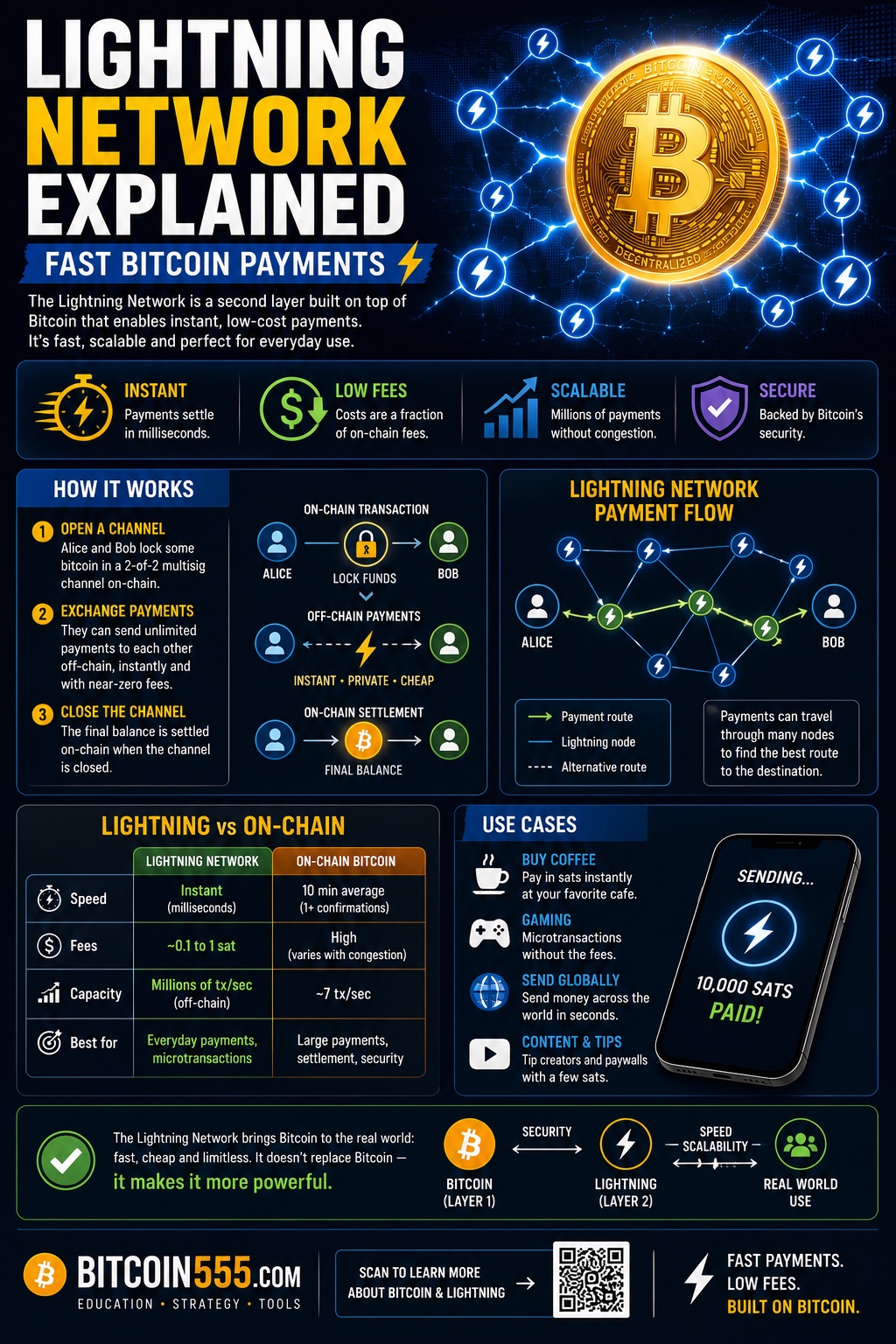
When Bitcoin first launched, its creator envisioned a peer-to-peer electronic cash system. But as adoption grew, limitations became apparent. The main Bitcoin blockchain can only process about seven transactions per second, and during busy periods, fees can spike dramatically. For everyday purchases like coffee or groceries, this simply doesn't work.
Enter the Lightning Network: a second-layer solution built on top of Bitcoin that enables instant payments at virtually zero cost. If you've ever wondered how Bitcoin can scale to serve billions of users or how you can actually spend satoshis in daily life, you're in the right place. Let's break down everything you need to know about this transformative technology.
What Is the Lightning Network and Why Does It Exist?
The Lightning Network is a payment protocol that operates as a "second layer" on top of the Bitcoin blockchain. Think of it like this: the main Bitcoin blockchain is a heavily secured vault where large, important transactions are permanently recorded. The Lightning Network is like a tab you keep open at your favorite bar—you can make numerous small transactions quickly, and only the final balance gets settled on the main chain.
The need for Lightning arose from Bitcoin's fundamental design tradeoffs. To maintain decentralization and security, Bitcoin intentionally limits block size and block time. This creates a bottleneck: during periods of high demand, users compete for limited block space by paying higher fees. In some cases, sending $5 worth of Bitcoin could cost more in fees than the actual amount being sent.
The Lightning Network solves this by moving most transactions off the main blockchain while still inheriting Bitcoin's security properties. It achieves this through a clever system of payment channels and smart contracts.
Here's the key insight: not every transaction needs to be recorded on the blockchain immediately. If you and your coffee shop transact daily, you could open a channel, make hundreds of payments over months, and only record two transactions on the main chain—one to open the channel and one to close it. Everything in between happens instantly and privately on Lightning.
How the Lightning Network Actually Works
Understanding Lightning requires grasping a few core concepts. Don't worry—while the underlying cryptography is complex, the basic mechanics are surprisingly intuitive.
Payment Channels: The Building Blocks
A payment channel is a private connection between two parties that allows them to send Bitcoin back and forth without touching the main blockchain. Here's how it works:
- Opening a channel: Two parties create a multi-signature Bitcoin address and each deposits funds. This "funding transaction" is recorded on the main blockchain.
- Transacting: The parties can now send payments by updating a shared balance sheet. If Alice deposited 0.01 BTC and Bob deposited 0.01 BTC, they each start with that balance. When Alice pays Bob 0.002 BTC, they both sign a new balance showing Alice has 0.008 BTC and Bob has 0.012 BTC.
- Closing the channel: When either party wants to settle, they broadcast the final balance to the blockchain. Each person receives their rightful share.
The Network Effect: Routing Payments
Here's where it gets powerful. You don't need a direct channel with everyone you want to pay. If Alice has a channel with Bob, and Bob has a channel with Carol, Alice can pay Carol through Bob. Bob acts as a router, passing the payment along and earning a tiny fee for the service.
This creates a network of interconnected channels—hence "Lightning Network." Payments hop from node to node until they reach their destination, typically in under a second. The beauty is that Bob cannot steal the funds in transit; cryptographic locks called Hash Time-Locked Contracts (HTLCs) ensure payments either complete fully or return to the sender.
Security Through Smart Contracts
What prevents cheating? Suppose Alice tries to broadcast an old balance that favored her. Lightning uses "penalty transactions"—if Bob catches Alice trying to cheat, he can claim all the funds in the channel. This creates a strong economic incentive for honest behavior. Both parties are effectively keeping each other honest through game theory.
Real-World Benefits of Using Lightning
The Lightning Network isn't just a technical curiosity—it delivers tangible advantages that make Bitcoin practical for everyday use.
Near-instant transactions: Lightning payments typically confirm in less than a second. Compare this to waiting 10 minutes or more for a single on-chain confirmation. For point-of-sale purchases, this speed is essential.
Microscopic fees: Routing fees on Lightning are usually measured in millisatoshis—fractions of a penny. This makes micropayments viable for the first time. You could tip a content creator 100 satoshis (a few cents) without the fee eating into the payment.
Scalability: While the main blockchain handles roughly seven transactions per second, the Lightning Network can theoretically process millions. Each channel can handle unlimited transactions, and closing a channel only requires one on-chain transaction regardless of how many Lightning payments occurred.
Enhanced privacy: On-chain Bitcoin transactions are publicly visible. Lightning payments are known only to the parties involved and the routing nodes. Once channels close, the individual payment history isn't recorded on the blockchain—only the final balances.
Streaming payments: Lightning enables entirely new use cases like pay-per-second streaming services, real-time gaming payments, or paying for data by the megabyte. These granular payments would be impossible with traditional payment rails.
If you're regularly accumulating satoshis through small purchases or dollar-cost averaging, Lightning makes it practical to actually use those sats in daily life rather than watching them sit idle due to high on-chain fees.
How to Get Started with Lightning Network Payments
Ready to experience Lightning for yourself? Here's a practical guide to making your first instant Bitcoin payment.
Step 1: Choose a Lightning Wallet
For beginners, custodial wallets offer the easiest entry point. These apps manage the technical complexity for you:
- Wallet of Satoshi: Extremely user-friendly, no setup required. Available on iOS and Android.
- Strike: Combines Lightning with traditional banking features in supported regions.
- Cash App: Enables Lightning sends and receives for US users.
For more control and privacy, consider non-custodial options:
- Phoenix Wallet: Manages channels automatically while keeping you in control of your keys.
- Breez: User-friendly non-custodial option with a built-in podcast player supporting streaming payments.
- Zeus: Connect to your own Lightning node for maximum sovereignty.
Step 2: Fund Your Wallet
Depending on your wallet, you can typically add funds by:
- Receiving a Lightning payment from another user
- Buying Bitcoin directly in the app (available in some wallets)
- Sending on-chain Bitcoin that gets converted to Lightning
- Purchasing through an exchange like Binance that supports Lightning withdrawals, allowing you to move your Bitcoin to your Lightning wallet with minimal fees
Step 3: Make a Payment
Lightning payments use invoices or Lightning addresses:
- The recipient generates an invoice (a long string starting with "lnbc") or shares their Lightning address (looks like email: user@wallet.com)
- You scan the QR code or paste the invoice into your wallet
- Review the amount and tap send
- The payment arrives almost instantly
Step 4: Explore Lightning-Enabled Services
Test your new setup with services that accept Lightning:
- Online merchants displaying Lightning payment options
- Content platforms enabling satoshi tips
- Gaming platforms with instant Bitcoin deposits and withdrawals
- VPN services accepting Lightning for subscription payments
Advanced Considerations: Running Your Own Node
While mobile wallets are convenient, running your own Lightning node offers maximum control, privacy, and the opportunity to earn routing fees.
Why Run a Node?
Operating your own node means:
- Full sovereignty: You control your keys and channels entirely
- Enhanced privacy: No third party sees your transaction history
- Routing revenue: Earn small fees by routing payments for others
- Network contribution: Help strengthen the Lightning Network's infrastructure
Hardware Requirements
A Lightning node requires a Bitcoin full node, so you'll need:
- A computer or dedicated device (Raspberry Pi 4 works for small-scale use)
- At least 1TB of storage for the Bitcoin blockchain
- Reliable internet connection with reasonable upload speeds
- UPS battery backup recommended to prevent channel corruption from power loss
Popular node solutions include Umbrel, RaspiBlitz, and Start9, which provide user-friendly interfaces for managing both Bitcoin and Lightning.
Capital Requirements
Opening channels requires locking up Bitcoin. For effective routing, you might need 0.01-0.1 BTC or more distributed across several channels to popular nodes. This capital earns fees but carries opportunity cost—those sats can't be used elsewhere while committed to channels.
For significant amounts, proper security becomes crucial. Before committing substantial funds to any Bitcoin setup, ensure you're using proper cold storage for your main holdings. Hardware wallets like those from Ledger provide the security foundation you need before experimenting with more advanced configurations.
Lightning Network Limitations and Challenges
No technology is perfect, and understanding Lightning's limitations helps you use it appropriately.
Liquidity constraints: You can only receive up to the amount of inbound liquidity in your channels. New users often find they can send payments but struggle to receive until they've established channels with sufficient inbound capacity.
Online requirement: Unlike on-chain Bitcoin, which you can receive while offline, Lightning requires your node (or custodian's node) to be online to receive payments. For mobile wallets, this is usually handled through background processes or custodial services.
Channel management complexity: Self-custodial Lightning requires understanding channel capacity, rebalancing, and backup procedures. The learning curve is steeper than simple on-chain Bitcoin.
Hot wallet risk: Lightning channels require funds in a "hot" wallet (connected to the internet) to function. This creates security tradeoffs compared to cold storage. Never keep more on Lightning than you'd carry in a physical wallet.
Routing failures: Occasionally payments fail due to insufficient liquidity along the route. Better pathfinding algorithms and liquidity pools continue to improve success rates, but it's not yet as reliable as on-chain transactions.
These challenges are actively being addressed by developers. The network has improved dramatically since its early days, and solutions like splicing, channel factories, and improved routing continue to enhance user experience.
The Future of Lightning and Bitcoin Payments
The Lightning Network continues evolving rapidly. Several developments are shaping its trajectory:
Taproot integration: Bitcoin's Taproot upgrade enables more efficient and private channel constructions. Point Time-Locked Contracts (PTLCs) will enhance privacy by making routing hops unlinkable.
Channel factories: This proposed technology would allow many users to share a single on-chain transaction for channel opening, dramatically reducing costs and improving scalability.
LSPs (Lightning Service Providers): These services handle liquidity management for users, making non-custodial Lightning accessible to everyday users without technical complexity.
Bolt 12: This specification enables reusable payment codes, improving the user experience for receiving payments and enabling features like subscriptions.
The trend is clear: Lightning is becoming easier to use while maintaining its core properties of speed, low cost, and Bitcoin's security. As these improvements roll out, the gap between custodial convenience and self-custodial security continues to narrow.
Frequently Asked Questions
Is the Lightning Network safe to use?
Yes, when used correctly. Lightning inherits Bitcoin's security through smart contracts that ensure either both parties agree on the balance or the blockchain arbitrates. The main risks are operational—losing channel state backups or having your hot wallet compromised. Start with small amounts while learning, use reputable wallets, and never keep more on Lightning than you can afford to lose. For larger holdings, always use proper cold storage.
How much does it cost to use Lightning Network?
Lightning fees are remarkably low—typically fractions of a cent regardless of payment size. However, opening and closing channels requires on-chain transactions with regular Bitcoin fees. Some wallets charge service fees for managing channels on your behalf. Overall, Lightning is dramatically cheaper than on-chain transactions for frequent payments.
Can I convert my on-chain Bitcoin to Lightning?
Yes, through several methods. You can open a Lightning channel directly with your on-chain Bitcoin (this locks it in the channel). Many wallets handle this automatically. You can also use submarine swaps—services that exchange on-chain Bitcoin for Lightning funds without requiring you to run your own channel. Some exchanges now support direct Lightning withdrawals as well.
What happens if my Lightning wallet goes offline?
For custodial wallets, the service provider maintains your channels. For self-custodial setups, your channels remain open but you can't send or receive until you're back online. Extended offline periods can be risky if a channel partner tries to close with an outdated state. Watchtower services can monitor your channels and protect against this while you're offline.
Is Lightning only for small payments?
While Lightning excels at micropayments, it handles larger amounts too. Channel capacity continues to increase, and multi-path payments can split large transactions across several routes. That said, very large payments may face liquidity constraints. The sweet spot is everyday transactions—from cents to a few hundred dollars—where Lightning's speed and low fees provide the greatest advantage over on-chain transactions.
Conclusion: Lightning Makes Bitcoin Practical for Daily Use
The Lightning Network represents one of the most significant developments in Bitcoin's evolution. By enabling instant, nearly free transactions without sacrificing Bitcoin's core properties, it transforms Bitcoin from purely a store of value into a practical medium of exchange.
Whether you're buying coffee, tipping content creators, or streaming payments for services, Lightning makes satoshis usable in ways that would be impractical on-chain. The technology has matured significantly, with user-friendly wallets making it accessible to anyone willing to spend a few minutes learning.
Start simple: download a Lightning wallet, fund it with a small amount, and make a few payments to get comfortable. As you gain experience, you might explore non-custodial options or even running your own node. The rabbit hole goes deep, but the entrance is easier than ever.
The vision of Bitcoin as everyday money is no longer theoretical. With Lightning, it's happening today—one instant payment at a time.