Imagine you have a safety deposit box at a bank, but instead of one key, it requires two or three different keys held by different people to open. No single person can access the contents alone—everyone involved must cooperate. This is essentially how multisignature (multisig) Bitcoin wallets work, and understanding them could be the difference between sleeping soundly at night and losing your entire Bitcoin stack to a single point of failure.
Whether you're holding a significant amount of Bitcoin, managing funds for a business, or simply want the peace of mind that comes with redundant security, multisig wallets represent one of the most powerful tools in your self-custody arsenal. In this guide, we'll break down exactly how they work, when you should use them, and how to set one up—all in plain English, without the technical jargon that often makes this topic seem more complicated than it needs to be.
What Exactly Is a Multisig Bitcoin Wallet?
A multisig wallet is a Bitcoin wallet that requires multiple private keys to authorize a transaction, rather than just one. The name comes from "multiple signatures"—because multiple parties (or multiple devices) must sign off before any Bitcoin can be moved.
Traditional single-signature wallets work like your front door: one key opens the lock. If someone steals that key or you lose it, you're in trouble. Multisig wallets work more like a nuclear launch protocol: multiple authorization codes must be entered before anything happens.
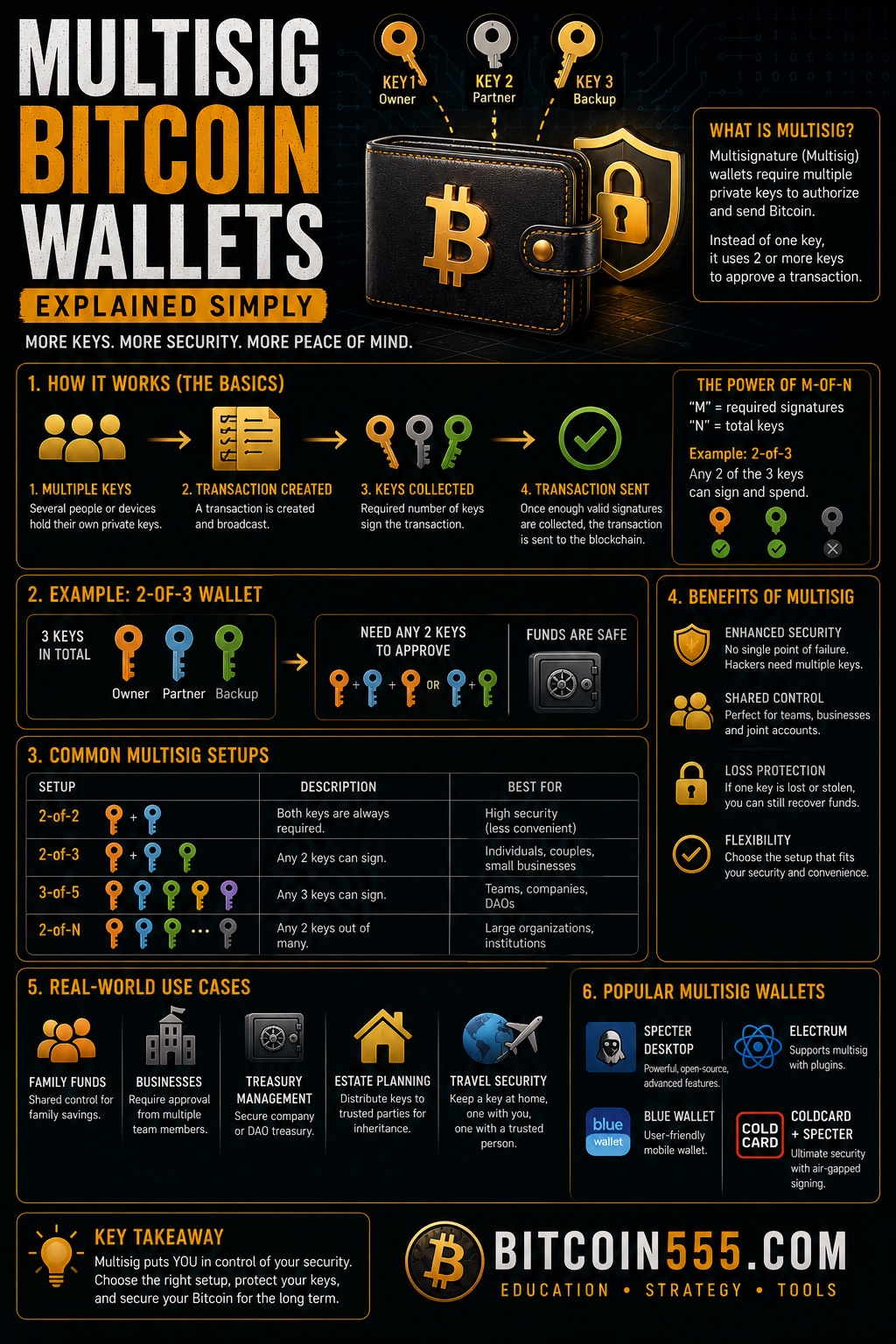
The most common configurations are expressed as "m-of-n" setups:
- 2-of-3 multisig: Three keys exist, and any two of them are required to sign a transaction. This is the most popular setup for individuals.
- 3-of-5 multisig: Five keys exist, and any three must sign. This is common for businesses and organizations.
- 2-of-2 multisig: Both keys must sign every transaction. This offers maximum security but no redundancy if one key is lost.
The beauty of multisig is that it's built into Bitcoin's protocol itself. It's not a third-party feature or a company's proprietary technology—it's native Bitcoin functionality that has been battle-tested since the early days of the network.
Why Multisig Matters: The Security Advantages
Understanding why multisig exists requires understanding the vulnerabilities of standard single-signature wallets. Let's walk through the key advantages:
Eliminating Single Points of Failure
With a standard wallet, everything depends on protecting one seed phrase or private key. If it's compromised—through theft, hacking, phishing, or even a home invasion—your Bitcoin is gone. With a 2-of-3 multisig setup, an attacker would need to compromise two separate keys, likely stored in different locations and possibly on different types of devices. The difficulty of executing such an attack increases exponentially.
Protection Against Physical Threats
Consider a nightmare scenario: someone breaks into your home and demands your Bitcoin at gunpoint. With a single-sig wallet, you have no choice but to comply. With multisig, you can truthfully say that you cannot move the funds alone—the other required keys are held elsewhere, perhaps by a family member in another city or in a bank safety deposit box. This provides genuine protection, not just security theater.
Inheritance and Succession Planning
Multisig elegantly solves the inheritance problem that plagues many Bitcoin holders. You can set up a 2-of-3 arrangement where you hold one key, your spouse holds another, and your estate attorney holds the third. During your lifetime, you and your spouse can manage the funds together. If something happens to you, your spouse and attorney can access the Bitcoin without any single person ever having unilateral control.
Business Treasury Management
For companies holding Bitcoin on their balance sheet, multisig is practically mandatory for good governance. A 3-of-5 setup might include the CEO, CFO, two board members, and an external security firm. This prevents embezzlement, protects against any single executive being compromised, and creates a clear audit trail of who authorized what.
If you're planning to hold Bitcoin for the long term as part of your financial future, using our Bitcoin retirement calculator can help you understand what your holdings might look like over time—and give you even more motivation to secure them properly with multisig.
How Multisig Actually Works Under the Hood
You don't need to understand the cryptography to use multisig effectively, but having a basic mental model helps you make better decisions. Here's a simplified explanation:
When you create a multisig wallet, you're generating a special Bitcoin address that has encoded rules about how many signatures are required to spend from it. These rules are enforced by the Bitcoin network itself—no company or third party is involved in the enforcement.
The Setup Process
- Generate multiple key pairs: Each participant (or each device) generates their own private key and corresponding public key.
- Create the multisig address: The public keys are combined using a specific script to create a unique multisig address. This address starts with "3" for legacy multisig or "bc1" for modern native SegWit multisig.
- Distribute the keys: Each private key is stored separately, ideally on different devices in different physical locations.
- Backup everything: Each key holder backs up their seed phrase, and ideally, the wallet configuration file (sometimes called the wallet descriptor or XPUB file) is also backed up in multiple locations.
Spending from a Multisig Wallet
When you want to send Bitcoin from a multisig wallet:
- One key holder creates and signs the transaction, but it's not yet valid.
- The partially signed transaction (called a PSBT—Partially Signed Bitcoin Transaction) is passed to the next signer.
- The second signer reviews and adds their signature.
- Once enough signatures are collected (2 of 3, for example), the transaction becomes valid and can be broadcast to the Bitcoin network.
This process can happen in person with devices side by side, or asynchronously across the globe using encrypted file sharing. The flexibility is remarkable.
Setting Up Your First Multisig Wallet: A Practical Guide
Let's walk through setting up a 2-of-3 multisig wallet for personal use. This is the most common configuration for individuals who want serious security without excessive complexity.
What You'll Need
- Three hardware wallets: Ideally from different manufacturers to avoid any single vendor vulnerability. For example, two Ledger devices and one from another reputable manufacturer. Hardware wallets like Ledger provide the secure key generation and storage essential for robust multisig setups.
- A coordination software: You'll need software to create the multisig wallet and coordinate signing. Popular options include Sparrow Wallet (desktop), Specter Desktop, or Nunchuk (mobile-friendly).
- Secure storage locations: Three different physical locations for your devices and seed phrase backups.
Step-by-Step Setup Using Sparrow Wallet
Step 1: Initialize your hardware wallets. Set up each hardware wallet separately, writing down and securing each 24-word seed phrase. Never store multiple seed phrases in the same location.
Step 2: Install and configure Sparrow Wallet. Download Sparrow from the official website and verify the signature. Connect to your own Bitcoin node if possible, or use a reputable public server.
Step 3: Create a new multisig wallet. In Sparrow, select File → New Wallet. Choose "Multi Signature" as the wallet type, then set your threshold (2-of-3).
Step 4: Import each key. Connect each hardware wallet one at a time and import its extended public key (XPUB) into Sparrow. The software will guide you through this process.
Step 5: Verify the addresses. After setup, verify that at least the first receiving address matches on all three hardware wallets. This confirms everything is configured correctly.
Step 6: Backup your wallet descriptor. Export the wallet configuration file and store copies with each seed phrase backup. Without this file, restoring your multisig wallet becomes much more complicated.
Step 7: Test with a small amount. Send a tiny amount of Bitcoin to your new multisig address, then practice spending it using two of your three devices. Never skip this step.
Common Multisig Mistakes and How to Avoid Them
Multisig adds security, but it also adds complexity. Here are the most common pitfalls:
Not Backing Up the Wallet Descriptor
This is the number one mistake. Your seed phrases alone are not enough to recover a multisig wallet. You also need the wallet descriptor (or the XPUBs of all participating keys and the derivation paths). Without this information, you won't be able to reconstruct the correct multisig addresses. Store the descriptor file with each seed phrase backup.
Storing Multiple Keys Together
The entire point of multisig is geographic and device distribution. If you keep all three hardware wallets in the same safe, you've negated most of the security benefits. A fire, flood, or theft could compromise everything at once.
Using Software-Only Keys
While it's technically possible to create multisig with software wallets, this dramatically reduces security. At least two of your keys should be on dedicated hardware devices that never expose your private keys to an internet-connected computer.
Overcomplicating the Setup
More keys don't always mean more security. A 4-of-7 multisig is extremely difficult to manage and increases the chance of losing access to your own funds. For most individuals, 2-of-3 provides an excellent balance of security and usability.
Neglecting to Test Recovery
At least once per year, verify that you can still access all keys and that your recovery documentation is accurate. Practice signing a transaction with each possible combination of keys.
When Should You Use Multisig?
Multisig isn't necessary for everyone. Here's a framework for deciding if it's right for you:
You Should Seriously Consider Multisig If:
- You hold more Bitcoin than you could afford to lose
- You want protection against physical coercion or home invasion
- You need to share control of funds with family members or business partners
- You're concerned about the security of any single device or location
- You want to create a clear inheritance plan for your Bitcoin
Single-Signature May Be Sufficient If:
- You're just getting started with small amounts
- You're actively trading and need quick access (though consider keeping only trading amounts on exchanges like Binance and moving larger holdings to secure storage)
- The complexity of multisig would likely cause you to make mistakes
Remember, the best security setup is one you'll actually use correctly. A well-executed single-signature wallet with proper backups beats a poorly maintained multisig wallet where you've lost track of your keys.
Collaborative Custody: The Middle Ground
For those who want multisig benefits without managing everything themselves, collaborative custody services offer an interesting middle ground. These services hold one key in your multisig setup, providing both security assistance and emergency recovery options.
In a typical 2-of-3 collaborative setup:
- You hold one key on your personal hardware wallet
- The service holds one key in their secure infrastructure
- A third "recovery" key is stored in a separate location you control
For normal transactions, you and the service sign together. If the service disappears or becomes uncooperative, you can use your personal key plus the recovery key to maintain access. If you lose your personal key, you can use the recovery key plus the service to recover.
This model offers professional security assistance while maintaining true self-custody—you can always access your Bitcoin without the service's permission if needed.
Frequently Asked Questions
Can I lose my Bitcoin if I lose one key in a multisig setup?
In a 2-of-3 multisig, losing one key doesn't mean losing your Bitcoin. You can still access funds with the remaining two keys. However, you should immediately set up a new multisig wallet and transfer your funds, because you've lost your redundancy. If you lose two keys, your Bitcoin is gone forever.
Is multisig supported by all Bitcoin wallets?
No. While multisig is a native Bitcoin feature, not all wallet software supports it. You'll need to use wallets specifically designed for multisig, such as Sparrow, Specter, Nunchuk, or Electrum. Most hardware wallets can participate in multisig setups when used with compatible coordination software.
How much does it cost to use multisig?
Multisig transactions require slightly higher network fees because they contain more data (multiple signatures). The difference is typically small—perhaps 20-50% higher fees than single-signature transactions. There's no additional cost for the multisig feature itself; it's built into Bitcoin.
Can I use multisig with Bitcoin stored on an exchange?
No. Bitcoin held on exchanges like Binance is custodied by the exchange—you don't control the private keys at all. Multisig only applies to self-custody wallets where you control the keys. If security is a priority, consider withdrawing Bitcoin from exchanges into your own multisig wallet.
What happens if one participant in a business multisig becomes unavailable?
This is exactly why proper threshold selection matters. In a 3-of-5 business setup, if one key holder leaves the company or becomes unreachable, the remaining four can still operate the wallet. The organization should then set up a new multisig with updated participants and migrate the funds.
Conclusion: Taking Your Bitcoin Security Seriously
Multisig represents a fundamental upgrade in how you can protect your Bitcoin. By requiring multiple signatures from multiple devices in multiple locations, it eliminates the catastrophic risk of a single point of failure. Whether you're protecting a life-changing sum or simply want the peace of mind that comes from serious security, multisig is a tool worth understanding and implementing.
The learning curve is real, but it's manageable. Start by reading and understanding the concepts (which you've now done). Next, practice with small amounts on testnet or with minimal real Bitcoin. Document everything carefully. Test your recovery process before you actually need it.
Remember that security is ultimately about trade-offs. Multisig trades some convenience for dramatically improved protection. For many Bitcoin holders—especially those thinking in terms of years or decades—that trade-off is absolutely worth making. Your future self, sleeping soundly knowing your Bitcoin requires multiple keys across multiple locations to access, will thank you for putting in the work today.