Here's a stat that surprises most new traders: crypto markets spend the majority of their time going nowhere. Depending on how you measure it, Bitcoin trades sideways somewhere between 60% and 80% of the time. Trends — the explosive moves everyone dreams about — are the exception, not the rule. Yet almost every trading course, YouTube video, and Twitter thread teaches you how to trade trends. Then people wonder why they bleed money for months waiting for a breakout that never comes.
I spent my first two years as a trader doing exactly that: buying breakouts that failed, getting stopped out, and watching the market chop back and forth inside the same boring band. It wasn't until I flipped my thinking — treating the chop itself as the opportunity — that my equity curve stopped looking like a ski slope. Range trading is not glamorous. Nobody posts screenshots of a clean 2R scalp between support and resistance. But it's one of the few strategies that actually matches what the market does most of the time.
In this guide I'll walk you through the range trading strategy I actually use: how to identify a real range (not a fake one), where to enter and exit with specific numbers, how to size positions so one bad trade doesn't hurt, and the mistakes that quietly destroy most range traders. No hype, no "guaranteed profits" nonsense. Just the mechanics.
What Is Range Trading and Why It Works in Crypto
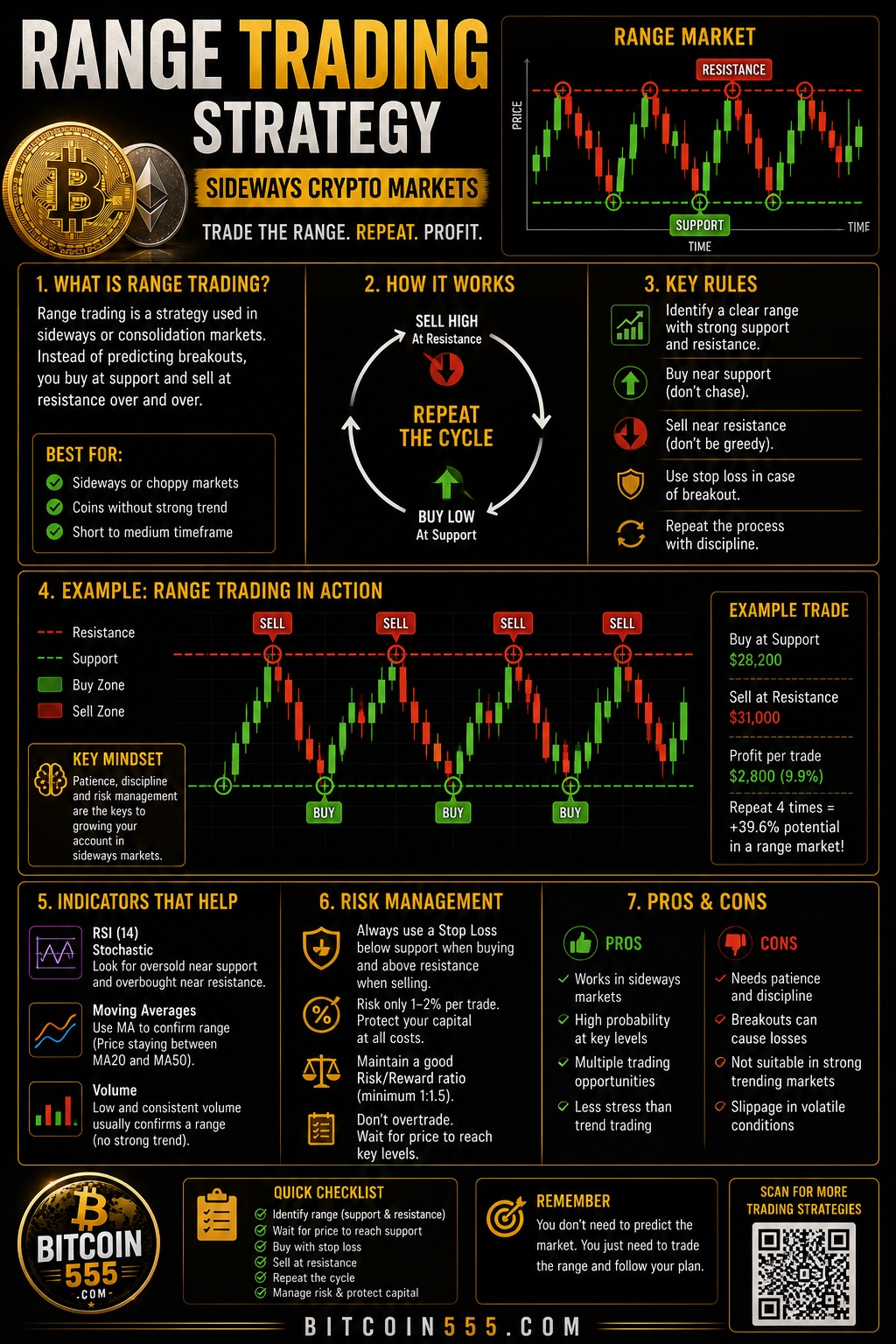
Range trading means buying near an established support level and selling near an established resistance level while price oscillates between the two. Instead of betting on where the market is going, you're betting on where it isn't going — that price will stay contained and keep bouncing between the same zones until something fundamentally changes.
Ranges form because of a temporary equilibrium between buyers and sellers. After a strong trend, early buyers take profit at a certain price (creating resistance) while late buyers and dip-hunters defend a lower price (creating support). Until new information or new money tips the balance, price ping-pongs between these zones. In crypto, this happens constantly: after every major rally or crash, the market typically consolidates for weeks or months.
Why does this strategy suit crypto specifically?
- Crypto ranges are wide. A stock might range in a 3% band. Bitcoin routinely ranges in 8–15% bands, and altcoins in 20–30% bands. That's enough room for meaningful profit even after fees.
- Markets run 24/7. Ranges get tested repeatedly — including during low-liquidity weekend hours — giving you more entry opportunities than traditional markets.
- Levels are respected because everyone watches them. Crypto is heavily technical. When thousands of traders and bots see the same horizontal level, their combined orders make it self-reinforcing — until it isn't (more on that later).
The honest downside: range trading has a defined ceiling on profit per trade and an ugly failure mode. When a range finally breaks, it often breaks violently, and if you're on the wrong side without a stop, one trade can erase ten winners. Everything in this strategy is built around managing that exact risk.
How to Identify a Tradeable Range (Not Every Sideways Market Qualifies)
This is where most people fail before they even place a trade. A tradeable range needs to meet specific criteria — otherwise you're just drawing lines on noise.
The minimum requirements I use
- At least two clean touches of support and two of resistance. Two touches each define the range; the third touch is your first tradeable signal. Trading off a single touch is guessing.
- The range must be wide enough to pay you. My rule: the distance from support to resistance should be at least 6x your total round-trip cost (fees + spread + slippage). If your costs are 0.2% per round trip, the range needs to be at least 1.2% wide — and realistically I want 5%+ on Bitcoin, 10%+ on altcoins.
- Declining volume inside the range, spiking volume at the edges. Healthy ranges show apathy in the middle and interest at the boundaries. If volume is expanding steadily in one direction, that's a trend building, not a range.
- Horizontal structure, not a triangle. If the highs are getting lower or the lows are getting higher, you're in a compression pattern, and those resolve with breakouts. Range trading works on flat, boxy structures.
Think in zones, not lines
Support at "exactly $60,000" doesn't exist. Support is a zone — maybe $59,600 to $60,400. Crypto is famous for wicking through obvious levels to hunt stop losses before reversing. If you treat levels as exact prices, you'll get wicked out of good trades constantly. Draw your zones using the cluster of wick lows/highs, not single candles.
Confirm with simple indicators (optional, not required)
I keep it minimal: RSI (14) to confirm momentum exhaustion at the edges (RSI under 35 at support, over 65 at resistance strengthens the setup), and volume to confirm the level is being defended. Some traders add Bollinger Bands or a stochastic oscillator. Fine — but indicators confirm the setup; the horizontal structure IS the setup. If you need five indicators to see a range, there is no range.
The Core Range Trading Setup: Entries, Stops, and Targets With Real Numbers
Let's build a complete trade. Suppose Bitcoin has been consolidating for three weeks between a support zone of $58,800–$59,500 and a resistance zone of $64,500–$65,200. Support has been tested twice, resistance twice, both rejections came on elevated volume. That's a valid range roughly 9% wide. You're trading on Binance with a $10,000 account.
The long setup at support
- Entry: $59,400 — inside the support zone, but I wait for a confirmation candle: a 4-hour close back above the zone low, or a clear rejection wick with above-average volume. I do not place blind limit orders at the level and walk away.
- Stop loss: $58,100 — below the entire support zone plus a buffer of roughly 0.7%, beyond typical wick-hunt distance. Risk per unit: $1,300, or about 2.2%.
- Target 1: $61,900 (mid-range) — take 50% off here.
- Target 2: $64,300 (just below the resistance zone) — close the rest. Never target the exact top of the range; price frequently falls 0.5–1% short of the obvious level.
Position sizing: risking 1% of the account = $100 max loss. Position size = $100 ÷ $1,300 risk per BTC = 0.0769 BTC, roughly $4,570 of exposure. No leverage needed.
Reward-to-risk: Target 1 gives $2,500 per BTC against $1,300 risk (1.9R). Target 2 gives $4,900 (3.8R). Blended, this trade returns about 2.8R when it works — meaning I can be wrong more often than I'm right and still make money.
The short setup at resistance
Mirror image: enter around $64,600 on a rejection from the resistance zone, stop at $65,900 (above the zone plus buffer), first target mid-range at $62,000, second target $59,900. Same 1% risk, same sizing math. If your exchange or jurisdiction doesn't allow shorting, you simply trade the long side only and stand aside at resistance — half the opportunities, but the long side of Bitcoin ranges historically treats you better anyway.
Why the confirmation candle matters
Waiting for confirmation means a slightly worse entry price. I accept that trade-off gladly. Blind limit orders at support get filled on every touch — including the touch where the range breaks down and support becomes a trapdoor. The confirmation candle filters out a meaningful share of those disasters. My win rate on confirmed entries runs roughly 15 percentage points higher than blind fills did, and that difference is the whole strategy.
Risk Management: The Part That Actually Determines Whether You Survive
Range trading has a seductive rhythm. Buy low, sell high, repeat — it can work eight times in a row and convince you it's easy. Then the ninth trade breaks the range against you, and if your risk management is sloppy, it takes back everything.
- Risk 0.5–1% of account equity per trade. Hard cap. With a $10,000 account, your maximum loss on any single range trade is $50–$100. This feels painfully small. It's also why you'll still be trading in a year.
- The stop loss is non-negotiable and goes in the market, not in your head. Range breaks are fast. A mental stop during a breakdown means you'll watch, freeze, hope, and exit 4% lower than planned. Place the actual order.
- Count the touches. Ranges don't last forever. The third and fourth tests of a level are the highest-probability trades. By the fifth or sixth touch, each retest is chewing through the resting orders that defend the level, and the odds of a break climb sharply. I reduce size by half after the fourth touch and stop trading the range entirely after the sixth.
- Reduce size in low liquidity. Weekend and off-hours ranges get wicked more aggressively. I trade half size or skip those sessions.
- Separate trading capital from holdings. This matters more than people admit. My range trading capital sits on Binance where I can execute instantly; my long-term Bitcoin position sits offline on a Ledger hardware wallet where I physically cannot revenge-trade it at 3 a.m. after a stop-out. That separation has saved me from myself more than once. If you're curious what long-term holding alone would have done historically, run some scenarios through our Bitcoin investment calculator — it's a useful reality check on how much of your capital should be trading versus holding in the first place.
Realistic expectations: a decent range trader might win 55–65% of trades at an average of 1.5–2R. On a $10,000 account risking 1%, that's roughly $300–$600 per month during good ranging conditions — with losing weeks mixed in. If someone promises you 20% monthly from range trading, they're selling something.
Advanced Tactics: Mid-Range Rules, Failed Breakouts, and Scaling
Never trade the middle of the range
The mid-range is no-man's-land. Price there has no nearby level to lean on, so your stop must be wide and your edge is zero. Draw the midpoint of your range and treat it as a decision line: above it, look only for shorts at resistance; below it, look only for longs at support. If price is hovering near the midpoint, close the laptop. Some of my most profitable weeks contained two trades.
The failed breakout — the best trade in the playbook
When price breaks below range support, triggers the stop-loss cluster, and then snaps back inside the range within one to three candles, you've witnessed a liquidity grab. Everyone who sold the breakdown is now trapped, and their forced buying fuels the reversal. Using our earlier range: price wicks to $58,300 (below support), then the next 4-hour candle closes at $59,800, back inside the zone. Entry $59,800, stop $58,200 below the wick low, target the opposite side at $64,000. That's roughly 2.6R, and in my experience these setups win noticeably more often than standard range touches because the trapped sellers do the work for you. The rule: the reclaim candle must close back inside the range. A wick back in is not enough.
Scaling out beats all-or-nothing exits
Taking half at mid-range and letting the rest run to the far side does two things: it locks in a profit on trades that stall halfway (many do), and after Target 1 fills, you move your stop to breakeven, converting the remainder into a free trade. Over a hundred trades, this exit structure smooths the equity curve dramatically compared with holding everything for the full range every time.
Match your timeframe to your life
Ranges exist on every timeframe, but 4-hour and daily ranges are far more forgiving than 5-minute ones. Fees eat scalpers alive, and low-timeframe ranges are noise-dominated. If you have a job, trade the 4-hour chart: check levels twice a day, set alerts at your zones, and let the market come to you.
Common Range Trading Mistakes That Destroy Accounts
- Trading ranges that don't exist yet. One bounce off a low is not support. Wait for two confirmed touches on each side. Impatience here is the number one killer.
- No stop loss because "support will hold." Every range breaks eventually. Every single one. The trader without a stop donates months of profit in one afternoon. I did this in my second year — nine winning range trades erased by one breakdown I "knew" would bounce. It didn't.
- Fighting a confirmed breakout. Price closes decisively outside the range on strong volume, and the range trader keeps buying the "dip" all the way down, averaging into a trend. The moment a daily candle closes outside your zone with volume, the range is dead. Stop trading it. Full stop.
- Oversizing because the setup "always works." A 65% win rate means you will hit three or four losers in a row regularly. At 1% risk that's a shrug; at 10% risk it's a crater.
- Ignoring fees on tight ranges. A 2% range with 0.2% round-trip costs hands 10% of your gross edge to the exchange before slippage. Trade wide ranges or don't bother.
- Placing stops at the obvious level. A stop one tick below round-number support is exactly where the wicks hunt. Give it a buffer beyond the zone, and size the position down to compensate for the wider stop — never the reverse.
- Revenge trading after a stop-out. You get wicked out, price reverses without you, and you chase back in with double size and no plan. This one trade pattern probably accounts for more blown crypto accounts than any market crash. Take the stop, walk away, wait for the next clean touch.
Frequently Asked Questions About Range Trading
How long do crypto ranges usually last?
Anywhere from a few days to several months. Post-crash consolidations on Bitcoin often run 4–12 weeks on the daily chart. There's no way to know in advance when a range will end, which is exactly why the touch-counting rule and hard stops exist. Trade what's in front of you and let the stop handle the future.
Is range trading better than trend following?
Neither is "better" — they profit from opposite market conditions. Range strategies make money in the 60–80% of the time markets chop, and lose money at trend transitions. Trend strategies do the reverse. Experienced traders often run both and let market structure dictate which playbook is active. If you're a beginner, learning range trading first teaches you support, resistance, and risk management — the foundation everything else is built on.
Can I range trade altcoins, or only Bitcoin?
You can, and altcoin ranges are wider, which means bigger R multiples. But altcoins also break ranges more violently, wick more aggressively, and carry thinner liquidity. If you trade them, halve your position size, stick to high-liquidity pairs on a major exchange like Binance, and expect a lower win rate in exchange for larger winners.
What's a realistic win rate and return for this strategy?
With disciplined execution: 55–65% win rate at 1.5–2.5R average winners is achievable. That compounds to solid returns over a year, but with flat and losing periods — especially when the market trends hard and offers no ranges. Anyone quoting 80–90% win rates is either using tiny targets with huge stops (a blowup waiting to happen) or lying.
Should I use leverage for range trading?
You don't need it, and early on you shouldn't touch it. The position-sizing math above delivers proper risk with spot trading alone. Leverage in a range means liquidation wicks can take you out even when your level ultimately holds. If you ever use it, keep it low (2–3x maximum) and understand that your stop distance, not the leverage number, determines your real risk.
Conclusion: Boring Trades, Consistent Results
Range trading will never make you famous. There's no lottery-ticket upside, no 50x moonshot, no screenshot worth posting. What it offers instead is a strategy aligned with what crypto markets actually do most of the time: a repeatable process of buying confirmed support, selling into resistance, risking 1%, and taking 2–3R when the market pays.
The traders who make this work share three habits: they wait for valid ranges instead of forcing trades, they place real stop losses on every position without exception, and they walk away the moment the range breaks. The strategy itself is simple. The discipline is the hard part — it always is.
Start small. Paper trade a range or trade with money so small the outcome doesn't matter emotionally. Track every trade: entry, stop, target, outcome, and what the setup looked like. After thirty trades you'll know whether your execution matches the plan. Keep your trading stack lean — an exchange account for execution, cold storage on a hardware wallet like Ledger for anything you're not actively trading — and let the boring math compound.
The market will spend most of next year going sideways, just like it always does. You can be frustrated by that, or you can get paid for it.
Disclaimer: This article is for educational purposes only and is not financial advice. Trading cryptocurrencies involves substantial risk of loss. Never trade with money you cannot afford to lose.