Let me save you some time: most people who try scalping crypto lose money. Not because scalping doesn't work — it does, for a small minority — but because almost everyone underestimates what it actually takes. I've scalped Bitcoin and altcoin pairs for years, blown up one account early on, and slowly figured out where the edge actually lives. This guide is the honest version I wish someone had handed me before I started: the real math on fees, strategies with concrete numbers, and a straight answer to the question everyone asks — is scalping crypto worth it?
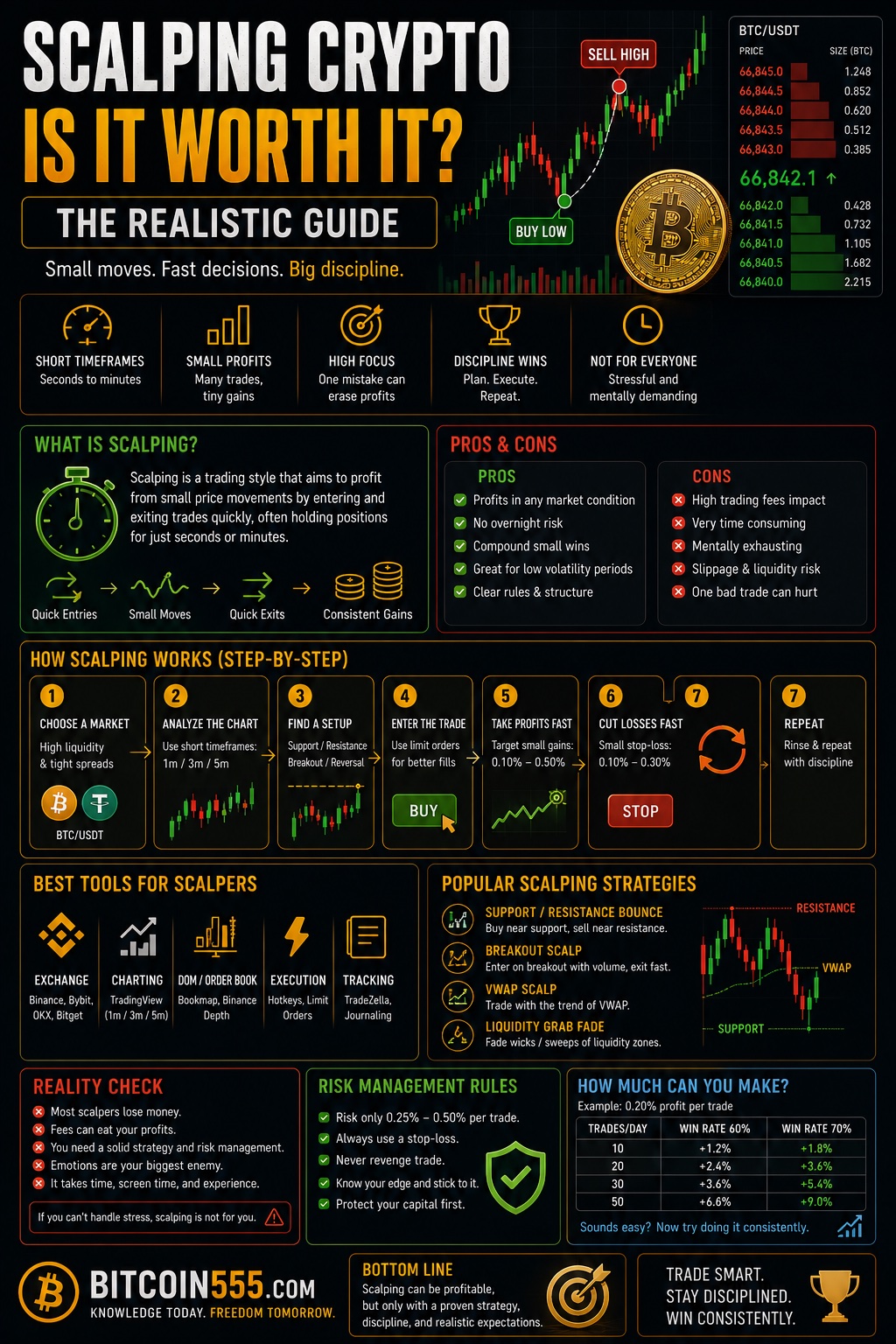
What Is Crypto Scalping, Really?
Scalping is the shortest-timeframe style of active trading. You're opening and closing positions within minutes — sometimes seconds — trying to capture small moves of 0.2% to 1%. A scalper might take 10 to 50 trades in a session, stacking small wins while cutting losers instantly.
The appeal is obvious. Crypto markets run 24/7, volatility is abundant, and on paper, grabbing 0.5% ten times a day sounds like a money printer. The reality is different. Scalping is a performance discipline closer to competitive gaming than investing. Your edge comes from three things:
- Execution speed and precision — entering and exiting exactly where your plan says, with zero hesitation
- Fee efficiency — because at this frequency, trading costs are your biggest opponent
- Emotional control — taking loss number seven of the day without revenge trading
If any of those three sound like a weakness for you, that's not a small problem. In scalping, it's fatal. Swing traders can be sloppy on entries and still profit because their targets are 5-10% away. Scalpers targeting 0.4% have no room for sloppiness at all.
The Math Nobody Shows You: Fees Eat Scalpers Alive
Before we talk strategies, let's do the math that kills most scalping careers before they start. This is the single most important section of this article.
Say you trade on Binance with standard spot fees of 0.1% per side (taker). A round trip — one entry, one exit — costs you 0.2% of your position. Now run the numbers on a typical scalping day:
- Position size: $5,000 per trade
- Trades per day: 20
- Round-trip cost: 0.2% × $5,000 = $10 per trade
- Daily fee bill: $200
To simply break even, you need to extract $200 of edge from the market every single day. If your average winning trade captures 0.5% ($25) and your average loser costs 0.3% ($15), you need a win rate above roughly 60% just to cover fees and scratch out a small profit. Most retail traders don't have a 60% win rate on anything.
This is why serious scalpers obsess over fee reduction. Practical ways to cut the bill:
- Use limit orders (maker fees) where possible — maker fees are typically lower than taker fees, and on some pairs and tiers they approach zero
- Use fee discounts — paying fees in the exchange's native token or hitting volume tiers can cut costs 25% or more
- Trade high-liquidity pairs only — BTC/USDT and ETH/USDT have spreads of a fraction of a basis point; a low-cap altcoin might have a 0.3% spread, which is an invisible fee you pay on every trade
Cutting your round-trip cost from 0.2% to 0.06% changes scalping from nearly impossible to merely difficult. If you can't get your all-in costs (fees plus spread plus slippage) below roughly 0.1% per round trip, honest answer: don't scalp. Trade a higher timeframe instead.
The Realistic Scalping Setup: Timeframes, Pairs, and Tools
Here's what a functional scalping setup actually looks like — no $5,000 course required.
Timeframes
Most crypto scalpers work on the 1-minute and 5-minute charts, with the 15-minute chart for context. My personal workflow: 15-minute chart to define the trend and key levels, 1-minute chart for entries and exits. Trading the 1-minute chart in isolation, with no higher-timeframe context, is how you get chopped to pieces.
Pairs
Stick to the top of the liquidity table: BTC/USDT, ETH/USDT, and maybe two or three major altcoins during high-volume periods. Tight spreads, deep order books, minimal slippage. Scalping illiquid altcoins means the spread alone can exceed your profit target — you've lost before you've entered.
Sessions
Crypto trades 24/7, but volume doesn't. The overlap of European and US trading hours (roughly 13:00–17:00 UTC) typically brings the most volume and the cleanest moves. Scalping dead hours means fighting choppy, algorithm-dominated price action for scraps. Pick a 2-3 hour window, trade it consistently, and stop when it ends.
Tools
- A charting platform with real-time data and fast order entry
- Level 2 order book and time & sales if you're trading order flow
- A simple indicator stack — I use VWAP, a 9 and 21 EMA, and volume. That's it. More indicators do not equal more edge; they equal more hesitation.
- A trading journal — non-negotiable, and I'll explain why in the mistakes section
Three Scalping Strategies With Real Numbers
These are the three setups I've found actually hold up over hundreds of trades. None are secrets. The edge isn't in knowing them — it's in executing them with discipline.
1. The VWAP Bounce (Trend Continuation)
In a trending market, price frequently pulls back to the session VWAP (volume-weighted average price) and bounces. You're buying the pullback in an uptrend, selling the rally in a downtrend.
Example trade (long):
- Context: BTC in a clear uptrend on the 15-minute chart, trading above VWAP all session
- Setup: Price pulls back to VWAP at $64,200 and prints a 1-minute candle that holds the level with a wick rejection
- Entry: $64,230 on the reclaim
- Stop loss: $64,040 (below the VWAP wick low) — risk of $190, roughly 0.3%
- Target: $64,610 (prior swing high) — reward of $380, roughly 0.6%
- R:R = 1:2
With a $10,000 account risking 0.5% per trade ($50), your position size is $50 ÷ 0.3% ≈ $16,900 notional — which on spot means using leverage or, more sensibly for most people, accepting a smaller position of $10,000 and risking about $30. At 1:2 R:R, you only need to win 34% of the time to break even before fees. Realistically, this setup wins 45-55% of the time in a clean trend, which is where the profit lives.
2. The Range Fade
When price is stuck in a well-defined range on the 15-minute chart, you fade the extremes: buy the bottom of the range, sell the top, with a tight stop just outside.
Example trade (short):
- Context: ETH ranging between $3,120 and $3,180 for three hours, multiple touches on both sides
- Entry: Short at $3,176 as price stalls at range resistance with declining volume
- Stop loss: $3,192 (above the range high plus a buffer) — risk of $16, roughly 0.5%
- Target: $3,132 (just above range support) — reward of $44, roughly 1.4%
- R:R ≈ 1:2.7
The catch: ranges break eventually, and the breakout candle will blow through your stop fast. Never fade a range after news, and never widen a stop hoping the range holds. When this setup loses, it loses fast — take the loss and move on.
3. The Liquidity Sweep Reversal
Crypto markets love to run stops. Price spikes just beyond an obvious high or low — sweeping the stop losses clustered there — then reverses hard. Scalping the reversal after the sweep is one of the highest-quality setups in crypto.
Example trade (long):
- Context: BTC has an obvious swing low at $63,500 that's been tested twice
- The sweep: Price flushes to $63,380 on a volume spike, then aggressively reclaims $63,500 within two 1-minute candles
- Entry: $63,540 on the reclaim confirmation
- Stop loss: $63,340 (below the sweep low) — risk of $200, roughly 0.3%
- Target: $63,940 — reward of $400
- R:R = 1:2
The discipline here is waiting for the reclaim. Buying the flush itself feels heroic and occasionally works, but catching falling knives is how scalping accounts die. Let the market prove the sweep failed, then enter.
Risk Management: The Only Reason Scalpers Survive
Every profitable scalper I know is boring about risk. Here are the rules that keep you alive long enough for your edge to play out.
- Risk 0.25-0.5% of your account per trade. At 20 trades a day, risking 1% per trade means a bad day can cost you 8-10% of your account. That's unsurvivable psychologically. At 0.5%, a terrible day costs 3-4% — painful but recoverable.
- Set a daily loss limit and enforce it mechanically. Mine is 2% of the account. Hit it, close the platform, walk away. Not one more trade. The worst losses in scalping don't come from bad setups — they come from tilted traders trying to win the day back.
- Minimum 1:1.5 R:R, target 1:2. Setups where you risk 0.4% to make 0.3% require win rates that almost nobody sustains after fees.
- Calculate position size from your stop, not from your feelings. Formula: position size = (account × risk %) ÷ stop distance %. A $10,000 account, 0.5% risk, 0.3% stop distance = $16,667 notional. If that number requires leverage you're uncomfortable with, trade smaller and accept smaller absolute returns.
- Cap yourself at 3 consecutive losses per session. Three losses in a row usually means either the market doesn't fit your setups today or you're off your game. Either way, stopping is the correct trade.
One more structural point: your scalping capital should be completely separate from your long-term holdings. Keep only your active trading capital on an exchange like Binance, and keep long-term positions offline in a Ledger hardware wallet. This isn't just security hygiene — it's psychological protection. When your entire stack sits in your trading account, the temptation to "size up just this once" after a losing streak becomes overwhelming. Cold storage puts a wall between your future and your worst trading day.
Common Scalping Mistakes That Drain Accounts
I've made every one of these. In rough order of how much money they cost people:
- Ignoring fees until the monthly statement. Traders count their gross wins and wonder why the account shrinks. Track your net P&L after fees per trade from day one. If your average win is $25 and your round trip costs $10, you don't have a strategy — you have a fee-generation machine for the exchange.
- Revenge trading. You take two losses, feel the sting, and start hunting for setups that aren't there to "get it back." This turns a -1% day into a -6% day. The daily loss limit exists precisely because you cannot trust your judgment while tilted.
- Overtrading dead markets. Scalping requires volatility and volume. Forcing trades during low-volume chop because you're "at your desk anyway" is a slow bleed. No setup, no trade. Some sessions the correct number of trades is zero.
- Moving stop losses. Widening a stop "to give it room" converts a planned $50 loss into an unplanned $300 loss. Your stop is where your idea is wrong. If price gets there, the idea was wrong. Period.
- Scalping with leverage you don't understand. Leverage isn't inherently evil — it's a position-sizing tool. But 20x leverage on a 1-minute chart means a 0.5% wick against you is a 10% account hit, and crypto produces 0.5% wicks constantly. If you use leverage at all, size so your stop-out risk stays at that 0.25-0.5% of account.
- Not journaling. Without a record of every trade — setup, entry, stop, exit, screenshot, emotional state — you cannot know which setups make money and which lose. My own journal revealed that one of my three setups was net negative after fees over 200 trades. Cutting it added more to my bottom line than any new strategy ever did.
- Strategy hopping. Three losing days convince beginners the strategy is broken, so they switch. Every strategy has losing streaks; a 55% win rate produces five losses in a row regularly, just by math. You need a sample of 100+ trades before judging a setup.
Scalping vs. Long-Term Holding: The Honest Comparison
Here's the part most scalping articles skip. For the majority of people reading this, scalping will underperform simply buying and holding — and it's not close.
Consider a realistic good outcome: a disciplined scalper nets 5% per month on their trading capital after fees. That's a genuinely strong result that puts you ahead of most active traders. It also requires 3-4 hours of intense screen time daily, real emotional wear, and years of skill-building — and it compounds on what is usually a small trading account, because sensible people don't scalp with their life savings.
Meanwhile, a passive dollar-cost averaging approach requires ten minutes a month and zero emotional damage, and historically Bitcoin's long-term holders have been rewarded for patience through multiple market cycles. If you want to see what systematic accumulation actually looks like over time, run your own numbers through a DCA calculator — for most people, the comparison against their realistic scalping results is humbling.
The traders for whom scalping genuinely makes sense share a profile: they treat it as a job, they have hours of daily availability during liquid sessions, they're emotionally stable under rapid losses, and they enjoy the process itself — not just the fantasy of profits. Many of the best traders I know do both: they scalp with a dedicated account and DCA into cold storage with completely separate money. The two strategies don't compete; they answer different questions.
FAQ: Scalping Crypto
How much money do I need to start scalping crypto?
You can technically start with a few hundred dollars, but the math is unforgiving on small accounts: a great month of 5% on $500 is $25 — less than minimum wage for the hours invested. A realistic minimum for scalping to matter financially is $5,000-$10,000. That said, everyone should start with a small amount (or paper trading) for the first 100+ trades, because your early tuition losses are nearly guaranteed. Better to pay tuition on a $500 account than a $10,000 one.
Is scalping crypto profitable for beginners?
Almost never in the first six to twelve months. Scalping is the hardest trading style to learn because mistakes compound at high frequency and fees punish every inefficiency. Most beginners are better served by learning on the 4-hour or daily timeframe first, where decisions are slower and costs matter less, then compressing timeframes as skill develops.
What's the best time frame for scalping crypto?
The most common combination is a 15-minute chart for trend and key levels, with a 1-minute or 5-minute chart for execution. Trading the 1-minute chart without higher-timeframe context is a common and expensive mistake — you end up buying micro-breakouts directly into major resistance.
Do I need leverage to scalp crypto?
No, and beginners shouldn't use it. Leverage is a position-sizing tool for experienced traders with tight, respected stops — not a shortcut to bigger profits. If your stop is 0.3% away and you risk 0.5% of your account, modest leverage lets you reach the correct position size. Anything beyond that is gambling with extra steps.
Can I scalp crypto with a bot instead of manually?
Bots remove emotion, which is genuinely valuable, but they don't remove the need for edge — a bot running a losing strategy just loses money faster and more consistently. Off-the-shelf bots sold with profit promises are almost universally junk. If you go the automation route, expect to backtest rigorously, account for fees and slippage in every simulation, and forward-test on tiny size for months.
Conclusion: So, Is Scalping Crypto Worth It?
For most people: no. The combination of fees, screen time, emotional strain, and the sheer skill required means the realistic expected outcome for a casual scalper is a slow (or fast) loss. That's not pessimism — it's the base rate, and pretending otherwise is how courses and signal groups get sold.
For a disciplined minority: yes, it can be worth it. If you can get all-in costs below 0.1% per round trip, trade only liquid pairs during liquid hours, hold a hard daily loss limit, maintain 1:2 risk-reward setups, and journal every trade for months before judging results — scalping can become a genuine skill-based income. It's a craft, and crafts pay the people who put in the apprenticeship.
Whichever path you take, structure protects you: keep active trading capital ring-fenced on your exchange, keep long-term holdings in cold storage on a hardware wallet like a Ledger, and never let one bleed into the other. Start small, measure everything net of fees, and let the data — not the dopamine — tell you whether scalping is worth it for you.
Disclaimer: This article is for educational purposes only and is not financial advice. Trading cryptocurrencies involves substantial risk of loss. Never trade with money you cannot afford to lose.