Every trader who has spent more than a month in crypto knows this feeling: you enter a long, the market dips exactly to your stop loss, takes you out, and then rallies straight to your original target. It feels personal. It feels like someone is watching your orders. And honestly, in a market as thin and predatory as crypto, sometimes your stop really was sitting in the most obvious pool of liquidity on the chart.
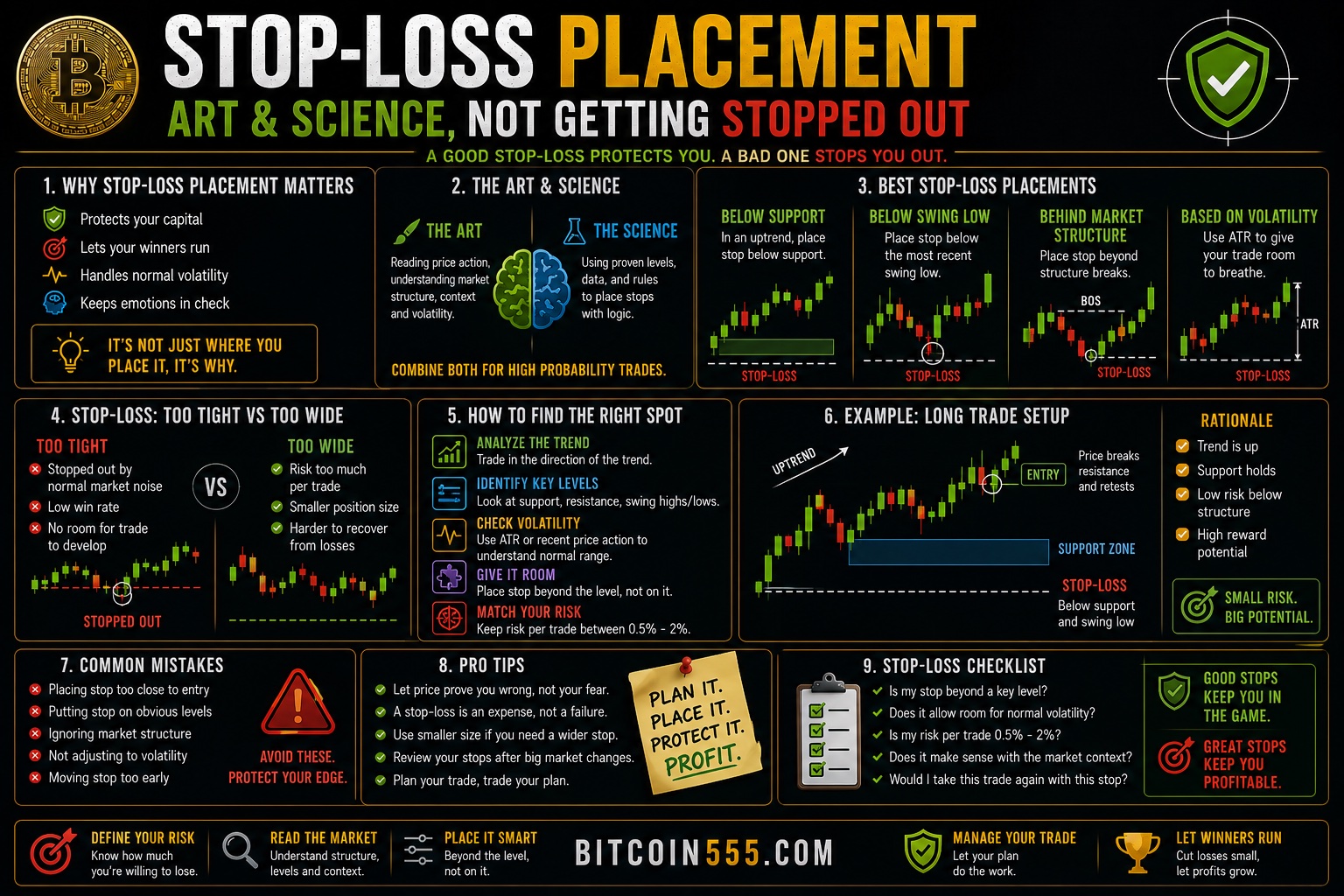
Here's the uncomfortable truth I learned the expensive way over years of trading: most traders don't lose money because their entries are bad. They lose money because their stops are placed where everyone else's stops are, sized without any math behind them, or removed entirely the moment the trade goes against them. Stop loss placement is half art, half science — and this article covers both halves with real numbers, not vague advice.
Why Stop Losses Exist (And Why 'Mental Stops' Fail)
A stop loss has exactly one job: to define your maximum loss before you enter the trade. That's it. It is not a prediction. It is not an admission that you're wrong about the market long-term. It is a pre-commitment device that removes your emotional brain from the decision at the worst possible moment — when you're losing money and desperately want to believe the market will come back.
Crypto punishes traders without hard stops more brutally than any other market. Bitcoin can drop 8% in an hour. Altcoins can drop 25% while you sleep. There are no circuit breakers, no market close, no weekend pause. If you trade a 24/7 market without a hard stop sitting on the exchange, you are effectively trading with unlimited risk.
The 'mental stop' — telling yourself you'll exit manually if price reaches a certain level — fails for a predictable reason. When price actually hits your level, you're not the calm person who made the plan anymore. You're a stressed person watching red candles, and stressed people negotiate. 'I'll give it a bit more room.' 'This wick doesn't count.' 'Let me wait for the candle close.' Three excuses later, your planned 2% loss is a 12% loss, and now you genuinely can't afford to exit. I've done this. Everyone has done this once. Good traders make sure it's only once.
The exception: some experienced traders use mental stops specifically to avoid stop hunts on illiquid pairs, executing manually with iron discipline. If you've been trading less than three years, assume this exception does not apply to you. Use hard stops on the exchange — on Binance you can set stop-limit or stop-market orders directly in the order panel, and they'll execute whether you're awake or not.
The Science: Position Sizing Comes Before Stop Placement
Here's where most tutorials get it backwards. They tell you to place a stop 'below support' and then trade whatever size feels comfortable. Professional risk management works in the opposite order:
- Decide your maximum risk per trade as a percentage of your account (typically 0.5%–2%).
- Find where the stop belongs based on the chart structure — the level that invalidates your trade idea.
- Calculate position size from those two numbers.
The formula is simple:
Position size = (Account × Risk %) ÷ (Entry price − Stop price)
Let's run it with real numbers. Say you have a $10,000 account and risk 1% per trade — that's $100 of maximum loss. You want to long Bitcoin at $60,000 because it just reclaimed a key level, and the structure tells you the trade is invalid below $58,200. Your stop distance is $1,800, or 3% of entry.
- Account: $10,000
- Risk per trade: 1% = $100
- Entry: $60,000
- Stop loss: $58,200 (stop distance = $1,800)
- Position size: $100 ÷ $1,800 = 0.0555 BTC ≈ $3,333 of exposure
If the stop hits, you lose $100 — exactly what you planned. If your target is $65,400 (a prior resistance zone), your reward is $5,400 per BTC against $1,800 of risk, a 3:1 reward-to-risk ratio. At 3:1, you only need to win 25% of your trades to break even. Win 40% and you're solidly profitable.
Notice what this framework does: it makes stop distance and position size inversely related. A wider stop doesn't mean more risk — it means a smaller position with the same dollar risk. This single realization fixes the most common structural error in retail trading: sizing the position first and then squeezing the stop to fit, which guarantees you get stopped out by normal noise.
The Art: Placing Stops Where Your Idea Is Actually Invalidated
The science tells you how much to risk. The art tells you where. The guiding principle: your stop should sit at the price where your trade thesis is objectively wrong — not at the price where the loss starts to feel uncomfortable.
Below/above structure, not at structure
If you're long because a support level at $2,400 on ETH is holding, the trade isn't invalidated at $2,399. Support is a zone, not a line, and crypto loves to wick through obvious levels before reversing. Place the stop where a genuine break is confirmed — typically below the low of the wick that formed the level, plus a volatility buffer. If the support low is $2,385, a stop at $2,352 (roughly 1.4% below the wick) survives the fakeout that a stop at $2,395 does not.
Use ATR to set the buffer objectively
The Average True Range (ATR) indicator measures recent volatility. A practical rule: your stop buffer beyond the structural level should be at least 0.5–1× the ATR on your trading timeframe. If the 4-hour ATR on your altcoin is $0.80 and price is $18.50, giving your stop less than $0.40–$0.80 of breathing room beyond the level means normal noise — not a real move — will take you out. During high-volatility periods, ATR expands and your stops should widen (with position size shrinking accordingly). During quiet ranges, ATR contracts and you can tighten up.
Avoid round numbers and obvious swing points
Stops cluster at psychologically obvious places: round numbers ($60,000, $2,500, $100), recent swing lows, and just below moving averages everyone watches. Large players know this. The 'stop hunt' — a sharp wick into an obvious liquidity pool followed by an immediate reversal — is not a conspiracy theory; it's how markets fill large orders. You can't avoid it entirely, but you can stop making it easy. If the obvious stop location is $58,000 even, place yours at $57,720. That extra distance costs you a slightly smaller position, and it saves the trade surprisingly often.
A Complete Worked Example: Swing Long on an Altcoin
Let's put everything together on a realistic altcoin swing trade.
Setup: A large-cap altcoin has been ranging between $0.92 and $1.18 for six weeks. Price sweeps below the range low to $0.895, reclaims $0.92 within two 4-hour candles, and holds. This is a classic deviation-and-reclaim setup — the failed breakdown suggests sellers are trapped.
- Account: $25,000
- Risk per trade: 1% = $250
- Entry: $0.94 (on retest of the reclaimed level)
- Invalidation logic: if price falls back below the sweep low at $0.895, the reclaim failed and the thesis is dead
- 4H ATR: $0.021
- Stop placement: $0.895 − $0.021 ≈ $0.874. Round awkwardly to $0.871 to avoid clustering.
- Stop distance: $0.94 − $0.871 = $0.069 (7.3% of entry)
- Position size: $250 ÷ $0.069 ≈ 3,623 tokens ≈ $3,405 exposure
- Target 1: range midpoint at $1.05 → +$0.11 per token → 1.6R, take one-third off
- Target 2: range high at $1.17 → +$0.23 per token → 3.3R for the remainder
Three outcomes are possible. Stop hits: you lose $250, exactly 1% of the account, and you're fine. Target 1 then stop at breakeven: small win. Full targets: roughly $600–700 profit depending on how you scale out. The trade risks 1% to make roughly 2.5%. String together a few dozen trades like this with even a mediocre win rate and the math works in your favor. That is the entire game.
Stop Loss Strategies for Different Trading Styles
Scalping (minutes to hours)
Tight stops, typically 0.3%–1% from entry, placed beyond the most recent micro swing point. Fees and slippage matter enormously here — a 0.1% taker fee on entry and exit eats 40% of a 0.5% stop. Scalpers should use stop-market orders (guaranteed execution) and accept slippage as a cost of doing business, because a stop-limit that doesn't fill during a fast move is a catastrophe.
Swing trading (days to weeks)
Stops of 3%–10% from entry, anchored to daily or 4-hour structure with an ATR buffer. This is the sweet spot for most part-time traders because the stops are wide enough to survive noise but the invalidation levels are clear.
Position trading (weeks to months)
Stops of 10%–25%, often based on weekly closes below major levels rather than intraday wicks. Position sizes are correspondingly small. Some position traders use a 'soft stop' — they exit only if the weekly candle closes below their level — which filters out wicks but requires genuine discipline and accepting worse fills.
Trailing stops for trend riders
Once a trade moves 1.5–2R in your favor, trailing the stop locks in profit while leaving room to run. Practical methods: trail below each new higher low on your timeframe, or trail at 2–3× ATR below price (the Chandelier Exit approach). Avoid tight percentage trails like 2% on volatile assets — you'll surrender every big winner to a routine pullback. Big winners pay for all the small losses; don't strangle them.
Common Stop Loss Mistakes That Drain Accounts
- Moving the stop further away after entry. This is the cardinal sin. You defined invalidation before the trade with a clear head; widening the stop mid-trade means your emotions are now managing your risk. The only acceptable direction to move a stop is toward profit.
- Using the same percentage stop on everything. A 3% stop might be generous on BTC and suicidal on a mid-cap altcoin whose daily ATR is 9%. Stops must scale with the asset's volatility, not your comfort level.
- Sizing first, stopping second. 'I want to buy $5,000 worth, so I'll put the stop 2% away to keep the loss small.' You've placed a stop based on your feelings, not the chart. It will get hit by noise, repeatedly.
- Placing stops at exact swing lows and round numbers. You're handing your position to whoever runs the liquidity sweep. Add a buffer, use awkward numbers.
- Ignoring leverage's effect on liquidation vs. stop. If you trade perpetual futures, your liquidation price must be far beyond your stop loss. If they're close, the exchange will close your position with fees and penalties before your stop ever triggers. As a rule, at 5x leverage or more, check that your stop sits well inside your liquidation price with margin to spare.
- Revenge-widening risk after a stop-out. Getting stopped and immediately re-entering with double size 'to make it back' turns one planned 1% loss into an unplanned 5% hole. Two consecutive stop-outs on the same idea means the market is telling you something. Listen.
- Keeping long-term holdings on trading accounts. Your swing trades belong on the exchange; your multi-year conviction holdings do not. Coins you have no intention of selling shouldn't sit next to your leverage. Move long-term positions to a Ledger hardware wallet — it removes both exchange counterparty risk and the temptation to turn holdings into margin collateral during a drawdown.
Frequently Asked Questions About Stop Losses
Should I use a stop-limit or stop-market order?
For most crypto traders, stop-market. It guarantees execution, which is the entire point of a stop loss. A stop-limit can fail to fill during a fast crash — precisely when you need protection most — leaving you in a free-falling position. Accept a little slippage as insurance premium. Stop-limits make sense only on highly liquid pairs when you set the limit price with a generous gap below the trigger.
What percentage should my stop loss be in crypto?
There is no universal percentage, and anyone giving you one is guessing. The stop belongs where your trade idea is invalidated, adjusted for the asset's volatility (ATR). What should be fixed is your dollar risk — 0.5%–2% of your account per trade — with position size calculated to match whatever stop distance the chart demands.
Why does price so often reverse right after hitting my stop?
Partly selection bias — you remember those trades vividly and forget the times the stop saved you from a 30% drawdown. Partly real market mechanics: obvious levels attract clustered stops, and sweeping them provides liquidity for large players to fill orders. The fix isn't removing stops; it's placing them beyond the obvious liquidity pools with an ATR-based buffer and sizing down to afford the wider distance.
Can I trade without a stop loss if I only use spot?
You can, in the sense that spot can't be liquidated. But 'no stop' really means 'my stop is zero.' Plenty of altcoins have fallen 90%+ and never recovered. If it's a trade — something you bought to sell higher — it needs an exit plan for being wrong. If it's a genuine long-term holding with a multi-year thesis, that's a different activity: size it as an investment, don't leverage it, and store it on a hardware wallet like a Ledger rather than leaving it on an exchange.
Should I move my stop to breakeven as soon as I'm in profit?
Not immediately — a stop at exact breakeven is another obvious level that gets swept on retests of your entry. A better habit: once the trade reaches roughly 1.5R in profit, move the stop to entry plus fees, or slightly below entry beyond the nearest micro-structure. You slightly reduce 'winner turned loser' pain without turning every retest into a scratch trade.
Conclusion: Stops Are Where Trading Discipline Lives or Dies
After enough years in this market, you realize that stop losses are not really about individual trades. They're about survival across hundreds of trades. Any single stop-out is noise. The system — fixed dollar risk, structure-based placement, volatility-adjusted buffers, position size derived from the math rather than from greed — is what keeps your account alive long enough for your edge to play out.
Getting stopped out will never stop hurting, and it will never stop happening. The goal isn't to avoid stop-outs; it's to make every stop-out small, planned, and survivable, while making sure your winners are allowed to run multiples of what you risked. Do the sizing math before every entry, place the stop where the idea dies rather than where the pain starts, add a buffer past the obvious levels, and never — ever — move a stop away from price once you're in the trade.
The market will take money from you regularly. Your job is to decide, in advance and with a calm head, exactly how much it's allowed to take each time. That decision is your stop loss. Treat it accordingly.
Disclaimer: This article is for educational purposes only and is not financial advice. Trading cryptocurrencies involves substantial risk of loss. Never trade with money you cannot afford to lose.