I've been trading crypto long enough to have blown up an account, rebuilt it, and learned the hard way that being clever is overrated. The single strategy that has kept me profitable across multiple market cycles isn't some exotic indicator stack or a secret Telegram signal. It's trend following — the least glamorous, most misunderstood approach in trading. Buy strength, sell weakness, cut losers fast, let winners run until the market tells you to leave. Simple to describe. Brutally hard to execute, because everything in your psychology fights against it.
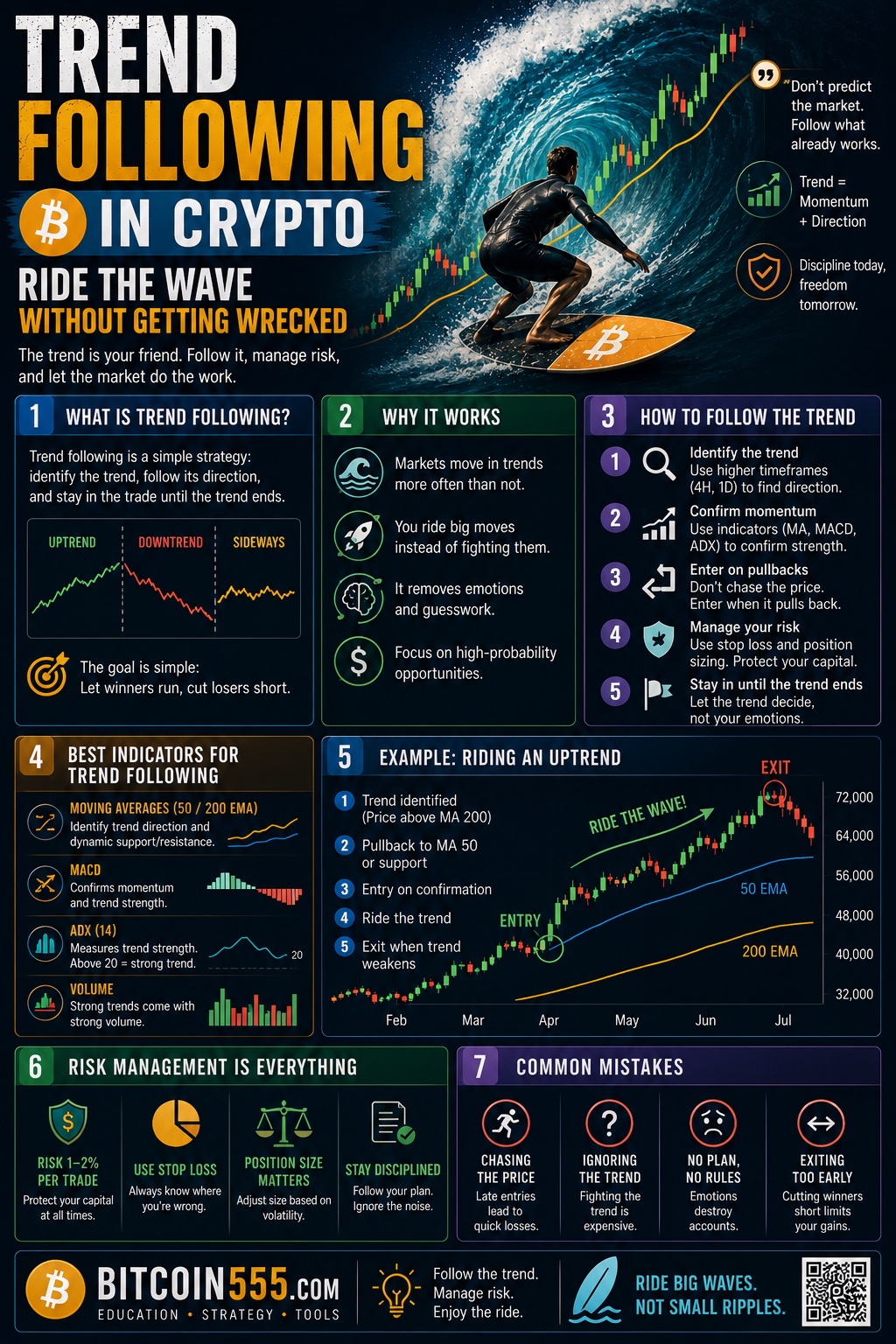
Here's the uncomfortable truth up front: a real trend following strategy loses more often than it wins. My own win rate on trend trades hovers around 35-40%. I'm profitable because my average winner is four to six times my average loser. If you can't stomach losing six trades in a row while sticking to the plan, this article will save you money by convincing you not to try. If you can, keep reading — because crypto, with its violent, extended trends, is arguably the best asset class ever created for this style of trading.
Why Trend Following Works in Crypto Markets
Trend following exists because markets are not efficient in the short-to-medium term. Prices don't move in neat random walks — they move in persistent directional runs driven by narrative, liquidity, leverage, and herd psychology. Crypto amplifies all four. When Bitcoin decides to move, it can trend for months, gaining or losing 60-80% while barely pausing. Altcoins are even more extreme: a strong altcoin trend can deliver 300-500% moves, and a bad one can erase 90% of value.
Traditional trend followers in commodities and futures have exploited this behavior for over fifty years. The math behind their edge is called positive skew: many small losses, occasional huge wins. Crypto's fat-tailed return distribution — meaning extreme moves happen far more often than a normal distribution predicts — makes this skew even fatter. You don't need to predict anything. You need to be positioned when the outlier move happens and out of the way when it isn't happening.
Contrast this with mean reversion strategies (buying dips, fading pumps), which win often but occasionally suffer catastrophic losses when the dip keeps dipping. In crypto, where a coin can drop 40% in a day, mean reversion without iron discipline is a slow-motion account destroyer. Trend following inverts the risk profile: your worst-case scenario on any single trade is a small, predefined loss.
Defining a Trend You Can Actually Trade
Everyone thinks they can spot a trend. Most people spot it after it's two-thirds over, buy the top, and then hold through the reversal. So let's get concrete about what qualifies as a tradeable trend.
The structure test: higher highs and higher lows
An uptrend, mechanically defined, is a sequence of higher swing highs and higher swing lows on your trading timeframe. For me, that timeframe is the daily chart. Anything below the 4-hour chart is mostly noise in crypto — you'll get chopped to pieces by liquidation wicks and weekend illiquidity.
The moving average filter
I use two simple filters, and I've tested dozens of fancier ones that don't beat them:
- Price above the 200-day moving average — I only take long trend trades when this is true. This single rule keeps you out of bear markets, which is where trend followers who ignore it get destroyed.
- The 20-day EMA above the 50-day EMA — this confirms medium-term momentum is aligned with the long-term regime.
When both conditions are met, I'm hunting for entries. When they're not, I do nothing. "Do nothing" is a position — in fact, it's the position trend followers hold most of the time. If you glance at Bitcoin's long-term history with a Bitcoin investment calculator, you'll notice something striking: the overwhelming majority of gains came from a handful of extended trending periods, separated by long stretches of chop and decline. Your entire job is to be exposed during the former and flat (or small) during the latter.
ATR: measuring the trend's breathing room
The Average True Range (ATR) tells you how much an asset typically moves per day. A 14-day ATR is the backbone of my stop placement and position sizing. If Bitcoin's daily ATR is $1,800, a stop loss placed $500 below entry is not a stop loss — it's a donation. Normal daily noise will take you out before the trend even gets started.
Entry Tactics: Breakouts vs Pullbacks (With Real Numbers)
There are two legitimate ways to enter a trend. Both work. Neither works all the time. Pick one and master it before touching the other.
Method 1: The range breakout
Classic Turtle-style entry: buy when price breaks above the highest high of the last 20-55 days, with the regime filters (above the 200 MA) already satisfied. The logic: markets consolidate, then expand. A multi-week high breaking on rising volume is often the first footprint of a new trend leg.
Worked example. Suppose you're trading a $20,000 account. Bitcoin has been ranging between $58,000 and $64,000 for five weeks, sitting above its 200-day moving average. Daily ATR is $1,900. Price closes at $64,800 — a clean break of the range high.
- Entry: $64,800 (on the daily close, not the intraday spike — this filters out fake breakouts)
- Stop loss: 2× ATR below entry = $64,800 − $3,800 = $61,000
- Risk per trade: 1% of account = $200
- Position size: $200 ÷ $3,800 risk per BTC = 0.0526 BTC (roughly $3,410 of exposure)
Notice the position is only about 17% of the account despite the 1% risk. That's the point. The stop distance dictates the size, never the other way around. If this trend runs 30% — entirely ordinary for Bitcoin — that position gains about $1,020, or roughly 5R. If the breakout fails, you lose $200 and move on.
Method 2: The pullback entry
Instead of buying the break, you wait for the trend to establish itself, then buy the first meaningful retracement — typically a pullback to the 20-day EMA or a prior breakout level acting as support.
Worked example. Ethereum is in a confirmed uptrend: above its 200-day MA, printing higher highs. It rallies from $3,100 to $3,900, then retraces to $3,450, right at the 20-day EMA, where a daily candle prints a strong rejection wick.
- Entry: $3,500 (break of the rejection candle's high)
- Stop loss: below the pullback swing low at $3,340 — a $160 risk per ETH
- Risk per trade: 1% of $20,000 = $200
- Position size: $200 ÷ $160 = 1.25 ETH (~$4,375 exposure)
- First target reference: the prior high at $3,900 is 2.5R away; a trend continuation beyond it is where the real payoff lives
Pullback entries give you tighter stops and better R:R, but you'll sometimes miss the strongest trends — the ones that never pull back. Breakout entries never miss the trend but suffer more false starts. Roughly 60% of my breakout entries fail. I take them anyway, because the 40% that work pay for everything.
Execution note: whichever method you use, place your orders on an exchange with deep liquidity so your fills match your plan — I execute on Binance for exactly this reason. Slippage on thin order books quietly destroys the edge of tight-stop strategies.
Position Sizing and Risk: The Part That Actually Determines Survival
Entries get all the attention. Sizing determines whether you're still trading in two years. Here are the non-negotiables I follow after learning each one expensively:
- Risk 0.5-1% of account equity per trade. Not 5%. Not "whatever feels right." At 1% risk, a ten-trade losing streak — which will happen — draws you down about 9.6%. Annoying, survivable. At 5% risk, the same streak costs 40% of your account and probably your discipline with it.
- Cap total portfolio heat at 4-5%. If I have five open trend trades each risking 1%, I'm done adding until something either stops out or gets its stop trailed to breakeven. Crypto correlations converge to 1 in a crash — five altcoin longs are effectively one big trade.
- Size from the stop, always. Position size = (account × risk %) ÷ (entry − stop). Tattoo this formula somewhere visible.
- Reduce size on leverage, don't expand it. If you use perpetual futures, leverage should be a capital-efficiency tool, not a size amplifier. My exposure calculation never changes just because leverage is available.
One more structural point: your trading capital and your long-term holdings should never share a wallet, an account, or a mental category. My trend-trading stack lives on the exchange where I execute; my long-term Bitcoin position sits in cold storage on a Ledger hardware wallet, deliberately inconvenient to access. That friction has saved me from "borrowing" from long-term holdings to add to a losing trade — a move that starts as a one-time exception and ends as a habit that ruins accounts.
Exits: Trailing Stops, Pyramiding, and Letting Winners Run
Trend following makes its money on exits, not entries. The entire edge lives in one behavior: holding winners far longer than feels comfortable.
The trailing stop is your only exit
I don't use profit targets on trend trades. Targets cap exactly the outlier moves the strategy depends on. Instead, I trail a stop and let the market throw me out:
- Chandelier / ATR trail: stop sits 3× ATR below the highest close since entry. As price rises, the stop ratchets up. It never moves down.
- Swing-low trail (my preference): stop goes below each new higher swing low on the daily chart. Slower to react, but keeps you in through normal 15-20% crypto pullbacks that shake out tighter trails.
Yes, this means you always give back profit at the end. In the Bitcoin example above, if the trend ran from $64,800 to $89,000 and the 3× ATR trail stopped you out at $81,500, you'd "lose" $7,500 of open profit per BTC from the peak. Traders obsess over this giveback. Ignore them. You cannot know the peak in real time, and every method that tries to nail it exits early on the trades that would have tripled. The giveback is the fee you pay for unlimited upside.
Pyramiding: adding to winners, carefully
Once a trade moves 2R in my favor and I've trailed the stop to breakeven, I'll consider adding a second unit at the next pullback or breakout — sized at half the original risk (0.5%). The original position now risks nothing, so total open risk stays controlled while exposure to a working trend grows. Two rules: never add to a position that's below your last add, and never let combined risk on one asset exceed 1.5% of equity. Pyramiding turns good trends into great years, but done greedily it turns one reversal into a multi-unit loss.
Common Mistakes That Wreck Trend Followers
Every mistake below is one I've personally made or watched cost someone real money. In rough order of destructiveness:
- Trading trends against the higher-timeframe regime. Buying a 4-hour "uptrend" while price sits below the 200-day MA is fighting the tide. Most of these rallies are bear market bounces, and they fail with vicious speed.
- Stops inside the noise. Placing a stop 1% below entry on an asset with a 4% daily ATR guarantees you get stopped out by randomness. If the proper stop distance forces a position too small to feel exciting — good. That's the strategy working.
- Abandoning the system during the losing streak. Trend following delivers its losses in clusters, usually during choppy, rangebound markets. Six to eight consecutive small losses is normal, not broken. The traders who quit at loss number seven donate their edge to the ones who take trade number eight — often the one that trends for three months.
- Taking profits early because "it's up a lot." Cutting a winner at 2R because you're nervous, then watching it run to 12R, is the most expensive comfort in trading. With a sub-40% win rate, capped winners equal a losing system. Full stop.
- Revenge sizing. Doubling risk after losses to "get it back faster" converts a routine drawdown into a terminal one. Your risk per trade is a constant, not a mood.
- Chasing extended moves. Entering after a coin has already run 80% without a pullback means your logical stop is miles away and your R:R is garbage. Missed trades cost nothing. There's always another breakout.
- Over-diversifying into correlated altcoins. Ten altcoin longs isn't diversification — it's one leveraged bet on Bitcoin's direction. Count your true exposure honestly.
- Confusing trading capital with savings. If your trend trading and your retirement stack live in the same account, one bad month bleeds into the other. Trade with defined risk capital; keep long-term coins offline on a hardware wallet like a Ledger and pretend they don't exist during market hours. If accumulation is your real goal, systematic buying may suit you better than trading — run the numbers through a DCA calculator and compare honestly.
Frequently Asked Questions About Crypto Trend Following
What timeframe is best for trend following in crypto?
Daily charts for signals, weekly charts for regime confirmation. Trends on lower timeframes exist, but transaction costs, slippage, and liquidation wicks eat most of the theoretical edge. The daily chart also fits around a normal life — I check my charts once per day after the daily close and place orders for the next session. More screen time usually means more mistakes, not more profit.
What win rate should I expect from a trend following strategy?
Between 30% and 45% is typical and healthy. The profitability comes from asymmetry: average winners of 3-6R against fixed 1R losers. If your backtest shows a 70% win rate on a trend system, something is wrong — usually lookahead bias, cherry-picked data, or profit targets that have quietly turned it into a scalping system.
Does trend following work on altcoins or only Bitcoin?
It works on liquid altcoins — arguably better in raw percentage terms, because altcoin trends are more explosive in both directions. But you must halve your risk per trade (0.5% instead of 1%), demand real spot volume, and accept that many altcoins enter permanent downtrends and never recover. I only trend-trade alts within the top tier of liquidity on major venues like Binance, and I treat every altcoin position as expendable. No bag-holding, no "it'll come back." The stop is the stop.
How is trend following different from just buying and holding?
Buy-and-hold rides every drawdown in full — including the 70-85% bear market declines crypto has historically delivered. Trend following aims to capture most of the upside while stepping aside during sustained declines, trading smaller total returns in raging bull markets for dramatically shallower drawdowns. Many traders sensibly run both: a cold-storage core position for the decade-long thesis, and a trend-traded satellite for the cycles.
Can I automate a trend following strategy?
Yes, and the mechanical nature of trend rules makes them well suited to automation. But automate only after you've traded the system manually for months and understand its drawdown behavior in your gut. Bots don't fix a strategy you'd abandon under pressure — they just execute your future panic-override faster.
Conclusion: Boring Rules, Executed Relentlessly
Trend following in crypto isn't a prediction game, and it isn't clever. It's a discipline: trade with the higher-timeframe regime, enter on strength via breakouts or pullbacks, size every position from a volatility-based stop, risk about 1% per trade, trail your stops, and let the rare monster winners pay for the many small losses. The edge is real, it's decades old, and crypto's fat-tailed trends feed it better than almost any market in history.
The catch is that the strategy's difficulty is emotional, not intellectual. You will lose more often than you win. You will give back open profits at the end of every trend. You will sit flat through choppy months while others brag about scalps. If you can accept all of that and execute the boring rules anyway — with your trading capital ring-fenced on the exchange and your long-term holdings safely offline — you'll be running the same core playbook that has kept systematic traders alive through every market regime for half a century. Start small, respect the math, and let the waves do the work.
Disclaimer: This article is for educational purposes only and is not financial advice. Trading cryptocurrencies involves substantial risk of loss. Never trade with money you cannot afford to lose.