The Coldcard exploit that began on July 30 is one of the most serious self-custody incidents Bitcoin has seen. I've been following it closely from the first hours — watching the drains unfold on-chain — and people I know were affected, some of them badly. If you own a Coldcard, any model, this guide walks you through exactly what to check and what to do, step by step, calmly and without mistakes.
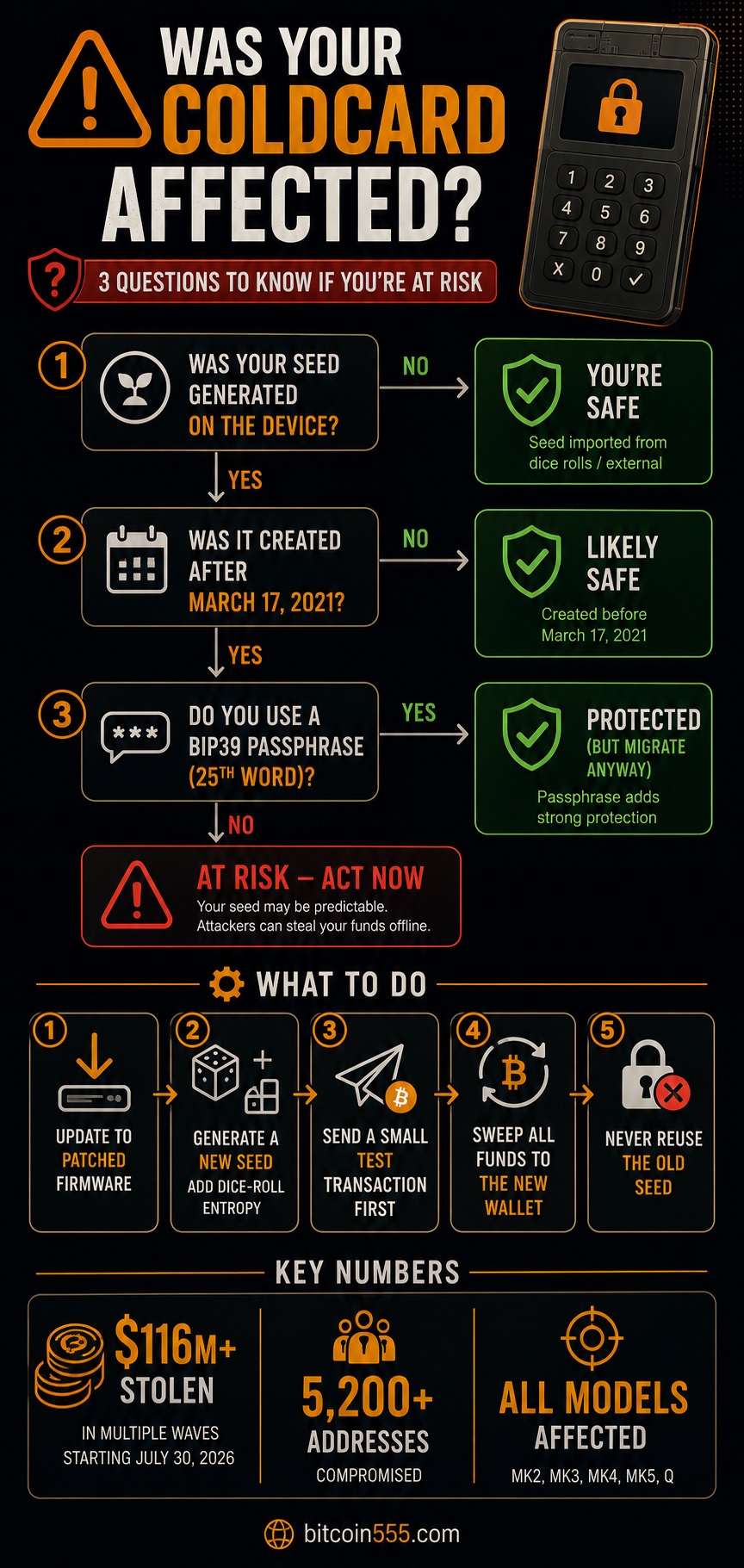
Quick answer: you are potentially affected if your seed was generated on a Coldcard — any model: Mk2, Mk3, Mk4, Mk5 or Q — after March 17, 2021, and you do not use a BIP39 passphrase. If that describes your setup, treat the seed as compromised. Move your funds to a freshly generated seed on patched firmware now, then come back and read the rest of this guide.
How to check if you're affected
Four questions determine your exposure. Answer them honestly, and when in doubt, assume the worse answer — the cost of being wrong in one direction is a wallet migration; in the other direction it's everything.
1. When was your seed generated?
The vulnerable firmware shipped in March 2021. Every wallet drained so far traces back to a seed created after March 17, 2021. If you set up your Coldcard before that date and never regenerated the seed, this particular bug does not apply to you. If you're not sure of the date — and many people aren't — treat the seed as at risk. A wallet migration costs you an afternoon and a transaction fee; guessing wrong costs you the balance.
2. Where was the seed generated?
This bug lives in the Coldcard's own seed generation. If the device created your seed — the standard "new wallet" flow — you're in scope. If you imported a seed that was created somewhere else, or generated it with dice rolls and typed the words in yourself, your seed never touched the weak random number generator and is safe from this specific flaw. People who added their own dice-roll entropy on top of the device's generation are also protected: the whole point of that feature is exactly this scenario.
3. Do you use a BIP39 passphrase?
Here's the one piece of genuinely good news in this mess: users who protected their wallet with a BIP39 passphrase — the so-called 25th word — have not been drained, even where the underlying seed was weak. Attackers can regenerate the vulnerable seeds, but the passphrase never lived on the device's random number generator, so the derived wallets remain out of reach. If you've been using one, your funds are protected. Migrate anyway at your convenience, because the seed underneath is still weak — but you are not in the emergency category.
4. Which model do you have? It doesn't matter
The early advisories focused on the older Mk3, and a lot of Mk4, Mk5 and Q owners relaxed. That was a mistake. On August 1, security researchers confirmed that wallets from the newer models were being drained as well, and the on-chain data backs it up. Do not assume a newer device means a safe seed. The four questions above are what matter — the model number is not one of them.
What to do right now if you're affected
- Move with urgency, not panic. At least fifteen separate attackers have been sweeping vulnerable wallets in waves since July 30 — over $116 million taken so far. Waiting is the worst option. But so is fumbling a rushed migration: people lose funds to typos and phishing sites in moments like this. Work deliberately through the steps below, ideally in one sitting.
- Update the firmware first. Download the latest patched firmware from Coinkite's official site — type the address yourself, don't follow links from messages or search ads — verify it, and install it. Generating a new seed on vulnerable firmware just creates a second compromised wallet.
- Generate a completely new seed on the patched firmware. Better still, use the dice-roll option and add your own entropy while you're at it. Write the new words on paper or steel. This is a fresh start — treat the backup with the seriousness the old one deserved.
- Move everything. Send a small test amount from the old wallet to the new one first, confirm it arrives, then sweep the full balance. Every satoshi left behind on the old seed remains claimable by anyone who can regenerate it — and thousands of people evidently can.
- Verify and retire the old seed. Confirm the funds show up under the new seed at a fresh address, then never touch the old seed again. Don't reuse it, don't "keep it for small amounts," don't keep receiving to old addresses. It's burned.
- Consider a passphrase for the new setup. This incident is the strongest real-world argument the passphrase has ever had. But understand it before enabling it — a passphrase you forget is indistinguishable from a hack. Our passphrase guide covers how it works and the mistakes to avoid.
What actually happened
In short: a Coldcard firmware build released in March 2021 routed seed generation through a weak pseudo-random number generator instead of the device's true hardware RNG. Seeds that should have been unguessable became reproducible by anyone who understood the flaw — offline, at scale, five years later. The first mass drain hit on July 30, 2026, and it has since grown to more than $116 million across four distinct waves, with at least fifteen attackers racing each other for the remaining vulnerable wallets. The stolen coins are still traceable on-chain, roughly 600 attacker addresses have been reported to federal investigators, and Bitcoin itself worked exactly as designed throughout — the keys were simply never as random as their owners believed. We're maintaining a full timeline with running totals on our Coldcard hack tracker.
Lessons for every Bitcoiner — not just Coldcard owners
- A hardware wallet is only as good as its firmware. The secure element, the air gap, the open source code — none of it helped, because the flaw was in the code that created the keys in the first place.
- Passphrases are a survival layer. This hack turned a nice-to-have into a proven defense: passphrase users with identical vulnerable seeds kept their coins.
- Multisig protects against single-seed failure. A 2-of-3 setup across different devices means one compromised seed — from any cause — cannot move your funds. If your balance justifies the extra complexity, read our plain-English multisig guide.
- No single vendor deserves blind trust. This was a five-year-old bug in one of the most respected, open-source, Bitcoin-only devices on the market — and nobody caught it until the money moved. Diversify your assumptions the way you'd diversify anything else that matters.
Where to go from here
Follow the developing situation on the Coldcard hack tracker, which we update as new waves are confirmed. If this episode has you rethinking your whole setup, our guides on why self-custody matters and how to start and the hardware wallet comparison will help you rebuild on firmer ground. Self-custody is still the right answer — this week just reminded us it's a practice, not a purchase.