If you've spent any time learning about Bitcoin beyond the basics, you've probably encountered the term UTXO. It sounds technical, perhaps even intimidating, but understanding UTXOs is essential if you want to truly grasp how Bitcoin works under the hood. Think of it as learning how an engine functions before you start racing cars—you don't absolutely need it, but it makes you a far more capable driver.
Unlike traditional banking systems where your account simply displays a balance that gets updated with each transaction, Bitcoin operates on a fundamentally different model. There's no central database keeping track of everyone's balances. Instead, Bitcoin uses something called the UTXO model—Unspent Transaction Outputs—to determine who owns what at any given moment.
In this comprehensive guide, we'll break down exactly what UTXOs are, how they work in practice, why they matter for your privacy and transaction fees, and how you can use this knowledge to become a more sophisticated Bitcoin user. Whether you're a curious beginner or someone looking to deepen your technical understanding, this explanation will give you the clarity you need.
Understanding the UTXO Model: Bitcoin's Accounting System
To understand UTXOs, let's first consider how traditional banking works. When you have $500 in your bank account, there's a database somewhere that says "Account #12345 has a balance of $500." When you spend $50, the bank simply updates that number to $450. Simple, centralized, and completely reliant on trust in the bank.
Bitcoin takes a radically different approach. Instead of tracking balances, Bitcoin tracks individual chunks of value called Unspent Transaction Outputs. Every time you receive Bitcoin, you're actually receiving one or more UTXOs—specific outputs from previous transactions that are now assigned to your address and haven't been spent yet.
The key insight is this: Your Bitcoin "balance" is actually the sum of all UTXOs that your private keys can unlock. There's no single number stored anywhere saying how much Bitcoin you own. Your wallet software calculates your balance by scanning the blockchain for all UTXOs associated with your addresses.
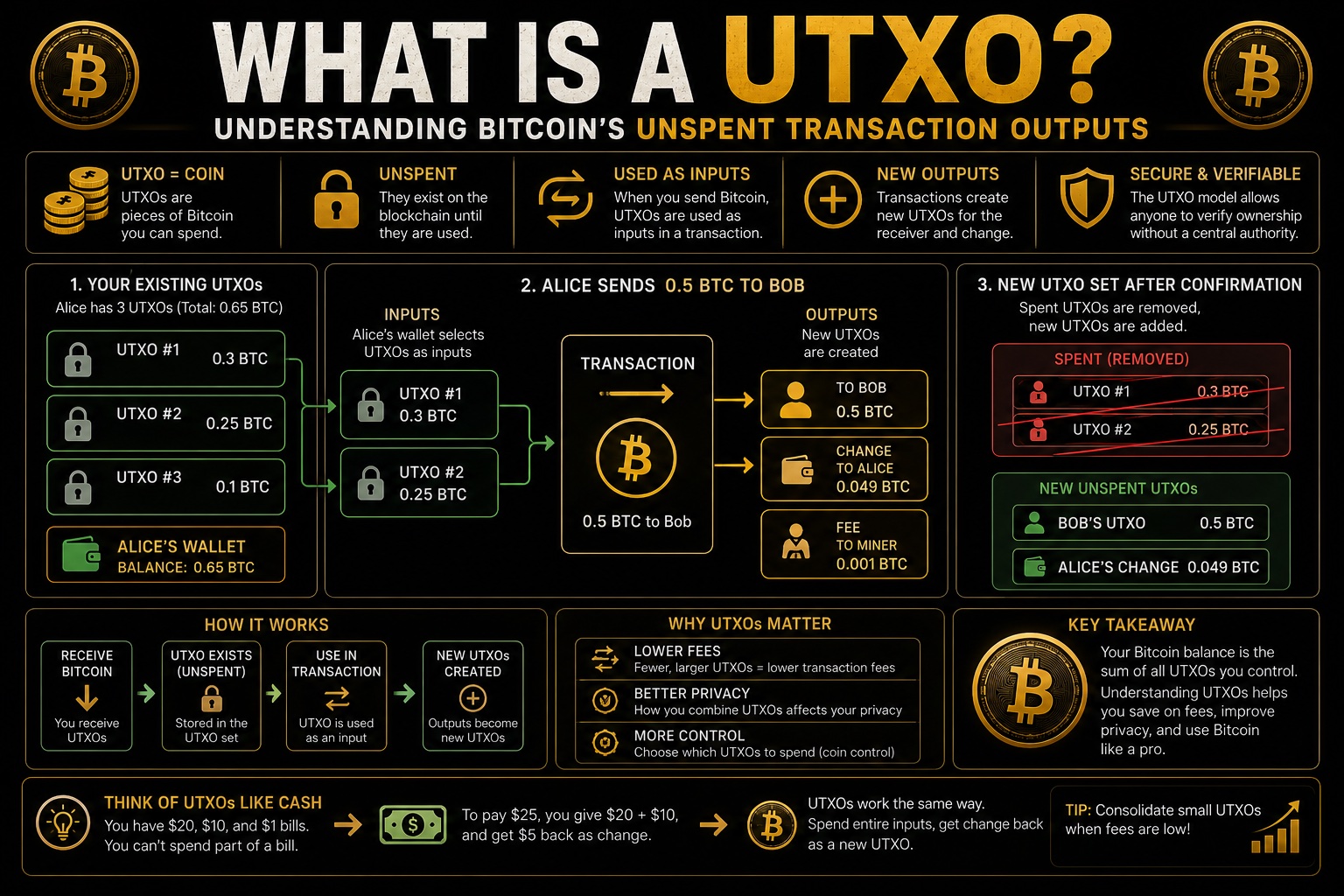
Think of UTXOs like physical cash. If you have a $20 bill, a $10 bill, and three $1 bills, your total is $33. But that $33 exists as separate, distinct pieces of paper. You can't spend $15 by somehow cutting your $20 bill in half. Instead, you hand over the $20 and receive $5 in change. UTXOs work the same way.
How Bitcoin Transactions Actually Work with UTXOs
Let's walk through a concrete example to make this crystal clear. Imagine Alice wants to send 0.5 BTC to Bob. Here's what actually happens at the UTXO level:
Step 1: Gathering Inputs
Alice's wallet scans her available UTXOs. Let's say she has three:
- UTXO #1: 0.3 BTC (received from a previous transaction)
- UTXO #2: 0.25 BTC (received from another transaction)
- UTXO #3: 0.1 BTC (received from a third transaction)
Her total balance is 0.65 BTC, but this exists as three separate UTXOs.
Step 2: Creating the Transaction
To send 0.5 BTC to Bob, Alice's wallet selects UTXOs that together equal or exceed 0.5 BTC. It might select UTXO #1 (0.3 BTC) and UTXO #2 (0.25 BTC), totaling 0.55 BTC.
Step 3: Defining Outputs
The transaction creates new outputs:
- Output #1: 0.5 BTC to Bob's address (this becomes Bob's new UTXO)
- Output #2: 0.049 BTC back to Alice's change address (this becomes Alice's new UTXO)
- The remaining 0.001 BTC goes to the miner as a transaction fee
Step 4: Spending the Inputs
The moment this transaction is confirmed, UTXO #1 and UTXO #2 are marked as "spent" and can never be used again. They're removed from the UTXO set. Meanwhile, two new UTXOs are created—one belonging to Bob and one belonging to Alice.
This is the fundamental cycle: transactions consume existing UTXOs and create new ones. The entire history of Bitcoin transactions is really just a chain of UTXOs being created and destroyed.
Why UTXOs Matter for Your Transaction Fees
Here's where understanding UTXOs becomes practically useful: the number and size of UTXOs you use directly affects your transaction fees.
Bitcoin transaction fees aren't based on the amount of Bitcoin you're sending. They're based on the size of your transaction in bytes. And what determines transaction size? Primarily, the number of inputs (UTXOs being spent) and outputs you include.
Each input requires your wallet to include a digital signature proving you own that UTXO. These signatures take up space—roughly 68 bytes for a standard single-signature input, or more for multi-signature setups. If your wallet needs to combine 10 small UTXOs to make a payment, your transaction will be much larger (and more expensive) than if you could use just one large UTXO.
Practical example: Let's say the current fee rate is 20 satoshis per byte (sat/vB). A simple transaction with one input and two outputs might be around 225 bytes, costing 4,500 satoshis (about 0.000045 BTC). But a transaction combining 15 small UTXOs could easily be 2,500 bytes, costing 50,000 satoshis—more than ten times as much for potentially the same payment amount.
This is why accumulating many small UTXOs can become expensive. If you receive lots of tiny payments, you might find that spending them costs more in fees than they're worth. This is sometimes called "dust"—UTXOs so small that the cost to spend them exceeds their value.
UTXO Management: Best Practices for Bitcoin Users
Now that you understand how UTXOs affect your fees and transaction efficiency, let's discuss practical strategies for managing them wisely.
Consolidate During Low-Fee Periods
When network fees are low, consider consolidating your smaller UTXOs into larger ones. You do this by sending Bitcoin to yourself—selecting all your small UTXOs as inputs and creating one larger UTXO as output. Yes, you'll pay a fee, but consolidating when fees are 5 sat/vB is far cheaper than being forced to use those UTXOs when fees spike to 100 sat/vB.
Most quality Bitcoin wallets allow you to manually select which UTXOs to spend. This feature, often called "coin control," is essential for advanced UTXO management. If your current wallet doesn't offer this, consider upgrading to one that does.
Consider UTXO Size When Receiving
If you're regularly receiving Bitcoin payments, think about how they arrive. Receiving one payment of 0.01 BTC is more efficient than receiving ten payments of 0.001 BTC each, because you'll have fewer UTXOs to manage later.
For those purchasing Bitcoin on exchanges like Binance, consider accumulating a meaningful amount before withdrawing to your personal wallet. This way, you create one reasonable-sized UTXO rather than many small ones from frequent withdrawals.
Avoid Creating Dust
When sending transactions, be mindful of change outputs. If you'd be creating a tiny change output (say, 546 satoshis—the minimum), it might be more economical to slightly increase your fee and avoid creating that dust UTXO altogether.
Use SegWit Addresses
Segregated Witness (SegWit) addresses significantly reduce the size of signature data in transactions. Using SegWit (addresses starting with "bc1") means your UTXOs are cheaper to spend than legacy UTXOs. Native SegWit (bech32) addresses offer the best savings.
UTXOs and Bitcoin Privacy
Beyond fees, UTXOs have significant implications for your privacy. This is an often-overlooked aspect that sophisticated Bitcoin users should understand.
When you spend multiple UTXOs in a single transaction, you're essentially revealing that those UTXOs are controlled by the same entity. Blockchain analysts call this the "common input ownership heuristic." If you received Bitcoin from three different sources and then spend all three UTXOs together, observers can reasonably conclude all those addresses belong to you.
The change output problem
Change outputs also create privacy concerns. When you spend a UTXO and receive change, that change is sent to a new address in your wallet. But sophisticated analysis can often identify which output is the change, linking your new address to your previous ones.
For users who prioritize privacy, UTXO management becomes even more important. Strategies include:
- Avoiding mixing UTXOs from different sources when possible
- Using wallets that implement coin control for deliberate UTXO selection
- Considering CoinJoin transactions that combine UTXOs with other users to break the chain of ownership
- Being mindful of round-number payments that make change outputs obvious
Hardware wallets like Ledger devices can help with security, but privacy requires conscious UTXO management regardless of your storage method. Understanding that your UTXOs carry history—they can be traced back through every previous transaction—is crucial for maintaining financial privacy.
The Technical Side: How the UTXO Set Works
For those interested in the deeper technical aspects, let's explore how Bitcoin nodes handle UTXOs.
Every full Bitcoin node maintains what's called the "UTXO set"—a database of all currently unspent transaction outputs. This is separate from the blockchain itself. While the blockchain is a historical record of all transactions ever made, the UTXO set is a current snapshot of who owns what.
As of recent years, the UTXO set contains hundreds of millions of individual UTXOs and requires several gigabytes of storage. Every time a new block is mined, nodes update their UTXO set: they remove the UTXOs that were spent in that block's transactions and add the new UTXOs that were created.
This design is remarkably efficient. To verify a new transaction, a node only needs to check the UTXO set to confirm that the inputs being spent actually exist and haven't been spent before. It doesn't need to scan through the entire transaction history. This is one reason why Bitcoin can function without requiring complete trust in historical data—you can verify current ownership independently.
The UTXO commitment
The UTXO set is so fundamental that there have been proposals to include a cryptographic commitment to it in each block. This would allow new nodes to quickly sync to the current state without downloading and verifying the entire blockchain history—though this remains an area of ongoing development and discussion.
Common UTXO Misconceptions Clarified
As you deepen your understanding of UTXOs, it helps to address some common misunderstandings.
Misconception #1: "I have 1 Bitcoin in my wallet."
More accurately, your wallet controls UTXOs that sum to 1 Bitcoin. You might have a single UTXO worth exactly 1 BTC, or you might have a hundred UTXOs that together equal 1 BTC. The distinction matters for fees and privacy.
Misconception #2: "The Bitcoin I received is the same Bitcoin I'll send."
When you spend Bitcoin, the original UTXO is destroyed and new UTXOs are created. It's not like passing a physical coin from person to person. Each transaction creates entirely new outputs—even your change is a new UTXO.
Misconception #3: "My wallet stores my Bitcoin."
Your wallet stores your private keys, which give you the ability to spend UTXOs on the blockchain. The Bitcoin itself—the UTXOs—exist on the distributed ledger, not in your wallet. This is why backing up your seed phrase (which generates your private keys) is essential. Whether you use a software wallet or a hardware wallet like Ledger for enhanced security, you're storing keys, not coins.
Misconception #4: "Smaller transactions are cheaper."
Transaction fees depend on data size, not Bitcoin value. Sending 0.001 BTC could cost more in fees than sending 10 BTC if the small transaction requires combining many UTXOs while the large one uses a single UTXO.
Frequently Asked Questions About Bitcoin UTXOs
How can I see my UTXOs?
Most Bitcoin wallets show you a single balance, but many allow you to view individual UTXOs through advanced settings or coin control features. Wallets like Sparrow, Electrum, and Bitcoin Core offer UTXO visibility. Hardware wallet interfaces often include this feature as well. You can also look up any address on a block explorer to see its UTXOs.
What happens to spent UTXOs?
Once a UTXO is spent, it's removed from the active UTXO set and can never be used again. The transaction that spent it remains permanently recorded in the blockchain as historical proof, but the UTXO itself is effectively destroyed. The Bitcoin value it represented now exists in the new UTXOs created by that transaction.
Can a UTXO be partially spent?
No. A UTXO must be spent entirely in a single transaction—you cannot spend half of a UTXO. However, transactions can create change outputs, sending the unused portion back to an address you control as a new, separate UTXO. This is why understanding change addresses is important for both privacy and fee management.
Why does UTXO consolidation help with fees?
When you consolidate UTXOs during low-fee periods, you're essentially paying a small fee now to combine many small UTXOs into fewer larger ones. Later, when you need to make a payment, your transaction will require fewer inputs, resulting in smaller transaction size and lower fees—especially valuable if network fees have increased since you consolidated.
Do other cryptocurrencies use the UTXO model?
Yes, many cryptocurrencies adopted Bitcoin's UTXO model, including Litecoin, Bitcoin Cash, and Cardano. However, others use an account-based model similar to traditional banking, most notably Ethereum. Each approach has trade-offs in terms of privacy, scalability, and smart contract capability.
Conclusion: Mastering UTXOs for Better Bitcoin Usage
Understanding UTXOs transforms how you think about Bitcoin. Instead of viewing your wallet as a simple account with a balance, you now see it for what it truly is: a collection of individual, distinct pieces of value that you control through cryptographic keys.
This knowledge has practical implications. You can make smarter decisions about consolidating UTXOs when fees are low, selecting specific UTXOs for privacy, and understanding why some transactions cost more than others. You'll appreciate why hardware wallets like Ledger emphasize backup procedures—losing access to your keys means losing access to your UTXOs forever, regardless of their value.
The UTXO model is elegant in its simplicity. It allows Bitcoin to operate without any central authority tracking balances, enables straightforward verification of transactions, and provides a foundation for advanced features like multi-signature security and payment channels. As you continue your Bitcoin education, you'll find that UTXOs connect to nearly every other concept—from mining to the Lightning Network.
Take time to explore your own wallet's UTXOs. Look at how your past transactions created the specific UTXOs you hold today. Practice coin selection if your wallet supports it. The more hands-on experience you gain with UTXO management, the more confident and capable you'll become as a Bitcoin user.