The first time I got wrecked by a dead cat bounce, I was convinced I'd caught the bottom. A major altcoin had dumped 38% in two days, then ripped 15% higher in six hours. I bought the strength, sized up because I was "confident," and watched the price roll over and make a new low the next morning. That trade cost me 4% of my account and taught me one of the most valuable lessons in crypto trading: a bounce is not a reversal. Most of the time, it's bait.
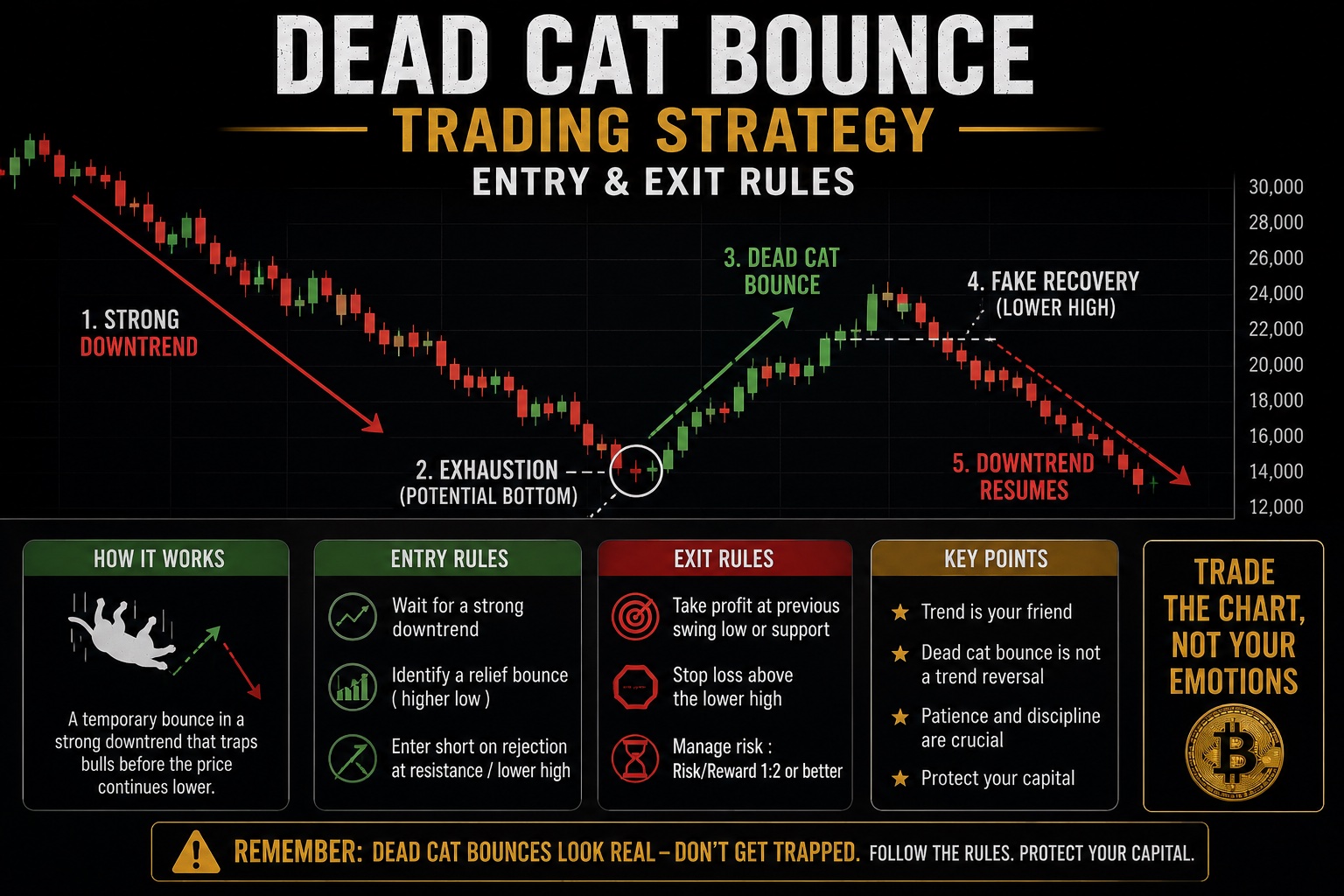
The good news? Once you understand the dead cat bounce, you can flip the script. Instead of being the exit liquidity for smarter traders, you can trade the bounce itself — or short its failure — with defined risk and a repeatable edge. This guide covers exactly how I do it: pattern recognition, entry triggers, stop placement, position sizing, and the mistakes that will drain your account if you ignore them.
What Is a Dead Cat Bounce in Crypto Trading?
A dead cat bounce is a temporary, short-lived recovery in the price of an asset that's in a strong downtrend. The name comes from the grim old market saying: "even a dead cat will bounce if it falls from high enough." The bounce looks like a recovery, feels like a recovery, gets called a recovery on social media — and then price rolls over and continues lower, often breaking the previous low.
Mechanically, here's what's happening under the hood:
- Short covering. Traders who shorted the initial dump take profits, and their buy orders push price up.
- Bargain hunters. Retail traders see a coin down 30-50% and buy "the dip" without confirmation.
- Oversold mechanics. After a violent move, order books are thin. It takes very little buying pressure to move price up quickly.
None of these forces represent genuine new demand at scale. That's why the bounce dies. Once shorts have covered and dip buyers are loaded, there's no fuel left — and the sellers who missed the first leg down use the bounce to exit. In crypto, where leverage is everywhere and moves are amplified, dead cat bounces are more frequent and more violent than in traditional markets.
Typical characteristics I look for:
- An initial decline of 20% or more within days (crypto moves fast).
- A bounce retracing roughly 25-50% of the drop — rarely more than 61.8% (the Fibonacci golden pocket).
- Declining volume during the bounce compared to the sell-off. This is the single most reliable tell.
- The bounce failing at an obvious resistance level: prior support turned resistance, a moving average, or a Fib retracement zone.
Dead Cat Bounce vs. Genuine Reversal: How to Tell the Difference
This is the question that decides whether you make money or become someone else's exit liquidity. There's no perfect answer, but there are strong probabilistic signals.
Signs it's a dead cat bounce
- Volume divergence. The sell-off happened on 3-5x average volume; the bounce is happening on below-average volume. Buyers aren't committed.
- V-shaped bounce with no base. Real bottoms almost always involve consolidation — days or weeks of sideways chop, higher lows, accumulation. A straight vertical bounce off the low with no structure is suspect.
- Bounce stalls at broken support. If price dumped through $2,400 support on ETH and the bounce dies exactly at $2,400 from below, that's textbook resistance flip — bearish.
- Funding rates flip positive fast. On perpetual futures, if funding goes strongly positive during the bounce, longs are crowded and the move is fragile.
- No change in the macro driver. If the dump was caused by a specific catalyst (exchange trouble, regulatory news, a token unlock) and nothing has changed, the bounce is purely technical.
Signs it might be a real reversal
- Volume expands on the bounce and holds on subsequent green days.
- Price reclaims and holds key levels — closing back above broken support and successfully retesting it from above.
- Higher lows form on the retest. The first pullback after the bounce holds above the original low with clear buying interest.
- Bullish divergence on RSI at the low (price makes a lower low, RSI makes a higher low) on the 4H or daily timeframe.
My working rule after years of trading these: assume every bounce in a downtrend is a dead cat bounce until price proves otherwise by reclaiming structure on volume. This default assumption alone will save you from most bad entries.
Two Ways to Trade the Dead Cat Bounce
There are two distinct strategies here, and you should know which one you're running before you click buy or sell.
Strategy 1: Long the bounce itself (aggressive, fast)
You're trading the bounce as a bounce — a quick counter-trend scalp. You're not pretending it's a reversal. You get in early, take profit into strength, and you're flat before the rollover.
Entry rules:
- Wait for a decline of at least 20% from the local high within 1-5 days.
- Look for a capitulation signal: a high-volume wick on the 1H/4H chart, RSI below 25 on the 4H, or a liquidation cascade that suddenly stops.
- Enter on the first 1H candle that closes back above the low of the capitulation candle, or on a reclaim of the nearest intraday level.
- Stop loss goes below the capitulation wick low.
- Target: 38.2% Fibonacci retracement of the drop as target one, 50% as a stretch target. Take at least half off at target one. Always.
Realistic example. A large-cap altcoin falls from $180 to $126 (a 30% drop) in three days. On the third day, a 4H candle prints a massive wick to $121 on 4x average volume, and price closes back at $128. I enter long at $129 with a stop at $120.50 — risk of $8.50 per token. The 38.2% retracement of the $180-to-$121 move sits at ~$143.50. That's $14.50 of upside against $8.50 of risk, roughly 1.7R. The 50% retracement at ~$150.50 gives ~2.5R on the runner. I risk 1% of a $20,000 account ($200), so position size is $200 / $8.50 = ~23.5 tokens, about $3,030 notional. No leverage needed.
This trade works often, but it demands discipline: you must sell into strength when it feels like the coin is "coming back." That feeling is exactly what traps everyone else.
Strategy 2: Short the failed bounce (higher probability, my preference)
Instead of catching a falling knife, you let the dead cat bounce happen, wait for it to exhaust, and short the continuation. You're trading with the dominant trend, which is why win rates and R:R are typically better.
Entry rules:
- Confirm the downtrend: price below the 50-day and 200-day moving averages, or a clear break of a major daily support.
- Let the bounce retrace 38.2-61.8% of the drop into a confluence zone — broken support, a declining 20 EMA on the daily, or a prior consolidation area.
- Watch for exhaustion: declining volume, a 4H bearish engulfing candle, or a lower high forming inside the resistance zone.
- Enter short on the break of the bounce structure — typically the low of the last 4H swing.
- Stop loss above the bounce high, or above the resistance zone if the high is too far.
- Target one: retest of the original low. Target two: measured move below it (the height of the first leg projected from the bounce high, or simply a trail using 4H swing highs).
Realistic example. BTC drops from $95,000 to $78,000 — a 17.9% decline — on heavy volume after breaking a multi-week range. It bounces over four days to $86,500, which is almost exactly the 50% retracement ($86,500) and the underside of the broken range low at $86,000-$87,000. Volume on the bounce is roughly 40% of the sell-off volume. A 4H bearish engulfing prints at $86,200. I short at $85,400 when the last 4H swing low breaks, with a stop at $88,200 (above the bounce high). Risk: $2,800 per BTC. Target one is the retest of $78,000 — $7,400 of downside, or 2.6R. Target two, the measured move toward $71,500, is nearly 5R. Risking 1% of a $20,000 account means a position of $200 / $2,800 = 0.0714 BTC, roughly $6,100 notional. On Binance futures that's comfortably under 1x effective leverage relative to a spot-equivalent account — leverage as a capital efficiency tool, not a size amplifier.
I take 50% off at target one, move the stop to breakeven, and trail the rest. If the original low holds and price bounces hard, I'm out of the runner at breakeven and I still banked 1.3R on the trade overall.
Position Sizing and Risk Management Rules
Dead cat bounce setups are volatile by definition — you're trading around capitulation events. Risk management isn't optional garnish here; it's the whole meal.
- Risk 0.5-1% of account equity per trade. On the counter-trend long (Strategy 1), I cap it at 0.5% because I'm fighting the trend. On the continuation short (Strategy 2), I'll go up to 1%.
- Position size formula: Account risk in dollars ÷ distance from entry to stop = position size. A $10,000 account risking 0.75% ($75) with a $1.50 stop distance on a $30 token = 50 tokens, $1,500 notional. Simple. Do it every time.
- Minimum 1.5R for bounce longs, 2R for continuation shorts. If the math doesn't get there, skip the trade. There will be another one next week — crypto never runs out of dead cats.
- Hard stops, always in the exchange, always. Mental stops die during liquidation cascades. When price is moving 3% per minute, you will not execute manually. I learned this the expensive way.
- No adding to losers. Averaging down into a dead cat bounce long is how accounts go to zero. If your entry was wrong, your stop takes you out and you reassess.
- Separate trading capital from holdings. The coins you plan to hold for years should not sit on an exchange next to your trading margin, where a fat-fingered order or a moment of tilt can touch them. I keep long-term positions on a Ledger hardware wallet and only keep active trading capital on Binance. This isn't just security hygiene — it's psychological insulation. You trade worse when your whole stack is one click away.
A Complete Trade Walkthrough, Step by Step
Let me put it all together with a full hypothetical sequence, the way it actually unfolds on the screen.
Day 1-2: The dump. A mid-cap altcoin breaks down from a two-month range at $4.80 and falls to $3.20 — a 33% decline — on volume 4x its 30-day average. Funding on perps goes deeply negative. I do nothing. Knife-catching during the cascade is gambling.
Day 3: Capitulation and bounce. A final flush to $3.05 gets bought aggressively; the 4H candle closes at $3.30 with the highest volume of the entire move. This is my Strategy 1 trigger. Long at $3.32, stop at $3.02 ($0.30 risk). Target one at the 38.2% retracement, ~$3.72. Account: $15,000, risk 0.5% = $75, size = 250 tokens (~$830 notional). Price hits $3.74 the next day — I sell 60% and move the stop on the rest to $3.35. The runner gets stopped for a tiny gain when the bounce stalls at $3.88, just under the 50% retracement. Net result: roughly +1.1R, about $85 after fees.
Day 5-6: The failure. Price chops between $3.70 and $3.90 for two days on shrinking volume. The zone overlaps the underside of the broken range and the declining 20 EMA. A 4H lower high forms at $3.86, then the swing low at $3.68 breaks. Strategy 2 trigger: short at $3.66, stop at $3.92 ($0.26 risk). Target one: retest of $3.05, which is $0.61 away — 2.3R. Risk 1% = $150, size = 577 tokens (~$2,110 notional).
Day 8: Resolution. Price breaks $3.20, accelerates, and tags $3.04. I cover half at $3.08 (+2.2R on that half), move the stop to breakeven, and trail the rest with 4H swing highs. The low breaks and price grinds to $2.70 before the trail catches me at $2.85. Combined result on the short: roughly +2.7R, about $405.
Total across both trades: ~+3.8R, or roughly $490 on a $15,000 account, in about a week, with no single trade risking more than 1%. Not every sequence works this cleanly — plenty of times the bounce long stops out, or the short chops you before continuing. But the asymmetry is the point: small controlled losses, larger structured wins.
Common Mistakes That Kill Dead Cat Bounce Traders
- Confusing the bounce with the bottom. The number one killer. If you long a bounce, treat it as a rental, not a marriage. Set targets before entry and honor them.
- Buying the first green candle during the crash. A 20% dump doesn't mean the dump is over. Wait for a capitulation signal and a structural reclaim. "It's so cheap" is not a setup.
- Shorting too early into the bounce. Dead cat bounces routinely run to the 50% or even 61.8% retracement before dying. Shorting at the 23.6% level "because it has to go down" gets you squeezed. Wait for the exhaustion signal and the structure break.
- Oversizing because the setup "looks obvious." Volatility around these events is extreme. A stop that's usually 2% away can get wicked through by 5% in a liquidation spike. Size for the environment, not for your excitement.
- Ignoring volume. Trading dead cat bounces without reading volume is trading blind. Low-volume bounce = suspect. High-volume reclaim = respect it and stand aside on shorts.
- Using high leverage on counter-trend longs. A 10x long into a falling market means a 10% wick liquidates you — and 10% wicks are Tuesday in crypto. If you use leverage at all, keep effective exposure near what you'd hold in spot.
- Revenge trading the same coin. Got stopped on the bounce long? Fine, that's the cost of the strategy. Immediately re-entering out of frustration, without a fresh signal, turns one small planned loss into three unplanned ones.
- No trade journal. These setups have distinct variants. Without logging entries, retracement depth, volume conditions, and outcomes, you'll never learn which variants actually pay you. My own stats showed my bounce longs barely broke even for a year until I added the volume-capitulation filter — the journal is what revealed it.
FAQ: Dead Cat Bounce Trading
How long does a dead cat bounce last in crypto?
Anywhere from a few hours to about two weeks, depending on the timeframe of the preceding decline. Intraday crashes often bounce and fail within 24-48 hours. Multi-week downtrends can produce bounces lasting 5-10 days. As a rule of thumb, the bounce lasts roughly one-third to one-half the duration of the drop that preceded it. If a "bounce" persists beyond that with strong volume and reclaimed levels, start questioning your bearish thesis.
What retracement level do dead cat bounces usually reach?
Most stall between the 38.2% and 50% Fibonacci retracement of the decline. The 61.8% level is the practical ceiling — bounces that close above it on volume are statistically more likely to be genuine reversals. I place my highest-confidence short entries where a Fib level overlaps broken support or a declining moving average, because confluence is what turns a level into a trade.
Can I trade dead cat bounces on spot, or do I need futures?
Strategy 1 (longing the bounce) works perfectly on spot — buy on Binance spot, set your stop and targets, done. Strategy 2 (shorting the failure) requires either futures/perpetuals or margin. If you're not experienced with derivatives, either skip the short side entirely or use minimal leverage (1-2x effective) until you've proven the strategy in your journal. Meanwhile, keep any long-term holdings off the exchange on a Ledger hardware wallet so a bad trading week can never touch them.
What win rate should I expect from this strategy?
Realistically, 40-55% depending on your filters and discipline. The counter-trend bounce longs win less often (around 40-45% in my experience) but resolve fast. The continuation shorts win more often (50-60%) with better R:R. The strategy is profitable because average winners run 1.5-3R against 1R losers — not because you'll be right most of the time. If you can't emotionally handle losing nearly half your trades, this setup will break you.
Does this work on all coins?
It works best on liquid large-caps and established mid-caps where technical levels are respected and order books are deep. On illiquid micro-caps, the "bounce" can be a single whale's order, stops get hunted, and spreads eat your edge. I don't run this strategy on anything outside the top 100 or so by volume.
Conclusion: Respect the Cat
The dead cat bounce is one of the most reliable recurring patterns in crypto because it's driven by human behavior that never changes: shorts covering, dip buyers front-running a bottom that isn't there, and trapped holders selling into the first relief they see. You can't predict every bounce, but you can structure trades around them with defined risk, realistic targets, and sizing that survives being wrong.
Remember the core framework: assume every bounce in a downtrend is a dead cat until price reclaims structure on volume. Long the bounce only with a capitulation signal, tight risk, and quick profit-taking. Short the failure only after exhaustion at a confluence zone with a clear structure break. Risk no more than 1% per trade, keep hard stops on the exchange, journal everything, and keep your long-term stack in cold storage where your trading decisions can't reach it.
Trade the pattern enough times with discipline and the math works. Trade it on hope and conviction, and you'll be the bounce someone else sells into.
Disclaimer: This article is for educational purposes only and is not financial advice. Trading cryptocurrencies involves substantial risk of loss. Never trade with money you cannot afford to lose.