I blew up my first crypto account in eleven trades. Not because my analysis was terrible — some of those trades would have been winners if I'd survived long enough to take them. I blew up because I was risking 20% of my account on single positions, convinced that my conviction justified the size. It didn't. Three losers in a row and I was down nearly half my capital. Two more and I was done.
That was an expensive lesson, but it taught me the single most important truth in trading: position sizing matters more than entry signals. You can have a mediocre strategy and survive for years with proper sizing. You can have a brilliant strategy and go broke in a month without it. This article covers exactly how to size crypto positions — with real numbers, real math, and the mistakes I see traders repeat constantly.
Why Position Sizing Is the Foundation of Crypto Risk Management
Crypto is not the stock market. Bitcoin can move 8% in a day without any news. Altcoins can drop 30% overnight. If you size positions the way you might size a blue-chip stock trade, volatility will destroy you — not because you're wrong about direction, but because normal market noise will hit your stops or force emotional exits before your thesis plays out.
Position sizing answers one question: how much money do I put into this trade so that if I'm wrong, the loss doesn't matter? Notice the framing. Not "how much can I make" — how much can I lose and still show up tomorrow with a clear head and enough capital to keep trading.
Here's the math that changed how I think about drawdowns. If you lose 10% of your account, you need an 11.1% gain to get back to breakeven. Lose 25%, you need 33%. Lose 50%, you need 100%. Lose 80% — which happens fast when you risk big in crypto — you need a 400% return just to recover. The deeper the hole, the exponentially harder the climb out. Proper position sizing keeps you out of deep holes entirely.
Professional traders obsess over sizing because they know something beginners don't: losing streaks are statistically guaranteed. Even a strategy with a 55% win rate — genuinely good in trading — will produce five, six, even eight consecutive losses over a few hundred trades. Your sizing must assume the streak is coming, because it is.
The 1% Rule: The Standard That Actually Works
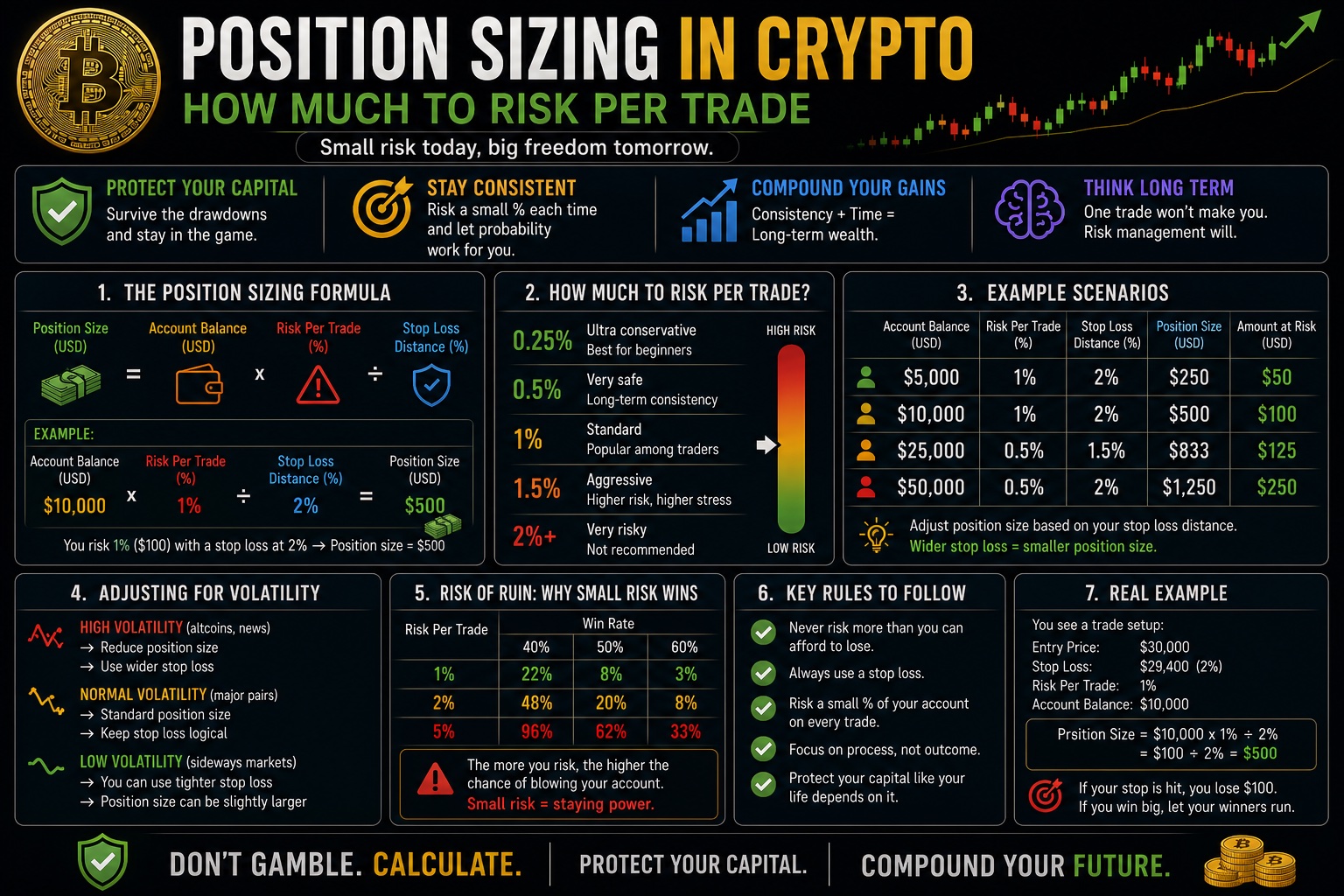
The most widely used position sizing framework is the fixed fractional method, usually expressed as the 1% rule: never risk more than 1% of your total trading capital on a single trade.
Critical clarification, because this trips up almost every beginner: risking 1% does not mean putting 1% of your account into a position. It means the amount you lose if your stop loss is hit equals 1% of your account. The actual position size is usually much larger than 1% of your capital.
The formula:
- Risk amount = Account size × Risk percentage
- Position size = Risk amount ÷ Distance from entry to stop loss (as a percentage)
Let's run real numbers. Say you have a $10,000 trading account and you're looking at a Bitcoin long:
- Entry: $60,000
- Stop loss: $57,600 (4% below entry, under a support level)
- Risk per trade: 1% of $10,000 = $100
Your stop distance is 4%. Position size = $100 ÷ 0.04 = $2,500. You buy $2,500 worth of BTC. If price drops to $57,600 and your stop triggers, you lose $100 — exactly 1% of your account. Painful? Barely. Survivable? Completely. You could take twenty of these losses in a row and still have 82% of your capital.
Now an altcoin example, where wider stops are necessary. Same $10,000 account, trading ETH:
- Entry: $3,000
- Stop loss: $2,700 (10% below entry, because altcoins need breathing room)
- Risk: $100 (1%)
Position size = $100 ÷ 0.10 = $1,000. Notice what happened: the wider stop forced a smaller position. This is the elegance of the system — volatile setups automatically get less capital. You never have to guess.
Should you ever go above 1%? Experienced traders with proven, tracked edge sometimes use 2%. I'd argue nobody should exceed 2% on directional crypto trades, ever. If you're new, start at 0.5%. Your first year is about surviving your education, not maximizing returns.
How to Calculate Position Size Step by Step
Here's the exact process I run before every single trade, in order. The order matters — position size is the last thing you calculate, never the first.
- Define your account size. This is your dedicated trading capital only — not your long-term holdings, not your savings. If you have $50,000 in crypto but $40,000 of it is a long-term Bitcoin stash sitting on a Ledger hardware wallet in cold storage, your trading account is $10,000. Keep these pools strictly separate.
- Find your entry. Based on your strategy — breakout, pullback to support, whatever your system dictates.
- Set your stop loss based on the chart, not on your comfort. The stop goes where your trade idea is invalidated — below the swing low, under the support zone, beneath the breakout level. Never place a stop based on "how much I'm willing to lose" and never tighten it just to take a bigger position. That's backwards and it's how accounts die.
- Calculate the stop distance. (Entry − Stop) ÷ Entry × 100. Example: entry $2.50 on an altcoin, stop $2.20. Distance = 0.30 ÷ 2.50 = 12%.
- Calculate your risk amount. $10,000 account × 1% = $100.
- Calculate position size. $100 ÷ 0.12 = $833. You buy $833 worth of the coin — roughly 333 tokens at $2.50.
- Check the reward-to-risk ratio. If your target is $3.10 (24% above entry) and your risk is 12%, your R:R is 2:1. I don't take trades below 2:1. With a 2:1 ratio you only need to win 34% of the time to be profitable. That margin for error is what keeps you in business.
Run this calculation every time, without exception. On exchanges like Binance you can set your stop loss as an OCO or stop-limit order the moment you enter, so the exit is automated and you're never relying on willpower at 3 a.m. when the market dumps.
Adjusting Position Size for Crypto Volatility
The fixed 1% rule is the foundation, but crypto's volatility varies wildly between assets and market conditions. A few refinements that have saved me real money:
Scale risk to asset volatility
Bitcoin and a micro-cap altcoin are not the same instrument. My personal tiers:
- BTC and ETH: full 1% risk per trade
- Established mid-cap altcoins: 0.75% risk
- Small caps and new listings: 0.5% or less — these can gap through stops, so your real loss can exceed your planned loss
Use ATR to set realistic stops
The Average True Range indicator measures how much an asset typically moves. A practical approach: set your stop 1.5–2× the daily ATR from your entry. If ETH's daily ATR is $120 and you enter at $3,000, a stop at $2,760 (2× ATR) sits outside normal noise. Then size the position around that stop. This prevents the classic frustration of getting stopped out by routine volatility right before the move you predicted.
Cut size in leveraged trades
Leverage doesn't change the math — $100 risk is $100 risk — but it changes the failure modes. Liquidation prices, funding fees, and forced closures mean leveraged positions carry hidden risks beyond your stop. If you use leverage at all, treat it as a capital-efficiency tool, not a way to risk more. A 5x leveraged position sized so your stop loss still equals 1% of account risk is defensible. Using 20x to "go big" is just gambling with extra steps, and the liquidation engine always wins eventually.
Reduce risk during drawdowns
My rule: if my account drops 10% from its high-water mark, I cut risk per trade in half (1% becomes 0.5%) until I recover to within 5% of the peak. This does two things — it slows the bleed mathematically, and it acknowledges that drawdowns often mean either the market regime changed or my execution is off. Either way, smaller size buys time to figure out which.
Managing Total Portfolio Exposure and Correlation
Per-trade sizing is half the picture. The other half is aggregate exposure — and in crypto this is where correlation quietly wrecks people.
Here's the trap: you risk 1% on a BTC long, 1% on an ETH long, 1% on a SOL long, and 1% on two other altcoin longs. You feel diversified. You're not. When Bitcoin drops hard, virtually every altcoin drops harder. Those five "independent" trades are effectively one trade — a 5% bet on crypto going up. All five stops can hit within the same hour.
My exposure limits:
- Maximum 5% total open risk across all positions at any time — meaning if every stop hit simultaneously, I lose at most 5% of the account.
- Maximum 3% risk in the same directional bias (all longs or all shorts), because in crypto, same direction effectively means same trade.
- Never risk on two coins in the same narrative simultaneously — two AI tokens, two meme coins, two layer-1s. Pick the strongest chart in the sector and trade that one.
One more portfolio-level point that isn't strictly position sizing but belongs in any honest risk discussion: keep trading capital and long-term holdings physically separate. Your active trading stack lives on the exchange — Binance works fine for this with its order types and liquidity. Your long-term holdings should live offline on a hardware wallet like a Ledger, where they can't be impulsively liquidated to "add margin" during a losing streak. I've watched traders feed their entire cold storage into a dying position one transfer at a time. The friction of cold storage isn't a bug; it's a firewall between your worst trading day and your net worth.
Common Position Sizing Mistakes That Destroy Accounts
After years of trading and talking to hundreds of traders, the same errors appear over and over:
- Sizing by feel or conviction. "I'm really sure about this one, so I'll go bigger." Your confidence level has near-zero correlation with trade outcome. The trades I've been most certain about include some of my worst losers. Fixed rules exist precisely because feelings lie.
- Confusing position size with risk. Putting "only 5% of my account" into a trade with no stop loss isn't risking 5% — it's risking whatever the market decides, potentially all of it. Risk is defined by your stop, not your allocation.
- Tightening stops to justify bigger positions. If proper sizing says $800 but you want a $3,000 position, moving your stop closer to entry doesn't reduce risk — it just guarantees you get stopped out by noise. Stop placement comes from the chart. Size comes from the math. Never reverse the order.
- Revenge sizing after losses. Down $300 on the day, so you double the next position to "make it back." This is the fastest account-killer in existence. Losses cluster; doubling into a losing streak is how a 3% drawdown becomes a 30% one in a single afternoon.
- Not recalculating as the account changes. The 1% rule is dynamic. If your $10,000 account grows to $13,000, your risk per trade grows to $130. If it drops to $8,000, risk drops to $80. This automatic compounding-up and de-risking-down is a feature — use it. Traders who keep risking dollar amounts based on their old account size lose the system's built-in protection.
- Ignoring fees and slippage. On small-cap coins with thin order books, your market stop might fill 1–2% worse than expected, and round-trip fees add up. Build a buffer: if you're targeting 1% risk on an illiquid coin, size for 0.8% and let slippage eat the difference.
- Averaging down without a plan. Adding to losers "to improve the entry" without predefined levels and total risk limits just concentrates capital in your worst ideas. If you scale into positions, the total risk across all entries must still respect your 1% cap — decided before the first order, not improvised as price falls.
Frequently Asked Questions About Crypto Position Sizing
Should I use the Kelly Criterion instead of the 1% rule?
The Kelly Criterion calculates mathematically optimal bet size from your win rate and average win/loss ratio. The problem: it requires accurate statistics most traders don't have, and full Kelly produces brutal drawdowns — often 50% or more. If you have 100+ tracked trades and know your real numbers, quarter-Kelly (25% of the Kelly output) is a reasonable ceiling. For everyone else, fixed fractional at 1% is simpler, more robust, and almost always the better choice. In practice, quarter-Kelly for most decent strategies lands near 1–2% anyway.
How is position sizing different for spot versus futures trading?
The core math is identical — risk amount divided by stop distance equals position size. The differences are practical: futures add liquidation risk (your position can be force-closed before your stop if margin runs out), funding costs that eat into holds, and the psychological temptation to oversize because leverage makes it easy. If you trade futures, set your leverage low enough that your liquidation price sits far beyond your stop loss. Your stop should always trigger long before liquidation is even a conversation.
Does position sizing apply to long-term investing and DCA?
The 1%-per-trade rule is built for active trading with defined stops. Long-term investing uses a different framework: allocation sizing. Decide what percentage of your total net worth belongs in crypto at all (for most people, an amount they could lose entirely without changing their life), then allocate within that — heavier weighting to BTC and ETH, small speculative slices elsewhere. Dollar-cost averaging handles the timing. And since these positions may sit for years, secure them properly on a hardware wallet like a Ledger rather than leaving them on an exchange.
What if 1% risk means my position is tiny and profits feel pointless?
Two honest answers. First, small profits on a small account are the tuition for learning to trade — the skills scale, and a trader who can grow $2,000 by 30% annually with controlled risk can do the same with $200,000 later. Second, if 1% of your account is $10 and fees eat half your edge, your account may genuinely be too small for active trading right now. There's no shame in DCA investing while you save more capital. What you should never do is "solve" a small account by risking 10% per trade. That doesn't grow small accounts; it deletes them.
How many positions should I have open at once?
As many as fit within your total exposure cap — for me, 5% aggregate open risk, which typically means three to five positions. More than that and two things break down: your attention (you can't manage eight crypto positions well) and your diversification (in crypto, more positions usually just means more correlated exposure to the same market move, not more safety).
Conclusion: Small Risk, Long Game
Position sizing isn't glamorous. Nobody posts screenshots of their risk calculations. But after enough time in this market, you notice something: the traders still standing after multiple cycles aren't the ones with the best entries — they're the ones who never took a loss big enough to matter.
The framework is simple enough to start using today. Risk 1% per trade (0.5% while you're learning). Place stops where the chart invalidates your idea, then let the math dictate size. Demand at least 2:1 reward-to-risk before entering. Cap total open risk at 5%, and remember that in crypto, most positions are secretly the same position. Cut risk in half during drawdowns. Keep trading capital on the exchange and long-term holdings in cold storage where your worst impulses can't reach them.
None of this guarantees profits — nothing does, and anyone telling you otherwise is selling something. What proper position sizing guarantees is that no single trade, no single bad day, and no single losing streak can take you out of the game. In a market that bankrupts overconfident traders every single cycle, survival is the edge. Everything else is built on top of it.
Disclaimer: This article is for educational purposes only and is not financial advice. Trading cryptocurrencies involves substantial risk of loss. Never trade with money you cannot afford to lose.